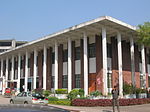
University of Dhaka
The University of Dhaka (also known as Dhaka University, or abbreviated as DU) is a public research university located in Dhaka, Bangladesh. It is the oldest university in Bangladesh. On the first day of July 1921, the university opened its doors to students. Today, it is the largest public research university in Bangladesh, with a student body of 37,018 and a faculty of 1,992. It was identified by AsiaWeek as one of the top 100 universities in Asia.Nawab Bahadur Sir Khwaja Salimullah, who played a pioneering role in establishing the university in Dhaka, donated 600 acres of land from his estate for this purpose.It has made significant contributions to the modern history of Bangladesh. After the Partition of India, it became the focal point of progressive and democratic movements in Pakistan. Its students and teachers played a central role in the rise of Bengali nationalism and the independence of Bangladesh in 1971. The university's distinguished alumni include Muhammad Yunus (winner 2006 Nobel Peace Prize, pioneer of microcredit), Natyaguru Nurul Momen (pioneer litereteur, theatre & cultural doyen; who was both an early student and teacher of DU), Muhammad Shahidullah (educator, philologist and linguist), Serajul Islam Choudhury (the country's leading public intellectual and writer), Rehman Sobhan (social democratic economist), Mohammad Ataul Karim (physicist), Abul Fateh (one of the founding fathers of South Asian diplomacy), Buddhadeb Bose (20th-century Bengali poet), Lotay Tshering (prime minister of Bhutan) and Sheikh Mujibur Rahman (the founding father of Bangladesh). It also enjoyed associations with Satyendra Nath Bose, Vijayaraghavan, and Kazi Nazrul Islam.
Excerpt from the Wikipedia article University of Dhaka (License: CC BY-SA 3.0, Authors).University of Dhaka
Vojjo Teler Goli, Dhaka Shahbag
Geographical coordinates (GPS) Address External links Nearby Places Show on map
 Continue reading on Wikipedia
 Geographical coordinates (GPS)
| Latitude | Longitude |
|---|---|
| N 23.733055555556 ° | E 90.391111111111 ° |
Address
ঢাকা বিশ্ববিদ্যালয়
Vojjo Teler Goli
1205 Dhaka, Shahbag
Dhaka Division, Bangladesh
Open on Google Maps