place

Fogn

Islands of StavangerRogaland geography stubs
Norway Fogn
Norway Fogn

Fogn is an island in Stavanger municipality in Rogaland county, Norway. The 10.4-square-kilometre (4.0 sq mi) island lies southeast of the island of Finnøy and northeast of the island of Talgje, about 25 kilometres (16 mi) northeast of the city of Stavanger. The Finnøyfjorden lies between Fogn and Finnøy and the Fognafjorden lies between Fogn and the mainland to the southeast. The highest point on the island is the 166-metre (545 ft) tall mountain Domfjellet. Fogn Church is located on the island. The island is especially well known for its large production of tomatoes in greenhouses, about 15 percent of Norway's total production. This employs large amounts of foreign labor on the island. There are about 354 inhabitants on the island (2014), with many more summer residents who live in summer cottages on the island. The island has its own kindergarten and an elementary school that provides education through 7th grade. Starting with 8th grade, students must take the boat to middle school, located on the island of Finnøy.There is no road connection to the island. There are regular ferry connections to Judaberg on Finnøy island as well as to some of the other small surrounding islands, and on to the mainland.

Excerpt from the Wikipedia article Fogn (License: CC BY-SA 3.0, Authors, Images).

Fogn
Vestre Fognavegen, Stavanger

Geographical coordinates (GPS) Address Nearby Places
placeShow on map

Wikipedia: FognContinue reading on Wikipedia

Geographical coordinates (GPS)

Latitude Longitude
N 59.1389 ° E 5.9 °
placeShow on map

Address

Vestre Fognavegen 64
4164 Stavanger
Norway
mapOpen on Google Maps

Norway Fogn
Norway Fogn
Share experience

Nearby Places

Ryfast
Ryfast

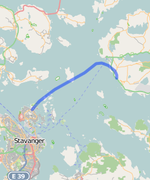
Ryfast is a subsea tunnel system in Rogaland county, Norway. The tunnel system is part of the Norwegian National Road 13, and it runs between the city of Stavanger in Stavanger Municipality, under a large fjord, and the area of Solbakk in the municipality of Strand.When the last section was drilled on 26 October 2017, Ryfast became the longest undersea road tunnel in the world, with its 14.3-kilometre (8.9 mi) length greater than the Eysturoyartunnilin in the Faroe Islands at 11.2 kilometres (7.0 mi), the Tokyo Bay Tunnel in Japan at 9.6 kilometres (6.0 mi), and the Shanghai Yangtze River Tunnel at nine kilometres (5.6 mi) in China. It is also currently the world's deepest subsea tunnel, reaching a maximum depth of 292 metres (958 ft) below sea level.The project was approved by the Norwegian Parliament on 12 June 2012, and construction began in the spring of 2013. The cost of Ryfast is estimated to 5.22 billion kr (Norwegian krone). The tunnel system replaced the ferry route between Stavanger and Tau. A large part of the cost is paid by road tolls. There are as of 2022 separate tolls for the Ryfylke Tunnel and for Hundvåg Tunnel, costing 179 NOK (17,45 euros) for a car without special agreement to pass both as of 2022. The tunnel system consists of two subsea tunnels: Ryfylke Tunnel, 14,400 metres (47,200 ft), running from the island of Hundvåg to just south of the village of Tau in Strand municipality on the other side of the fjord. This tunnel reduced travel time between the Northern Jæren and Ryfylke districts in Rogaland county. Ryfylke officially opened to traffic at noon on 30 December 2019. Hundvåg Tunnel, 5,500 metres (18,000 ft), running from the city of Stavanger to the island of Hundvåg, with a connection to the smaller island of Buøy. This tunnel relieved congestion on the Stavanger City Bridge. While the first section of Hundvåg was opened for a celebration in December 2019, the official opening for vehicles was delayed to 22 April 2020 due to extra technical testing, which was slowed due to the impact of the COVID-19 pandemic in Norway.The Ryfast tunnel system was built at the same time as the 3,700-metre (12,100 ft) Eiganes Tunnel, which was constructed from a similar starting point as the Hundvåg, under the city of Stavanger, but stays in (under) the city rather than continuing undersea. The Eiganes tunnel, like the Hundvåg tunnel, opened on 22 April 2020.