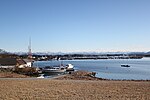
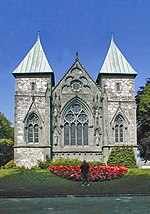
Stavanger (, UK also , US usually , Norwegian: [stɑˈvɑ̀ŋːər] ) is a city and municipality in Norway. It is the third largest city and third largest metropolitan area in Norway (through conurbation with neighboring Sandnes) and the administrative center of Rogaland county. The municipality is the fourth most populous in Norway. Located on the Stavanger Peninsula in southwest Norway, Stavanger counts its official founding year as 1125, the year the Stavanger Cathedral was completed. Stavanger's core is to a large degree 18th- and 19th-century wooden houses that are protected and considered part of the city's cultural heritage. This has caused the town center and inner city to retain a small-town character with an unusually high ratio of detached houses, and has contributed significantly to spreading the city's population growth to outlying parts of Greater Stavanger.
The city's population rapidly grew in the late 20th century due to its oil industry. Stavanger is known today as the Oil Capital of Norway. Norwegian energy company Equinor, the largest company in the Nordic region, has its headquarters in Stavanger. Multiple educational institutions for higher education are located in Stavanger. The largest of these is the University of Stavanger.
Domestic and international military installations are located in Stavanger, including the NATO Joint Warfare Centre. Other international establishments, and especially local branches of foreign oil and gas companies, contribute further to a significant foreign population in the city. The city has a strong international profile and 22,1% of the population has an immigrant background. In 2020, it was rated as the most liveable city for Europeans expatriates in Norway as well as 5th in Europe by ECA International. Stavanger has, since the early 2000s, consistently had an unemployment rate significantly lower than the European average. In August 2022, the unemployment rate was 1.6%. The city is also among those that frequent various lists of most expensive cities in the world, and Stavanger has even been ranked as the world's most expensive city by certain indices.The climate of the city is very mild by Nordic standards due to a strong maritime influence. As a result, winter usually remains above freezing whereas heat waves are rare and seldom long. Rainfall is common, although less so than in areas further north on the coastline.
Stavanger is served by international airport Stavanger Airport, Sola, which offers flights to cities in most major European countries, as well as a limited number of intercontinental charter flights. The airport was rated as one of the world's most punctual airports of its category by OAG in 2020.Every two years, Stavanger organizes the Offshore Northern Seas (ONS), which is the second largest exhibition and conference for the energy sector. The Gladmat food festival is also held each year and is considered to be one of Scandinavia's leading food festivals. The city is also known for being one of the nation's premier culinary clusters. Stavanger was awarded the 2008 European Capital of Culture alongside Liverpool.

 Continue reading on Wikipedia