place

OVRO 40 meter Telescope

Astronomical observatories in CaliforniaBuildings and structures in Inyo County, CaliforniaRadio telescopesUse American English from August 2025
OVRO 40m telescope 01

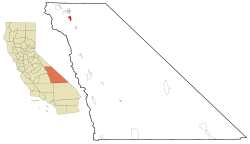
The OVRO 40 meter Telescope is a radio telescope at the Owens Valley Radio Observatory near Big Pine, California, US. It is owned and operated by Caltech. The telescope is easily visible from the section of US highway 395 just north of Big Pine.

Excerpt from the Wikipedia article OVRO 40 meter Telescope (License: CC BY-SA 3.0, Authors, Images).

OVRO 40 meter Telescope
Leighton Lane,

Geographical coordinates (GPS) Address Phone number Website Nearby Places
placeShow on map

Wikipedia: OVRO 40 meter TelescopeContinue reading on Wikipedia

Geographical coordinates (GPS)

Latitude Longitude
N 37.2333 ° E -118.284 °
placeShow on map

Address

Owens Valley Radio Observatory

Leighton Lane 100
93513
California, United States
mapOpen on Google Maps

Phone number
California Institute of Technology

call+17609382075

Website
ovro.caltech.edu

linkVisit website

OVRO 40m telescope 01
Share experience

Nearby Places

Sunyaev–Zel'dovich Array

The Sunyaev–Zeldovich Array (SZA) in California is an array of eight 3.5 meter telescopes that was operated as part of the now-closed Combined Array for Research in Millimeter-wave Astronomy (CARMA). Its initial goals were to survey the cosmic microwave background (CMB) in order to measure its fine-scale anisotropies and to find clusters of galaxies. The survey was completed in 2007, and the array is now used primarily to characterize clusters via the Sunyaev–Zeldovich effect. Observations commenced at the SZA in April 2005. One of the most important developments of the last few years has been the detection, through observations of the CMB and supernova studies, of a form of energy that is accelerating the expansion of the universe. Dubbed dark energy by analogy with dark matter, it is believed to account for roughly 70% of the universe's energy content. While dark energy cannot be observed directly, its basic properties can be inferred from its effect on structure formation in the universe. Just as an ecologist can learn about the food supply by studying how animal populations evolve with time, physicists can learn about dark energy by studying the population statistics of the universe's inhabitants—in this case, galaxy clusters. The SZA gets its name from the means by which it measures galaxy clusters: the scattering of CMB light as it passes through the hot ionized cluster gas, known as the Sunyaev–Zeldovich effect (SZ effect). In short, the CMB is used as a backlight against which galaxy clusters can be seen by the shadows they cast. Since the SZA sees the shadow rather than the light emitted by the cluster itself, it can be used to measure sufficiently large clusters nearly independently of their redshift, back to the epoch at which clusters first began to form.