place

Boggy Bayou Mullet Festival

1976 establishments in FloridaFestivals in FloridaFood and drink festivals in the United StatesRecurring events established in 1976Seafood festivals
Tourist attractions in Okaloosa County, Florida

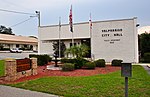
The Boggy Bayou Mullet Festival was an annual seafood and arts festival held in Niceville, Florida, United States, on the third Friday in October from 1977 to 2019. The main attractions were music, food (especially fried mullet), rides and a wide variety of arts and crafts. This festival was named after the mullet, a fish found in abundance in the local waters. While it is a common misconception, the mullet haircut is not the origin of the festival's name. The festival was founded by Walter Francis Spence Jr. in 1976. The first Mullet Festival took place on September 24, 1977, and soon lasted three days, starting the third Friday in October, and ended Sunday after dark. Alcohol is not served on Sunday. In recent years, the festival has typically had attendance over 40,000 for the weekend. Chantal, Hollywood entertainment reporter for ABC's "Good Morning America," broadcast from the festival on Friday, October 20, 1989. During the broadcast, festival founder, Francis Spence, and local James Campbell demonstrated how to catch and fry mullet.In 2009, a third annual Boggy Bayou Mullet Festival T-shirt made by Tailgate Clothing Company appeared in Season 2 of the HBO series, "True Blood" (Episode 3 - "Scratches"). A representative from the show said that she found the shirt on a Web site she used to outfit some of the characters. A Mullet Festival T-shirt had also appeared on the CBS comedy "How I Met Your Mother" (Season 4, Episode 1), according to Niceville City Manager Lannie Corbin.2019 was the 43rd & final. The next year, the COVID-19 pandemic, along with declining revenues & attendance in recent years, caused their doom.

Excerpt from the Wikipedia article Boggy Bayou Mullet Festival (License: CC BY-SA 3.0, Authors).

Boggy Bayou Mullet Festival
East College Boulevard,

Geographical coordinates (GPS) Address Nearby Places
placeShow on map

Wikipedia: Boggy Bayou Mullet FestivalContinue reading on Wikipedia

Geographical coordinates (GPS)

Latitude Longitude
N 30.535232 ° E -86.49232 °
placeShow on map

Address

East College Boulevard 1001
32578
Florida, United States
mapOpen on Google Maps

Share experience

Nearby Places

Choctawhatchee National Forest

Choctawhatchee National Forest is a United States National Forest established by President Theodore Roosevelt on November 27, 1908. The supervisory headquarters was established at DeFuniak Springs and moved to Pensacola in September 1910. It remained there until 1936 when it was relocated to Tallahassee. The Choctawhatchee's two districts (Easy Bay-Camp Pinchot and Niceville) were separated by what is now State Road 85. National defense needs prompted Congress to transfer the national forest to the War Department just prior to World War II. On June 27, 1940, Congress transferred the 340,890 acres (1380 km2) of the Choctawhatchee from the Forest Service to the War Department (and subsequently to its successor's constituent United States Department of the Air Force) for military purposes. The law provided that the land might be restored to national forest status by proclamation or order of the President when it was no longer needed for military purposes. It has been home to Eglin Air Force Base since. In descending order of amount of land area the forest is located in parts of southern Okaloosa, Walton, and Santa Rosa counties.During the early years, Camp Pinchot was the Forest Supervisor's summer headquarters. At that time, the only mode of transportation from Pensacola (site of the main supervisory headquarters) was by boat. In 2000, Camp Pinchot celebrated its 50th anniversary as the residence for the Eglin Air Force Base Commander. The current portion of the Choctawhatchee, that is still managed by the Forest Service, consists of several dispersed parcels that total only 1,110 acres (1.73 sq mi, or 4.492 km2) and are managed by the Apalachicola National Forest. Some parcels lost many of their national forest characteristics by changing land-use over the years and others are difficult to manage because they are not contiguous. They may therefore be traded or sold to allow the Forest Service to acquire privately held land within the boundaries of other national forests in the state.