place

Lindsay Creek

Geography of DunedinOtago geography stubs
Lindsay Creek
Lindsay Creek

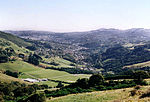
The Lindsay Creek is a tributary of the Water of Leith which runs through the northern suburbs of Dunedin, New Zealand. The Māori name Puke-haukea has been attributed to the creek; however, as puke means a hill, not a watercourse, this is likely to be a confusion. The creek has its origins on the southern slopes of Kapukataumahaka Mount Cargill about 1 kilometre southwest of the summit, and flows south, passing through the popular recreation reserve of Bethunes Gully before reaching Dunedin's suburban area at Normanby. It continues south-southwest, its thalweg running through North East Valley, passing through Chingford Park and along the foot of the Valley's Quarry Gardens before reaching the coastal plain of the Leith at The Gardens Corner. From here, it flows into Dunedin Botanic Gardens where it joins Ōwheo, the Water of Leith. Several measures are underway to widen the channel of the creek at various points, in an attempt to provide more protection against floods. The creek has flooded on numerous occasions, most significantly in the Leith Flood of 1929 and in 1955, when it led to the inundation of many properties in North East Valley. Protection works have been built over the years, most notably realignment and walling of the channel in the lower part of North East Valley after the 1929 flood and further work on the same area in 1965. Further walling of the channel in the central part of North East Valley was undertaken during the 1970s.

Excerpt from the Wikipedia article Lindsay Creek (License: CC BY-SA 3.0, Authors, Images).

Lindsay Creek
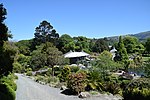
Edward Theomin Bridge, Dunedin Gardens

Geographical coordinates (GPS) Address Nearby Places
placeShow on map

Wikipedia: Lindsay CreekContinue reading on Wikipedia

Geographical coordinates (GPS)

Latitude Longitude
N -45.85797 ° E 170.51878 °
placeShow on map

Address

Edward Theomin Bridge
9010 Dunedin, Gardens
Otago, New Zealand
mapOpen on Google Maps

Lindsay Creek
Lindsay Creek
Share experience

Nearby Places

Salmond College
Salmond College

Salmond College is a residential college affiliated to the University of Otago in Dunedin, New Zealand. As an affiliated college, it is privately owned and is run independently from the university, being governed by The Council of Knox College and Salmond College, a body with links to the Presbyterian Church of Aotearoa New Zealand. The college was opened in 1971 as Salmond Hall, originally to accommodate women students, to parallel the male-only facility Knox College. It became a coeducational facility during the 1970s. The name was changed to Salmond College in 2006. Salmond and Knox share different parts of the same 4.57 hectare landscaped site (11 acres), located on the north side of the Dunedin Botanic Gardens, close to the area known simply as The Gardens Corner at the foot of North East Valley, approximately 15 minutes walk north of the campus. The site was originally the location for stables for Ross and Glendining Limited, and was donated by the Ross family. The college predominantly provides for first year students, with 40-50 returning for a second year. The college was named after James Salmond, for many years a lecturer at Knox Theological Hall, and his sister Mary Salmond, Principal of the Presbyterian Church's Deaconess Training School in the 1950s. The majority of students are housed in single rooms on one of the four levels in the main building. RLs, known at Salmond “Residential Leaders” are also students who live on site and mentor and support the first year residents. Both the Head and Deputy Head of College reside on the premises. Facilities include a gym, computing facilities, tutorial rooms, a library, television/recreation areas, dining hall, chapel, car-parking, and secure cycle storage. During the summer of 2014/2015 Salmond College was extensively refurbished, creating rooms for up to 261 residents. All bedrooms were be double glazed with new carpet and joinery throughout the College. The College introduced a key card system. President of Salmond College for 2021 is Harry Tran. Harry, who hails from Hastings in Hawke's Bay, returns in 2020 having completed First Year Health Science in 2020 at the University of Otago. Salmond's motto which can be seen in the college crest is 'Gratia et Veritas', or 'Grace and Truth'. At the end of 2020 a whakatauākī was confirmed as a part of the mission statement for the college: Ko te toa i a tini, i a mano o te takata - It is the bravery of a multitude, of thousands of people. This Ngāi Tahu whakatauākī, attributed to Tū Whakauika & Te Oreorehua, refers to the strength of collectivity. As Salmond enters its 50th year in 2021, it reminds us of the power of a living community stretching back several generations, and fosters hope as we continue to grow a community with a shared identity.

Knox College, Otago
Knox College, Otago

Knox College is a selective residential college, established by the Presbyterian Church of Aotearoa New Zealand and affiliated with University of Otago in Dunedin, New Zealand. The college is set in a 4.57 hectares (11.3 acres) landscaped site in Opoho on the opposite side of the Dunedin Botanic Gardens from the university. It is named after John Knox, a sixteenth century leader of the Scottish Reformation, whose efforts in establishing a universal system of free education comprising both academic learning and character formation had a profound influence, not just in Scotland, but internationally, as subsequent generations of Scottish settlers, products of the Scottish Enlightenment, emigrated to far-flung corners of the globe, including New Zealand, taking with them a deep-seated belief in the benefits of applied knowledge and a broad and liberal education. Those strong Scottish Presbyterian foundations are something that Knox College has in common with the university to which it is affiliated. They are depicted on the college's Coat of Arms in the form of a blue St Andrew's Cross. Superimposed on the St Andrew's Cross is the image of a white dove in flight, carrying an olive branch in its mouth, a symbolic depiction of the flood myth in Genesis 8, wherein the olive-branch-bearing dove is a symbol of life and peace. The college motto, Gratia et Veritas (Latin), or Grace and Truth (English), comes from the Prologue to the Gospel according to Saint John (John 1:).