place

Fat Margaret

Infrastructure completed in 1530Prisons in EstoniaTallinnTowers completed in the 16th century
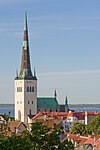
Paks Margareeta (Fat Margaret) (377463242)

Fat Margaret (Estonian: Paks Margareeta, German: Dicke Margarethe) is a tower in Tallinn, Estonia. Nowadays, the tower is the headquarter of Estonian Maritime Museum. The tower was built in the early 16th century (from 1511 to 1530) during the reconstruction of the medieval city gate system. The etymology of the tower's name derives from the fact that it was the largest part of the city's fortifications with walls measuring 25 meters in diameter, 20 meters in height and up to 5 meters thick. Apart from being a fortification against would-be invaders to the port of the town, it was also built to impress outside visitors arriving by sea.The tower is a defensive structure at the end of Pikk tänav (Pikk Street). Together with the Suur Rannavärav (Great Coastal Gate), a sixteenth-century arch flanked by two towers, it served to defend the harbour of Tallinn. Later, it was used as a storehouse for gunpowder and weapons, and then transformed into a prison, and was the scene of an outbreak of violence during the 1917 Revolution, when the prison guards were murdered by a mob of workers, soldiers and sailors. The tower was reconstructed from 1978-1981 to house the Maritime Museum.

Excerpt from the Wikipedia article Fat Margaret (License: CC BY-SA 3.0, Authors, Images).

Fat Margaret
Pikk, Tallinn Kesklinna linnaosa

Geographical coordinates (GPS) Address External links Nearby Places
placeShow on map

Wikipedia: Fat MargaretContinue reading on Wikipedia

Geographical coordinates (GPS)

Latitude Longitude
N 59.44253 ° E 24.74955 °
placeShow on map

Address

Paks Margareeta

Pikk 70
15055 Tallinn, Kesklinna linnaosa
Estonia
mapOpen on Google Maps

linkWikiData (Q282994)
linkOpenStreetMap (3502080)

Paks Margareeta (Fat Margaret) (377463242)
Share experience

Nearby Places

Tallinn Power Plant
Tallinn Power Plant

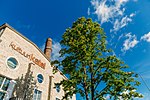
The Tallinn Power Plant (Estonian: Tallinna elektrijaam) is a former power plant located in Tallinn, Estonia. Construction of the power plant was initiated by Volta company and it was decided by the Tallinn City Council in 1912 after the work of special committee established in 1909. The plant was located next to the Tallinn Gas Factory at the location of the former Stuart fortress. The plant was designed by Volta and the architect was Hans Schmidt. Originally it used three Laval-type 250 horsepower (0.19 MW) steam turbines and three 250 horsepower (0.19 MW) electric generators—all produced by Volta. Two coal-fired boilers were manufactured by AS Franz Krull. The power plant was opened on 24 March 1913 and originally it was fired by coal. In 1919–1920 the plant was expanded and transferred to peat and wood. In 1924 the power plant was switched to oil shale. It was the first power plant in the world to employ oil shale as its primary fuel. In 1939, the plant achieved capacity of 22 MW.In 1929, a new turbine hall and in 1932 a new switchboard were commissioned. In 1941, the power plant was destroyed by leaving Soviet troops but was restored by 1948. A new 102.5-metre (336 ft) flue-gas stack was built. On 9 October 1959, the plant started to operate as combined heat and power plant providing district heating to Tallinn. In 1965, the plant was switched to fuel oil. The plant ceased electricity production on 2 February 1979.In 1978, the power plant area was used for the Andrei Tarkovsky's film Stalker as the threshold to the Zone. The UN's acronym, which is still visible, was painted on the power plant's flue-gas stack. A memorial plate of the film was set up on the flue-gas stack in 2008. Since 1984, the former power plant boiler house is used as an energy museum. Since 2011, the power plant complex is used for hosting the Tallinn Creative Hub (Kultuurikatel).