place

Patriarchate Court, Sremski Karlovci

Buildings and structures in Sremski KarlovciCultural Monuments of Exceptional Importance (Serbia)Eparchy of SremEpiscopal palacesHistory of the Serbian Orthodox Church
Immovable Cultural Heritage in the South Bačka DistrictNeoclassical palaces in SerbiaOffice buildings in SerbiaPalaces in SerbiaSerbian Orthodox church buildings in Serbia
Patriarchate Court in Sremski Karlovci 04

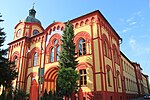
The Patriarchate Court (Serbian: Патријаршијски двор, Patrijaršijski dvor) is a listed historical building which was the seat of the Patriarchate of Karlovci between 1848 and 1920, in Sremski Karlovci, Serbia. The building remained as the unofficial seat of the Serbian Orthodox Church after the unification of 1920 until 1930 when the Serbian Patriarch moved his episcopal seat to Belgrade. Today, it is the seat of the Eparchy of Srem. The building is protected and listed as anImmovable Cultural Heritage of Exceptional Importance.

Excerpt from the Wikipedia article Patriarchate Court, Sremski Karlovci (License: CC BY-SA 3.0, Authors, Images).

Patriarchate Court, Sremski Karlovci
Trg Branka Radicevica,

Geographical coordinates (GPS) Address External links Nearby Places
placeShow on map

Wikipedia: Patriarchate Court, Sremski KarlovciContinue reading on Wikipedia

Geographical coordinates (GPS)

Latitude Longitude
N 45.203333333333 ° E 19.934722222222 °
placeShow on map

Address

Патријаршијски двор

Trg Branka Radicevica 8
21205
Vojvodina, Serbia
mapOpen on Google Maps

linkWikiData (Q7756346)
linkOpenStreetMap (200356991)

Patriarchate Court in Sremski Karlovci 04
Share experience

Nearby Places

Archives of Sremski Karlovci

The Archives of Sremski Karlovci (Serbian: Архив у Сремским Карловцима, romanized: Arhiv u Sremskim Karlovcima), formally the Serbian Academy of Sciences and Arts Archives in Sremski Karlovci (Serbian: Архив Српске академије наука и уметности у Сремским Карловцима, romanized: Arhiv Srspke akademije nauka i umetnosti u Sremskim Karlovcima), located in Sremski Karlovci, are the first archives in modern Serbian history. Established by the Serbian clergy of the Metropolitanate of Karlovci, since 1949 archives are managed by the Serbian Academy of Sciences and Arts. The archives were effectively established at the time of the Great Migrations of the Serbs in 1690, during which Serbian Orthodox clergy brought books, charters of Serbian rulers, sacred inventories, ecclesiastical letters, and other documents from the Balkan regions of the Ottoman Empire to the Habsburg Monarchy. This initial collection was expanded through correspondence conducted by Patriarch Arsenije III Crnojević and his successors with various institutions and individuals in the Habsburg Monarchy, Ottoman and revolutionary and subsequently independent Principality and Kingdom of Serbia, Russian Empire, and other countries. At the time, the town of Sremski Karlovci served as the religious, cultural, and political seat of Serb community in Habsburg lands. Being the primary archive in the town, today materials preserved in its collections are crucial for studying the political, cultural, and economic history of the Serbian people in present-day Vojvodina and other parts of the former Austro-Hungary. During the World War II in Yugoslavia, the archives were closed by the Independent State of Croatia Ustasha regime and partially damaged. Local German officers, motivated by Leopold von Ranke's historical interest in Serbian history, nevertheless ordered the archives to be secured, saving most of its documents until the end of the war. On July 4, 1949, the Holy Synod of the Serbian Orthodox Church handed over the archives of the Metropolitanate of Karlovci and the Patriarchate of Karlovci to the Serbian Academy of Sciences and Arts for preservation and organization for scientific use for an initial period of 50 years that was twice extended in 1999 and 2009. The archive remained permanently housed in the building of the Clerical High School of Saint Arsenije.

Clerical High School of Saint Arsenije

Clerical High School of Saint Arsenije (Serbian: Богословија Свети Арсеније Сремац, Bogoslovija Sveti Arsenije Sremac) is the oldest Serbian seminary, a clerical Grande école. It is a college following the French academic standards of the Grande école, hence Higher School or Visoka škola, on par with university. The university is located at Sremski Karlovci. It was founded in 1794, three years after the Gymnasium of Karlovci by Metropolitan Stefan Stratimirović. Then the city was the seat of the autocephalous Metropolitanate of Karlovci (later it became the Patriarchate of Karlovci). This school represents one of the oldest and most important educational institutions for Serbs. During the 19th century, along with the Orthodox Seminary in Belgrade, it formed the basis of Serbian theological education. The second half of the 19th century represents the golden age in the history of this school, when Ilarion Ruvarac became the rector, and Baron Jovan Živković was one of the professors. In that period one of the first departments for bee keeping was established in the school. The Clerical school was closed in 1914, after the World War I reestablished in Belgrade. The modern Clerical school called "Saint Arsenije Sremac" was founded in 1964, in a building called zgrada Crkveno-narodnih fondova (lit. 'seat of the Church and People's funds' or 'of the Church and Common funds'), built at the beginning of the 20th century by Patriarch Georgije Branković, located in the old city core. The building of the school houses the Archives of Sremski Karlovci, the oldest modern type Serbian archive.