place

Capitol Park Museum - Baton Rouge

Atchafalaya National Heritage AreaBaton Rouge, Louisiana building and structure stubsHistory museums in LouisianaLouisiana State MuseumMuseums in Baton Rouge, Louisiana
Southern United States museum stubsTourist attractions in Baton Rouge, Louisiana
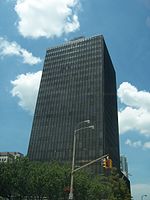
BRougeCenter23July08StateMuseumExterior

The Capitol Park Museum is a branch of the Louisiana State Museum located at 660 N. 4th Street, Baton Rouge, Louisiana. There are two permanent exhibits on the history and culture of Louisiana. The building was designed by New Orleans-based design studio Eskew Dumez Ripple and exhibits were created by Christopher Chadbourne & Associates. Notable objects include the Bayou St. John submarine and Louis Armstrong's childhood bugle.

Excerpt from the Wikipedia article Capitol Park Museum - Baton Rouge (License: CC BY-SA 3.0, Authors, Images).

Capitol Park Museum - Baton Rouge
North 4th Street, Baton Rouge Capitol Park Complex (Downtown Development District)

Geographical coordinates (GPS) Address Website External links Nearby Places
placeShow on map

Wikipedia: Capitol Park Museum - Baton RougeContinue reading on Wikipedia

Geographical coordinates (GPS)

Latitude Longitude
N 30.4539 ° E -91.18634 °
placeShow on map

Address

Capitol Park Museum (Louisiana State Museum)

North 4th Street 660
70802 Baton Rouge, Capitol Park Complex (Downtown Development District)
Louisiana, United States
mapOpen on Google Maps

Website
louisianastatemuseum.org

linkVisit website

linkWikiData (Q6689294)
linkOpenStreetMap (295180928)

BRougeCenter23July08StateMuseumExterior
Share experience

Nearby Places

Assassination of Huey Long

On September 8, 1935, United States senator and former Louisiana governor Huey Long was fatally shot at the Louisiana State Capitol in Baton Rouge, Louisiana. Long was an extremely popular and influential politician at the time, and his death eliminated a possible 1936 presidential bid against incumbent Franklin D. Roosevelt. Long was at the capitol to pass a redistricting bill to oust Judge Benjamin Henry Pavy, an opposition state judge. Shortly after passing the bill, Long was ambushed in a hallway by Carl Weiss, Pavy's son-in-law. According to the most widely accepted version of events, Weiss shot Long in the chest, and Long's bodyguards shot Weiss, killing him instantly. There remains some controversy over whether Weiss actually shot Long, with an alternative theory claiming he was shot by his bodyguard(s) by accident during the fight and another was that Weiss instead punched Long, who was then killed in the crossfire when his bodyguards opened fire on Weiss. Long was rushed to the Our Lady of the Lake Regional Medical Center, where emergency surgery failed to stop internal bleeding. He was pronounced dead at 4:10 a.m. on September 10, 31 hours after being shot. Over 200,000 people attended Long's funeral. His remains were buried on the grounds of the Louisiana State Capitol, which he had constructed. A statue of Long by Charles Keck was erected on his grave in 1940. Without Long as its leader, his Share Our Wealth movement collapsed, clearing the way for Roosevelt to be re-elected to the White House in a landslide. Long and Robert F. Kennedy of New York (in 1968) are the only two sitting United States senators to be assassinated.