place

Block 35 Cobblestone Alley

1889 establishments in ArkansasArkansas road stubsCobbled streetsDowntown Little Rock, ArkansasLittle Rock, Arkansas Registered Historic Place stubs
National Register of Historic Places in Little Rock, ArkansasRoads on the National Register of Historic Places in ArkansasStreets in ArkansasTransportation in Little Rock, Arkansas
Block 35 Cobblestone Alley

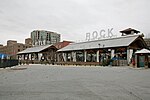
Block 35 Cobblestone Alley is located in Little Rock, Arkansas. It is a 300-foot-long (91 m), 30-foot-wide (9.1 m) cobblestone alley, which bisects a city block known as Block 35 of the City of Little Rock. It was originally surfaced around 1889, and is one of the city's few surviving brick-paved alleys. It provides access to the rear of buildings facing President Clinton Boulevard. It was listed on the National Register of Historic Places in January, 2009.It was listed as a featured property of the week in a program of the National Park Service that began in July, 2008.

Excerpt from the Wikipedia article Block 35 Cobblestone Alley (License: CC BY-SA 3.0, Authors, Images).

Block 35 Cobblestone Alley
Rock Street, Little Rock

Geographical coordinates (GPS) Address Nearby Places
placeShow on map

Wikipedia: Block 35 Cobblestone AlleyContinue reading on Wikipedia

Geographical coordinates (GPS)

Latitude Longitude
N 34.747222222222 ° E -92.267222222222 °
placeShow on map

Address

Central Arkansas Library System - Main Library

Rock Street 100
72201 Little Rock
Arkansas, United States
mapOpen on Google Maps

Block 35 Cobblestone Alley
Share experience

Nearby Places

Historic Arkansas Museum

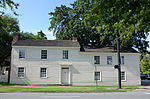
The Historic Arkansas Museum, sometimes called HAM, is a state history museum in downtown Little Rock, Arkansas. The museum was created as part of the Arkansas Territorial Capitol Restoration Commission, by Act 388 of the 1939 Arkansas General Assembly. The act named Louise Loughborough as chairwoman of the commission. Loughborough had been named to the Little Rock Planning Commission in 1935. Several houses near Cumberland and East 3rd Streets in downtown Little Rock were going to be condemned, including the Hinderliter House, the oldest building in Little Rock. Loughborough started a public relations campaign around Little Rock as a "town of three Capitols": the Hinderliter House, the Old State House, and the current Arkansas State Capitol Building. Use of the Hinderliter House as the last meeting place of the Arkansas Territorial Legislature has remained part of popular folklore, though it is not known if it was used for this purpose. Loughborough then gained support from the Works Progress Administration, the Arkansas General Assembly, and private donors. Loughborough worked with architect Max Mayer to restore the half-block of houses at Cumberland and East 3rd Street in downtown Little Rock. The Museum opened on July 19, 1941.The museum maintains gallery space and a number of historic buildings original to the site, as well as log structures transported from around the state. It was previously known as the Arkansas Territorial Restoration, but the name was changed in 2001 when new exhibit space and renovations were completed. The museum is an affiliate within the Smithsonian Affiliations program. The museum property was listed on the National Register of Historic Places in 2019 as the Arkansas Territorial Restoration Historic District.