place

Kecun station

Guangzhou Metro stations in Haizhu DistrictRailway stations in China opened in 2003
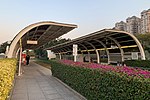
Kecun Station Platform 4 202005

Kecun Station (Chinese: 客村站; Cantonese Yale: Haakchyūn Jaahm) is an interchange station between Lines 3 and 8 of the Guangzhou Metro. It started operations on 28 June 2003. It is located at the underground of Kecun Village in Haizhu District.Before the extension to both lines 2 and 8 opened in September 2010, this station ran as part of Line 2 as a single line from Wanshengwei to Sanyuanli.

Excerpt from the Wikipedia article Kecun station (License: CC BY-SA 3.0, Authors, Images).

Kecun station
Chigang West Road, Haizhu District Chigang

Geographical coordinates (GPS) Address Nearby Places
placeShow on map

Wikipedia: Kecun stationContinue reading on Wikipedia

Geographical coordinates (GPS)

Latitude Longitude
N 23.096197 ° E 113.320331 °
placeShow on map

Address

赤岗西路

Chigang West Road
510310 Haizhu District, Chigang
Guangdong Province, China
mapOpen on Google Maps

Kecun Station Platform 4 202005
Share experience

Nearby Places

Fuda Cancer Hospital-Guangzhou

Guangzhou Fuda Cancer Hospital is a tertiary specialized cancer hospital which is affiliated with the Health Department of Guangdong Province in China. It was designated a national key clinical (cancer) hospital by the National Health and Family Planning Commission in 2011. The same year, Guangzhou Fuda Cancer Hospital was honored with National Trustworthy Private Hospital by the National Institute of Hospital Administration. In 2012, China Hospital Association rated Guangzhou Fuda Cancer Hospital as China Public Confidence Model Hospital. It was accredited by JCI in 2014.Guangzhou Fuda Cancer Hospital has locations in Tianhe District (located in the 2nd, Tangde Xi Road, Tianhe District, Guangzhou) and one in Haizhu District (located in Jude Zhong Road, Haizhu District, Guangzhou). The hospital has so far received more than 15 million RMB (~$2.5 million USD) of cancer research grant. Regarding patients with medium or advanced cancer as the main treating objects which is treated as medical difficulty in the world, Guangzhou Fuda Cancer Hospital adopts the international latest anticancer concept in focusing on applying 3C+P treatment model that composed of cryosurgical ablation (CSA), cancer microsphere intervention (CMI), combined immunotherapy for cancer (CIC including NK and CAR-T cell immunotherapy) and personalized treatment, which prolongs and improves patients’ lives in recent 10 years. Guangzhou Fuda Cancer Hospital remains at the forefront of cryosurgical ablation in treating cancer both in the number of treatments and types of tumors. Especially in treating central lung cancer, giant liver cancer, and pancreatic cancer, it makes a lot of achievements and obtains domestic and international awards many times.

Haixinsha Island (Tianhe District)

Haixinsha Island (Chinese: 海心沙) is an island in Tianhe District, Guangzhou, Guangdong, China. It is located to the south of Zhujiang New Town, newly developed CBD of the city, to the north of Canton Tower and to the east of Ersha Island.The island had been used as garrison and warehouses of the People's Liberation Army until the local government decided it was to be redeveloped and used as the venue of the opening and closing ceremonies of the 2010 Asian Games. The island also sat at a strategic point of the new city centre, bordered by the new CBD on the north and the Pearl River on the south. Besides allocating a piece of land to the military, local government reportedly compensated another ¥1 billion in order to acquire land of the island. A viewing stand which seated 35,000 in three tiers of seating, was erected on western end in November 2010 for the opening ceremony. Other infrastructures include an apm station and a large underground complex linked directly to the CBD. The future of the island is a subject of heated debate at the moment. When construction first started, the government claimed the area would serve as a civic square after the Asian Games. However, immediately after the games was finished, the whole island was turned into an Asian Games park, which charged an entry fee. Although the park attracted mainly tourists, the entry fee affected people who used the metro station as all entrances and exits of the station were located within the park. This sparked a public outcry and the entry fee was eventually lifted in September 2012. Moreover, the viewing stand was supposed to be a temporary structure which should ultimately be demolished. But in 2012, it was reported that a local real estate company was planning to turn it into a luxury hotel with a rooftop swimming pool.