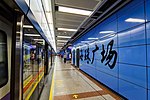
The Guangzhou Metro (simplified Chinese: 广州地铁; traditional Chinese: 廣州地鐵; pinyin: Guǎngzhōu Dìtiě; Jyutping: Gwong²zau¹ Dei⁶tit³) ([kwàŋ.ʈʂóʊ.tî.tʰjè] and [kʷɔːŋ˧˥.tsɐu˥.tei˨.tʰiːt̚˧]) is the rapid transit system of the city of Guangzhou in the Guangdong Province of China. It is operated by the state-owned Guangzhou Metro Corporation and was the fourth metro system to be built in mainland China, after those of Beijing, Tianjin, and Shanghai.
The earliest efforts to build an underground rapid transit system in Guangzhou date back to 1960. In the two decades that followed, the project was brought into the agenda five times but ended up abandoned each time due to financial and technical difficulties. Preparation of what would lead to today's Guangzhou Metro did not start until the 1980s, and it was not until 1993 that construction of the first line, Line 1, officially began. Line 1 opened four years later in 1997 with five stations in operation.As of 1 May 2022, Guangzhou Metro has 16 lines in operation, namely: Line 1, Line 2, Line 3, Line 4, Line 5, Line 6, Line 7, Line 8, Line 9, Line 13, Line 14, Line 18, Line 21, Line 22, Guangfo Line, and Zhujiang New Town APM reaching both the urban core and surrounding suburbs. Guangfo Line connects Guangzhou and Foshan and is the first metro line between two cities in the country. Daily service hours start at 6:00 am and end at midnight and daily ridership averages over 7 million. Having delivered 3.029 billion rides in 2018, Guangzhou Metro is the third busiest metro system in the world and the 3rd largest in terms of length, after the metro systems of Beijing and Shanghai. Guangzhou Metro operates 320 stations and 652.81 km (405.6 mi) of lines.
Extensive development of the metro network has been planned for the next decade, with construction started on Line 10, Line 11, and Line 12, and extensions of Line 3, Line 5, Line 8, Line 13, and Line 14, Line 18, Line 22, as well as the extension of Line 7 into Shunde District of Foshan.
Some of the system's lines were designed to operate much faster than traditional metro lines, with stations far apart and faster trainsets regularly running at 160 kilometres per hour (99 mph). Lines 18 and 22 are the fastest metro lines in China, a title previously held by Line 11 of the Shenzhen Metro.

 Continue reading on Wikipedia