place

Fai Chi Kei

1932 establishments in MacauBuildings and structures in MacauHistory of MacauMacau Peninsula
FaiChiKeiNewPublicHousing

Fai Chi Kei (Chinese: 筷子基) is a place located in Nossa Senhora de Fátima, Macau. It was originally a sandbank near the peninsula. The area is bounded by Rua da Bacia Sul, Avenida Marginal do Lam Mau, Rua da Doca Seca and Rua Sul do Patane.

Excerpt from the Wikipedia article Fai Chi Kei (License: CC BY-SA 3.0, Authors, Images).

Fai Chi Kei
船澳街 Rua da Doca Seca,

Geographical coordinates (GPS) Address Nearby Places
placeShow on map

Wikipedia: Fai Chi KeiContinue reading on Wikipedia

Geographical coordinates (GPS)

Latitude Longitude
N 22.205861111111 ° E 113.54095555556 °
placeShow on map

Address

海擎天 第三座 The Praia T3

船澳街 Rua da Doca Seca 82-124
519020 , 林茂塘 Doca do Lam Mau
Macau, China
mapOpen on Google Maps

FaiChiKeiNewPublicHousing
Share experience

Nearby Places

Mong-Há Fort
Mong-Há Fort

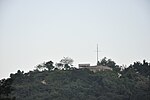
Mong-Há Fort (Chinese: 望廈炮台; Portuguese: Fortaleza de Mong-Há) is a fort on Mong-Há Hill, Nossa Senhora de Fátima, Macau, China. The fort is part of a greater military reservation – the Bairro Militar de Mong-Há, which included the Quartel de Mong-Há (Mong-Há Barracks). The Bairro Militar is bound by the Rua Francisco Xavier Pereira and the Colina de Mong-Há. The main fort complex was erected 1849 by Governor Ferreira do Amaral to protect the Macau's northern sector as precaution against a possible Chinese invasion following the First Opium War between Britain and China (1839–1842). The fort's construction began in 1849 and was completed in 1864/66. The Quartel de Mong-Há was constructed in the 1920s. With the complete withdrawal of the Portuguese military establishment in the 1960s following the Sino-Portuguese rapprochement, the fort and the Bairro Militar were deactivated, with the former being turned over to the Instituto de Formação Turística de Macau in the 1980s. In June 1997, the area surrounding the fort was transformed into the Jardim Municipal de Mong-Há. With an overall area of 650 square meters, the brick-walled fort held ten artillery pieces with a firing range capable of reaching the Portas do Cerco. Along with the barracks for Portuguese troops of African origin (Landins), the fort also included a lookout post and a munitions dump. The Quartel de Mong-Há occupied an area of 2244 square meters and was built in the style of 1920s Southern European and Modernist architecture. The government of Macau demolished the Quartel de Mong-Há and the neighboring Escola Keang Peng and put in their place public housing in the name of public security in late 2008.