place

Musselburgh, New Zealand

Suburbs of DunedinUse New Zealand English from January 2022
Musselburgh Rise Dunedin 001

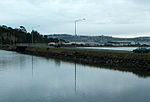
Musselburgh is a residential suburb of the New Zealand city of Dunedin. It is located in the southeast of the city's urban area, 2.8 kilometres (1.7 mi) southeast of the city's centre, and at the narrowest point of the isthmus which joins Otago Peninsula to the rest of the South Island (here just 1.5 kilometres (0.93 mi) in width). The suburb takes its name from the similarly named town in Scotland. Musselburgh's 2001 population was 2,835.

Excerpt from the Wikipedia article Musselburgh, New Zealand (License: CC BY-SA 3.0, Authors, Images).

Musselburgh, New Zealand
Musselburgh Rise, Dunedin Musselburgh

Geographical coordinates (GPS) Address Nearby Places
placeShow on map

Wikipedia: Musselburgh, New ZealandContinue reading on Wikipedia

Geographical coordinates (GPS)

Latitude Longitude
N -45.8978 ° E 170.5159 °
placeShow on map

Address

Musselburgh Rise

Musselburgh Rise
9013 Dunedin, Musselburgh
Otago, New Zealand
mapOpen on Google Maps

Musselburgh Rise Dunedin 001
Share experience

Nearby Places

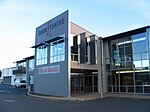
Edgar Centre
Edgar Centre

The Edgar Centre is a large multi-purpose indoor sports venue in South Dunedin, New Zealand, on the shore of Otago Harbour close to Andersons Bay Inlet. It is the home venue of the Otago Nuggets basketball team, and an alternate venue for the Southern Steel netball team. The centre also hosts a wide variety of other sports events and community events such as auctions and fairs, and is owned by the Dunedin City Council. The building is named after Dunedin millionaire and philanthropist Eion Edgar. Originally a wool-store, it was purchased and converted by the Dunedin City Council at a cost of NZ$2.5 million, of which 20% was provided by Edgar. The building was officially opened by Her Majesty Queen Elizabeth II in 1995, and won the Hillary Commission's 1996 Win-Win Facility Award. Extensions were carried out during 1996, which included the addition of a seminar room, refreshment facilities, foyer, and control rooms. In 2005, extra work was carried out, extending the playing area with the addition of the Lion Foundation Arena (now renamed the MoreFM Arena), which also includes a medical centre and enlarged viewing areas. The Arena is also used for functions and events, hosting up to 1,600 dinner guests. The centre contains five ASF Hormer PR1 Messemate timber floor courts suitable and marked for netball, basketball, and volleyball. It can be set up to provide 5 basketball courts, 21 netball courts, or 16 indoor tennis courts. Nets are also available for cricket training. In 2007 the centre hosted a Davis Cup tie with Pacific Oceania. The main arena at the Edgar Centre is the More FM Arena (formerly the Lion Foundation Arena), which is the home venue of the Otago Nuggets basketball team and one of the home venues of the Southern Steel netball franchise.At 14.4 hectares, the centre is the largest single-building indoor sports arena in the Southern Hemisphere.

Tainui, New Zealand
Tainui, New Zealand

Tahuna and Tainui are two small, somewhat vaguely defined suburbs of the New Zealand city of Dunedin. They lie to the south of Andersons Bay and Musselburgh, close to Dunedin's southern coastline (Ocean Beach). Both are often considered parts of either Musselburgh or Andersons Bay. Tainui lies to the north, in the area of residential housing which lies in the southeastern corner of "The Flat" (southern Dunedin's wide coastal plain) between Victoria and Tahuna Roads in the south and Musselburgh Rise in the north. Its eastern boundary is the start of a section of the Musselburgh Rise skirted by Tainui Road. Notable features of Tainui include Culling Park, a sports ground which is the home of Dunedin Technical football club. To the south of Tainui is Tahuna. This suburb stretches along Victoria and Tahuna Roads, and is largely dominated by several areas of open space which lie to the south between these roads and the ocean. These open spaces include two notable sports venues: Chisholm Park Golf Course and Tahuna Park. Chisholm Park is a championship-standard links course featuring one of New Zealand's finest holes, Lawyers Head. This hole dog-legs around craggy cliffs with the ocean pounding at their feet, and as such is both visually impressive and technically difficult. The course was founded in 1937 and extended from nine to 18 holes in 1941. Tahuna Park houses Dunedin's A&P showgrounds, and was the city's first rugby union and rugby league test venue. The grounds were inaugurated in a 20-acre (8.1 ha) here in 1883, and the park's only union test match was played in 1905, with the All Blacks beating Australia 14-3. The park hosted the 1924 Great Britain side when they defeated the New Zealand rugby league side 31-18 in front of 16,000 fans.The third notable open space close to the coast is the Andersons Bay Cemetery, Dunedin's biggest cemetery. This is located at the southeastern end of Tahuna, and is bounded to the west and south by Chisholm Park Golf Links. The cemetery occupies a prominent rise that juts into the sea as Lawyers Head. The cemetery was opened in 1867, but is now largely full. A crematorium, inaugurated in 1962, occupies a prominent spot close to the cliffs. Beyond the cemetery, Tahuna Road reaches a Y-junction with Tomahawk Road, which descends to the southeast to follow the coast to the suburb of Ocean Grove and rises to the north to meet with Silverton Road, Andersons Bay at that suburb's boundary with Shiel Hill. This area of Tahuna was formerly known as Ocean View, a name which is still occasionally encountered, though this name has fallen out of use due to confusion with the settlement of the same name which lies 15 kilometres (9.3 mi) to the southwest near Brighton.

Dunedin Gasworks Museum

Dunedin Gasworks Museum is located in South Dunedin, in the South Island of New Zealand. It is one of only a few known preserved gasworks museums in the world. The main part of the museum is housed in the engine house of the former Dunedin Gasworks in Braemar Street, close to Cargill's Corner, which operated from 1863 until 1987. Other buildings which are included in the museum include the boiler room, boiler house, chimney stack, fitting shop, and blacksmith's shop. The museum includes a unique collection of five stationary steam engines, at least some of which are in working full order. There are also displays of domestic and industrial gas appliances. As well as being an operating museum open to the public, the gasworks museum is also a popular venue for event ranging from music performances to gatherings of steampunk enthusiasts. The Dunedin Gasworks were the first in New Zealand and also the last to cease production. At its peak in the 1970s coal gas was provided to over 18,000 customers in the city. The Edwardian buildings of the gasworks were saved by a trust headed by Elizabeth Hinds, Director of the Otago Settlers Museum, and several are now listed by the New Zealand Historic Places Trust as Category I Historic Places.Much of Dunedin's gasworks facility was pulled down during the 1980s. The idea of restoring the remaining part of the complex into a museum was mooted during the latter part of the decade, with the first work on structural restoration of the buildings beginning in 1989. The museum was opened on 3 February 2001 in a ceremony attended by Dr. George Emerson, Chair of the Dunedin Gasworks Museum Trust, and Sir Neil Cossons, Chairman of English Heritage.