place

Marr Residence

Buildings and structures in SaskatoonCanadian Register of Historic Places in SaskatchewanHeritage sites in SaskatchewanHistoric house museums in CanadaHouses completed in 1884
Museums in SaskatoonNational Historic Sites in SaskatchewanSecond Empire architecture in CanadaUse Canadian English from January 2023
Marr Residence 2021
Marr Residence 2021

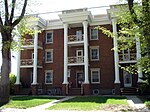
The Marr Residence is a National Historic Site located in the Nutana neighbourhood of Saskatoon, Saskatchewan, and was part of the original temperance colony that predated the city. Built in 1884 for stonemason Alexander "Sandy" Marr, it is the oldest building in Saskatoon on its original site. It was one of several houses requisitioned as a field hospital to treat wounded soldiers during the North-West Rebellion in 1885. When the hospital was closed in 1885 the home was returned to the Marr family. Although they left Saskatoon in 1889, the Marr family name remained associated with the house. The house remained a residential property until the 1970s.The Marr Residence was designated a municipal heritage property on January 11, 1982. It is noted for its blend of Second Empire and pioneer architecture, particularly its Mansard roof. The building is currently owned by the City of Saskatoon. On July 4, 2016, the Marr Residence was designated a National Historic Site.

Excerpt from the Wikipedia article Marr Residence (License: CC BY-SA 3.0, Authors, Images).

Marr Residence
11th Street East, Saskatoon Nutana

Geographical coordinates (GPS) Address External links Nearby Places
placeShow on map

Wikipedia: Marr ResidenceContinue reading on Wikipedia

Geographical coordinates (GPS)

Latitude Longitude
N 52.118611111111 ° E -106.66333333333 °
placeShow on map

Address

Marr Residence

11th Street East 326
S7N 0E4 Saskatoon, Nutana
Saskatchewan, Canada
mapOpen on Google Maps

linkWikiData (Q3944776)
linkOpenStreetMap (493688044)

Marr Residence 2021
Marr Residence 2021
Share experience

Nearby Places

Gustin House
Gustin House

Gustin House is a municipal and provincial designated historic building located in the Nutana neighborhood of Saskatoon, Saskatchewan, Canada. Trounce House, also a historic building, is located in the backyard of the Gustin House property. Gustin House is a 1920s style residential home with a special piano studio that connects to the main living room by sliding glass doors, permitting the use of the combined space for performances. In 1928 a back extension was constructed permitting a second rear piano studio to be added, the first remaining in the living room at the front of the house inside the veranda, with a library between the rooms. Dr Gustin's summer-class students also used the piano in Grace-Westminster United Church across the street at the corner of Eastlake Avenue—Westminster Church on 12th Street having closed in the mid-1960s. Built for Dr. Lyell Gustin (1895–1988), pianist and music teacher, the space was used to teach amateur and professional musicians over a period of 70 years. Between some 357 of the students taught by Lyell Gustin over 465 diplomas from Canadian and English music examining boards were awarded.In 1988, after the death of Lyell Gustin, the house was left to the University of Saskatchewan. Initially the university only intended to preserve the two Steinway pianos and portraits as a memorial. However, the university was persuaded to sell the building and its other contents to one of his former students, Lloyd Rodwell, who donated the assets to the Gustin/Trounce Heritage Committee. The committee now operates the home as an office to organize recitals in the city, while permitting it to be used to display artifacts of Lyell Gustin, for meeting space used by the local music community and hosting chamber music recitals.

Saskatoon Arena
Saskatoon Arena

The Saskatoon Arena was an indoor arena located in Saskatoon, Saskatchewan. It opened 30 October 1937 on a site overlooking the South Saskatchewan River. It was a wooden arena constructed in Saskatoon's downtown core. On opening day, it hosted a game between the New York Rangers and New York Americans, and was home to the Saskatoon Blades of the Western Hockey League for many years. It was also used for the city's annual Remembrance Day services as well as for major musical performances. Nicknamed "The Barn", the facility had outlived its usefulness by the 1970s and had become infamous for its leaky roof and substandard amenities. Yet Saskatonians were hesitant to lose the landmark and a number of years passed between the first proposal in the 1970s to replace the structure and its eventual closure in the late 1980s. The last hockey game played in the arena took place on February 2, 1988 as Saskatoon beat the Regina Pats 7–2 before 3,308 fans. The next week, the new Saskatchewan Place opened. Saskatoon Arena was demolished in 1989. During the summer of 1989, the Arena site was transformed into an amphitheatre hosting cultural events during the Canada Summer Games. During this time the city was considering a riverbank redevelopment project and it was thought that the Arena site could retain the amphitheatre, but in 1992, city council decided instead to approve construction of Clinkskill Manor, a low income seniors highrise. Plans for riverbank redevelopment continued, however, and were formally revived in the 2000s with the River Landing project. The site is the location of an ironic piece of street naming. For many years a Saunders Avenue provided access to Saskatchewan Place; but after the 2002 death of Bill Hunter, a businessman who attempted to build a new arena in the city, the street was renamed Bill Hunter Avenue (even though Hunter was known to have opposed the location of Saskatchewan Place). The name Saunders was then transferred to Saunders Place, a street that provides access to Clinkskill Manor and runs through the former site of the Saskatoon Arena.