place

Slieau Freoaghane

Isle of Man geography stubsMarilyns of the Isle of ManMountains and hills of the Isle of Man
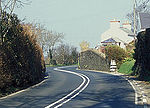
Slieau Freoaghane Summit geograph.org.uk 261423

Slieau Freoaghane (pronounced [sluː fəˈɾaːn]; Manx for 'mountain of the bilberry') is a hill on the Isle of Man, and the second highest of the Island's five Marilyns. It is located in the Sheading of Michael and can be climbed from Kirk Michael or Barregarrow to the west, from Brandy Cottage to the south, or from Druidale in the east. The summit is marked with a trig point.

Excerpt from the Wikipedia article Slieau Freoaghane (License: CC BY-SA 3.0, Authors, Images).

Slieau Freoaghane
To summit of Slieau Freoaghane, Michael

Geographical coordinates (GPS) Address Nearby Places
placeShow on map

Wikipedia: Slieau FreoaghaneContinue reading on Wikipedia

Geographical coordinates (GPS)

Latitude Longitude
N 54.263 ° E -4.55 °
placeShow on map

Address

To summit of Slieau Freoaghane

To summit of Slieau Freoaghane
Michael
Isle of Man
mapOpen on Google Maps

Slieau Freoaghane Summit geograph.org.uk 261423
Share experience

Nearby Places

Isle of Man
Isle of Man

The Isle of Man (Manx: Mannin [ˈmanɪnʲ], also Ellan Vannin [ˈɛlʲan ˈvanɪnʲ]), also known as Mann (), is a self-governing Crown Dependency in the Irish Sea between Great Britain and Ireland. As head of state, Charles III holds the title Lord of Mann and is represented by a Lieutenant Governor. The government of the United Kingdom is responsible for the isle's military defence and represents it abroad. Humans have lived on the island since before 6500 BC. Gaelic cultural influence began in the 5th century AD, when Irish missionaries following the teaching of St. Patrick began settling the island, and the Manx language, a branch of the Goidelic languages, emerged. In 627, King Edwin of Northumbria conquered the Isle of Man along with most of Mercia. In the 9th century, Norsemen established the thalassocratic Kingdom of the Isles, which included the Isle of Man. Magnus III, King of Norway from 1093 to 1103, reigned as King of Mann and the Isles between 1099 and 1103.In 1266, King Magnus VI of Norway sold his suzerainty over Mann to King Alexander III of Scotland under the Treaty of Perth. After a period of alternating rule by the Kings of Scotland and England, the island came under the feudal lordship of the English Crown in 1399. The lordship revested in the British Crown in 1765, but the island did not become part of the 18th-century Kingdom of Great Britain, nor of its successors, the United Kingdom of Great Britain and Ireland and the present-day United Kingdom of Great Britain and Northern Ireland. It has always retained its internal self-government. In 1881, the Isle of Man Parliament, Tynwald, became the first national legislative body in the world to give women the right to vote in a general election, although this excluded married women.The Manx economy is bolstered by its status as a tax haven and offshore banking destination. Insurance and online gambling each generate 17% of the GNP, followed by information and communications technology and banking with 9% each. This status has also brought the problems of money laundering, financial crime, and terrorism financing.Internationally, the Isle of Man is known for the TT Motorcycle Races, and the Manx cat, a breed with short or no tails. In 2016, UNESCO awarded the Isle of Man biosphere reserve status.

Douglas Road Corner
Douglas Road Corner

Douglas Road Corner (Manx: Cooilldarry – Oak Nook) or Kirk Michael Corner is situated adjacent the 14th Milestone road-side marker on the Snaefell Mountain Course on the primary A3 Castletown to Ramsey Road and the road junction with the A4 Peel to Kirk Michael Coast Road in the parish of Michael in the Isle of Man. In 1879 the Manx Northern Railway built a narrow gauge railway from St.John's to Ramsey which ran parallel to the A3 and A4 roads from St. Germain's through Kirk Michael to Sulby Bridge. The railway line crossed a number of minor roads as it passed the Devil's Elbow, Ballacarnane Beg, Ballagawne and a 75 feet high railway viaduct at Glen Wyllin near to Kirk Michael.The Douglas Road Corner in Kirk Michael was part of the Highroads Course used for the Gordon Bennett Trial in 1904 and the Tourist Trophy for automobiles in 1905. It was part of the Short Highland Course as part of the Peel Loop used for Tourist Trophy automobile car races held in the Isle of Man between 1906 and 1907. From 1908, Douglas Road Corner was part of the Four Inch Course used for automobile racing between 1908 and 1922. The name of the course derives from the regulations for the 1908 Tourist Trophy adopted by the Royal Automobile Club which limited the engines of the competing automobiles to a cylinder diameter of four-inches. The Four-Inch Course was adopted by the Auto-Cycle Club for the 1911 Isle of Man TT Races. The Four-Inch Course was subsequently known as the Snaefell Mountain Course or Mountain Course when used for motor-cycle racing. It was also part of the 15 miles 1,470 yards St. John's Short Course used for motor-cycle racing for the Isle of Man TT Races between 1907 and 1910. The Douglas Road Corner was situated between the 6th milestone and 7th milestone on the St. John's Short Course, 345 ft above sea level. Also, Douglas Road Corner is part of the Snaefell Mountain Course used since 1911 for the Isle of Man TT and from 1923 for the Manx Grand Prix Races.

Handley's Corner, Isle of Man

Handley's Corner (formerly Ballamenagh Corner) is situated just before the 12th Milestone road-side marker, measured from the startline at the TT Grandstand, on the Snaefell Mountain Course used for the Isle of Man TT races on the primary A3 road, in the parish of Michael, in the Isle of Man. The previous course landmark is the 11th Milestone and the next is McGuinness's, named in 2013 after TT rider John McGuinness, just preceding the next point at Barregarrow. The S-bend at Ballamenagh Corner, dominated by a high stone wall on the eastern side, was part of the Highland Course and the Four Inch Course used for the Gordon Bennett Trial and Tourist Trophy car races held between 1904 and 1922. The Ballamenagh Corner was part of the St John's Short Course used between 1907 and 1910 for the TT races. Later named Handley's Corner, it became part of the Snaefell Mountain Course used since 1911 for the TT and from 1923 for the Manx Grand Prix races. The area is dominated by the Ballamenagh and Shoughlaige-e-Caine farmland. The name derives from the TT race winner Wal Handley who, while riding a Rudge motorcycle, crashed heavily during lap 4 of the 1932 Senior TT race, sustained a back injury and subsequently retired from the race. The corner underwent road widening and reprofiling during the winter of 1953/1954 for the 1954 TT races. From the winter of 2003 to 2006, road repair work was carried-out on the primary A3 road from Barregarrow to Cronk-y-Voddy, including Handley's Corner and the 11th Milestone, by the Department of Transport.