place

Azalea Open Invitational

1945 establishments in Alabama1971 disestablishments in North CarolinaFormer PGA Tour eventsGolf in North CarolinaRecurring sporting events disestablished in 1971
Recurring sporting events established in 1945

The Azalea Open Invitational was a golf tournament in North Carolina on the PGA Tour, held at Cape Fear Country Club in Wilmington. Last played in November 1971 as an unofficial event; it was an official PGA Tour event in 1945 and from 1949 through 1970. The Heritage in South Carolina debuted in 1969 and soon displaced it on the schedule.It was also played under the names of the Azalea Open and the Wilmington Azalea Open; all were centerpieces of the city's Azalea Festival. Cape Fear was designed by noted course architect Donald Ross.From 1950 through 1965, the Azalea Open was a tune-up event for the first major of the year, The Masters in Augusta, Georgia. Jerry Barber, the winner of the PGA Championship in 1961, won the Wilmington event three times (1953, 1961, 1963). Arnold Palmer won in 1957 and nearly repeated, falling by a stroke in an 18-hole playoff in 1958; the difference was a penalty stroke he called on himself. Total prize money was initially $10,000, increasing to $12,500 in 1955 and $15,000 in 1958. It reduced to $12,000 in 1961 before increasing to $20,000 from 1962 to 1964. Prize money was $28,750 in 1965, $22,800 in 1966, $35,000 from 1967 to 1969 and $60,000 in 1970. The final non-tour event in 1971 had prize money of $35,000.

Excerpt from the Wikipedia article Azalea Open Invitational (License: CC BY-SA 3.0, Authors).

Azalea Open Invitational
Country Club Road, Wilmington

Geographical coordinates (GPS) Address Nearby Places
placeShow on map

Wikipedia: Azalea Open InvitationalContinue reading on Wikipedia

Geographical coordinates (GPS)

Latitude Longitude
N 34.22 ° E -77.918 °
placeShow on map

Address

Cape Fear Country Club Golf Course

Country Club Road 1518
28403 Wilmington
North Carolina, United States
mapOpen on Google Maps

Share experience

Nearby Places

Wilmington, North Carolina

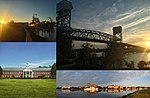
Wilmington is a port city in and the county seat of New Hanover County in coastal southeastern North Carolina. With a population of 115,451 at the 2020 census, it is the eighth-most populous city in the state. Wilmington is the principal city of the Cape Fear-Wilmington metropolitan statistical area, which includes New Hanover and Pender Counties in southeastern North Carolina, which had a population of 301,284 at the 2020 census.Wilmington's historic downtown has a 1.75-mile (2.82 km) Riverwalk, developed as a tourist attraction in the late 20th century. In 2014, Wilmington's riverfront was ranked as the "Best American Riverfront" by readers of USA Today. The National Trust for Historic Preservation selected Wilmington as one of its 2008 Dozen Distinctive Destinations.City residents live between the Cape Fear River and the Atlantic Ocean, with four nearby beach communities just outside Wilmington: Fort Fisher, Wrightsville Beach, Carolina Beach, and Kure Beach, all within half-hour drives from downtown Wilmington. The city is home to University of North Carolina Wilmington (UNCW), which provides a wide variety of programs for undergraduates, graduate students, and adult learners, in addition to cultural and sports events open to the community.Toward the end of the 19th century, Wilmington was a majority-black, racially integrated, prosperous city, and the largest city in North Carolina. In the Wilmington massacre of 1898, white supremacists launched a coup that overthrew the legitimately elected local Fusionist government. They expelled opposition black and white leaders from the city, destroyed the property and businesses of black citizens built up since the Civil War, including the only black newspaper in the city, and killed an estimated 60 to more than 300 people. This coincided with broader efforts of disenfranchisement at the state level. Whereas North Carolina had 125,000 registered black voters in 1896, it had 6,000 black voters by 1902. By 1910, Charlotte overtook Wilmington as North Carolina's largest city. In 2003, the city was designated by the U.S. Congress as a "Coast Guard City", one of 29 cities that currently bear that designation, and was the home port for the USCGC Diligence, a United States Coast Guard medium-endurance cutter until 2020. On September 2, 2020, then-President Trump officially declared Wilmington as the first World War II Heritage City in the country. The World War II battleship USS North Carolina, now a war memorial, is moored across from the downtown port area, and is open to the public for tours. Other attractions include the Cape Fear Museum of History and Science, The Children's Museum of Wilmington, and the Wilmington Hammerheads United Soccer Leagues soccer team.Wilmington is also the home of EUE/Screen Gems Studios, the largest domestic television and movie production facility outside California. Dream Stage 10, the facility's newest sound stage, is the third-largest in the United States. It houses the largest special-effects water tank in North America. After the studio's opening in 1984, Wilmington became a major center of American film and television production. Numerous movies and television shows, in a range of genres, have been produced here, including Iron Man 3, Super Mario Bros., The Conjuring, "A Walk to Remember.", The Crow, Sleepy Hollow, Dawson's Creek, One Tree Hill, and "The Summer I Turned Pretty".