place

Lenkom Theatre

1907 establishments in the Russian EmpireArt Nouveau architecture in MoscowArt Nouveau theatresCulture in MoscowMoscow geography stubs
Music venues completed in 1907Theatre companies in RussiaTheatres built in the Soviet UnionTheatres completed in 1907Theatres in Moscow
Moscow Lenkom Theater asv2019 09

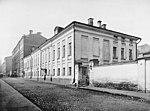
Lenkom Theatre is the official name of what was once known as the Moscow State Theatre named after Lenin's Komsomol. Designed by Illarion Ivanov-Schitz, it was built in 1907−1909 to house a Merchant's Club, and was home to many theatrical and musical performances. Occupied following the February Revolution, 1917 the building had several uses before becoming the home of "Theatre for Working Youth" (TRAM) in 1927. Thus, the future theatre established its reputation as a theatre for young people, by young people. Over its 80-year career, Lenkom has been a forerunner of new, fresh and experimental theatre in the Soviet Union, and now Russia.

Excerpt from the Wikipedia article Lenkom Theatre (License: CC BY-SA 3.0, Authors, Images).

Lenkom Theatre
улица Малая Дмитровка, Moscow Tverskoy District

Geographical coordinates (GPS) Address Phone number Website External links Nearby Places
placeShow on map

Wikipedia: Lenkom TheatreContinue reading on Wikipedia

Geographical coordinates (GPS)

Latitude Longitude
N 55.767777777778 ° E 37.606666666667 °
placeShow on map

Address

Ленком (Ленком Марка Захарова)

улица Малая Дмитровка 6
127006 Moscow, Tverskoy District
Moscow, Russia
mapOpen on Google Maps

Phone number
ГБУК г. Москвы «Московский государственный театр «Ленком»

call+74956999668

Website
lenkom.ru

linkVisit website

linkWikiData (Q2396186)
linkOpenStreetMap (52597841)

Moscow Lenkom Theater asv2019 09
Share experience

Nearby Places

Nativity Church at Putinki

The Church of the Nativity of the Theotokos at Putinki is one of the most picturesque churches in Moscow and the last major tent-like church in the history of Russian architecture. The snow-white church with its multiple tents and azure-and-gold domes resembles a daintily carved piece of ivory. The Nativity church at Putinki consists of six exquisite tented roofs arranged in a highly unusual composition. Three candle-like tents, placed in a row, crown the church, while its refectory is surmounted by several rows of corbel arches and the fourth tent. The fifth tent is a belltower placed between the church and refectory. The porch also terminates in a pyramidal roof. The church was commissioned by Tsar Alexis Mikhailovich in 1649 in order to grace a highway leading from Moscow to the Trinity Monastery. Construction works were completed within three years. As the story goes, Patriarch Nikon, when passing the church on his way to the Trinity Monastery, was so scandalized by its unorthodox design that he prohibited the construction of tent-like churches altogether. After the Vysokopetrovsky Monastery was closed down by the Soviet authorities in 1929, Archimandrite Bartholomew Remov arranged for the monks and nuns to continue their monastic life in secret at the Nativity Church, where he was the Rector. The spiritual life of the monastery continued at Putinki until the NKVD was informed and arrested everyone involved in 1935.The Soviet authorities closed the church in 1938 but they also funded repair works in 1957. Following the collapse of the Soviet Union, the church was reopened as the patriarch's metochion.

Pushkinskaya (Moscow Metro)

Pushkinskaya (Russian: Пушкинская) is a station on Moscow Metro's Tagansko-Krasnopresnenskaya Line. Opened on 17 December 1975, along with Kuznetsky Most as the segment which linked the Zhdanovskaya and Krasnopresnenskaya Lines into one. Like its neighbour, the station was a column tri-vault type, which had not been seen in Moscow since the 1950s. Arguably the most beautiful station on the Line, the architects Vdovin and Bazhenov took every effort to make it appear to have a 'classical' 19th century setting. The central hall lighting is created with stylised 19th century chandeliers with two rows of plafonds appearing like candles, while the side platforms have candlesticks with similar plafonds. The columns, covered with 'Koelga' white marble are decorated with palm leaf reliefs and the grey marble walls are decorated with brass measured insertions based on the works of the great Russian poet Alexander Pushkin. The grey granite floor completes the appearance of the masterpiece. Architecturally the station put the final stop to the functionality economy design of the 1960s and went against Nikita Khrushchev's policy of struggle to avoid decorative 'extras', which left the stations of 1958–59 greatly altered in their design. The station's original vestibule, with its magnificent cessoned ceiling from anodized aluminium (architects Demchinskiy and Kollesnikov) is situated under Pushkinskaya Square of the Boulevard ring, the centre of Moscow's nightlife, and is linked with subways to the square and to Tverskaya Street. In 1979 it was combined with the Gorkovskaya (now Tverskaya) station of the Zamoskvoretskaya Line. The opposite end was decorated with a bust of the great poet himself (architect — Shumakov), however in 1987 a pathway was opened to the underground vestibule of the two escalator cascades of the Chekhovskaya station of the Serpukhovsko-Timiryazevskaya Line. The bust was moved into a combined vestibule built into the office building of the newspaper Izvestia on the Strastnoi Boulevard of the Boulevard ring. When transferring between the stations it is possible to bypass the vestibule via the lyre fenced stairs leading from the middle of the columns. The transfer point, was originally named for the three writers and poets (Alexander Pushkin, Maxim Gorky, Anton Chekhov). In 1991, the original street Ulitsa Gorkova was renamed Tverskaya, and hence the station was also given this name. The transfer point is one of the busiest in Moscow; Pushkinskaya receives a daily load of 46,770 via the vestibules, 170,000 to Tverskaya and 212,000 to the Chekhovskaya station.