place

Moscow Hermitage Garden

AC with 0 elementsCulture in MoscowMoscow Art TheaterParks and gardens in MoscowTheatre companies in Russia
Theatres in Moscow
Theater Hermitage, Moscow

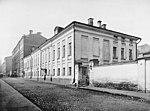
Moscow Hermitage Garden (Russian: Сад Эрмитаж), a popular recreation spot, is a park in the central part of Moscow, Russia on Karetny Ryad Street. It is known for its cultural attractions and adjacent theaters. Regular events include opera, ballet and concerts.

Excerpt from the Wikipedia article Moscow Hermitage Garden (License: CC BY-SA 3.0, Authors, Images).

Moscow Hermitage Garden
Karetnyj Ryad Street, Moscow Tverskoy District

Geographical coordinates (GPS) Address Nearby Places
placeShow on map

Wikipedia: Moscow Hermitage GardenContinue reading on Wikipedia

Geographical coordinates (GPS)

Latitude Longitude
N 55.771111111111 ° E 37.6075 °
placeShow on map

Address

Karetnyj Ryad Street 3 с14А
127006 Moscow, Tverskoy District
Moscow, Russia
mapOpen on Google Maps

Theater Hermitage, Moscow
Share experience

Nearby Places

Nativity Church at Putinki

The Church of the Nativity of the Theotokos at Putinki is one of the most picturesque churches in Moscow and the last major tent-like church in the history of Russian architecture. The snow-white church with its multiple tents and azure-and-gold domes resembles a daintily carved piece of ivory. The Nativity church at Putinki consists of six exquisite tented roofs arranged in a highly unusual composition. Three candle-like tents, placed in a row, crown the church, while its refectory is surmounted by several rows of corbel arches and the fourth tent. The fifth tent is a belltower placed between the church and refectory. The porch also terminates in a pyramidal roof. The church was commissioned by Tsar Alexis Mikhailovich in 1649 in order to grace a highway leading from Moscow to the Trinity Monastery. Construction works were completed within three years. As the story goes, Patriarch Nikon, when passing the church on his way to the Trinity Monastery, was so scandalized by its unorthodox design that he prohibited the construction of tent-like churches altogether. After the Vysokopetrovsky Monastery was closed down by the Soviet authorities in 1929, Archimandrite Bartholomew Remov arranged for the monks and nuns to continue their monastic life in secret at the Nativity Church, where he was the Rector. The spiritual life of the monastery continued at Putinki until the NKVD was informed and arrested everyone involved in 1935.The Soviet authorities closed the church in 1938 but they also funded repair works in 1957. Following the collapse of the Soviet Union, the church was reopened as the patriarch's metochion.

Saint Tikhon's Orthodox University

Saint Tikhon's Orthodox University of Humanities (Russian: Православный Свято-Тихоновский гуманитарный университет) in Moscow, Russia is a coeducational theological university for the laity affiliated with the Russian Orthodox Church. The university, established in 1991, is Russia's first theological graduate-level school for the lay men and women, unlike traditional Orthodox seminaries preparing male students for ordination. It is the only Orthodox institution in Russia that is accredited to issue generally accepted diplomas. Ten departments of the university provide education in theology, history, teaching, missionary practice, religious arts and music, economics, social services and information management. Basic theology studies are mandatory for students of all departments. Admission does not require adherence to Orthodox faith or any religious tests, except for the icon school where applicants should demonstrate skills in traditional Orthodox art. The university traces its roots to Orthodox missionaries Vsevolod Shpiller (1902–1984) and hieromonk Paul (Troitsky). In the end of the 1980s their alumni set up evening courses of theology that merged in a unified institution in 1991 and, with support of Patriarch Alexy II of Moscow, acquired state accreditation as a university in 1992. The University is closely associated with the Brotherhood of Merciful Saviour, which traditionally provided teaching staff and premises to the University.For years, the university operated on premises leased from other colleges or on the parish church properties, notably the church of Saint Nicholas in Kyzneci(Zamoskvorechye District) operated by the Brotherhood. In the 2000s the University obtained the rights to the former Bishopric House that prior to the October Revolution housed the Orthodox Open University and is now (2009) in the process of rebuilding the run-down building into its new, permanent, campus. The university has been continuously chaired by one of its founders, and the founding member of the Brotherhood of Merciful Saviour, Revd. Vladimir Vorobyov (born 1941) since 1991. Rector of the University is, as of 2009, an ex officio member of the Local Council (pomestny sobor) of the Russian Orthodox Church. Vladimir Vorobyov also chairs the department of religion and culture at the Ministry of Internal Affairs Academy.The university selects its staff primarily from ordained Russian Orthodox clerics and lay academicians; guest speakers may come from other denominations (most often Roman Catholic Church). University staff was actively engaged in the 2007 public controversy on the alleged Orthodox clericalisation of school education, opposing the nonsectarian approach of the Russian Academy of Sciences. In 2006 the late Patriarch Alexey, speaking in favor of increased Orthodox presence in public schools, proposed Saint Tikhon's university as the source of qualified lay teachers of the Basics of Orthodox Culture course recommended by the Church. In 2018 topped the list of the most demanded humanitarian universities in Russia.The university celebrates its holiday on November 18, the day of Saint Tikhon's ascension to the Patriarchy in 1917.

Pushkinskaya (Moscow Metro)

Pushkinskaya (Russian: Пушкинская) is a station on Moscow Metro's Tagansko-Krasnopresnenskaya Line. Opened on 17 December 1975, along with Kuznetsky Most as the segment which linked the Zhdanovskaya and Krasnopresnenskaya Lines into one. Like its neighbour, the station was a column tri-vault type, which had not been seen in Moscow since the 1950s. Arguably the most beautiful station on the Line, the architects Vdovin and Bazhenov took every effort to make it appear to have a 'classical' 19th century setting. The central hall lighting is created with stylised 19th century chandeliers with two rows of plafonds appearing like candles, while the side platforms have candlesticks with similar plafonds. The columns, covered with 'Koelga' white marble are decorated with palm leaf reliefs and the grey marble walls are decorated with brass measured insertions based on the works of the great Russian poet Alexander Pushkin. The grey granite floor completes the appearance of the masterpiece. Architecturally the station put the final stop to the functionality economy design of the 1960s and went against Nikita Khrushchev's policy of struggle to avoid decorative 'extras', which left the stations of 1958–59 greatly altered in their design. The station's original vestibule, with its magnificent cessoned ceiling from anodized aluminium (architects Demchinskiy and Kollesnikov) is situated under Pushkinskaya Square of the Boulevard ring, the centre of Moscow's nightlife, and is linked with subways to the square and to Tverskaya Street. In 1979 it was combined with the Gorkovskaya (now Tverskaya) station of the Zamoskvoretskaya Line. The opposite end was decorated with a bust of the great poet himself (architect — Shumakov), however in 1987 a pathway was opened to the underground vestibule of the two escalator cascades of the Chekhovskaya station of the Serpukhovsko-Timiryazevskaya Line. The bust was moved into a combined vestibule built into the office building of the newspaper Izvestia on the Strastnoi Boulevard of the Boulevard ring. When transferring between the stations it is possible to bypass the vestibule via the lyre fenced stairs leading from the middle of the columns. The transfer point, was originally named for the three writers and poets (Alexander Pushkin, Maxim Gorky, Anton Chekhov). In 1991, the original street Ulitsa Gorkova was renamed Tverskaya, and hence the station was also given this name. The transfer point is one of the busiest in Moscow; Pushkinskaya receives a daily load of 46,770 via the vestibules, 170,000 to Tverskaya and 212,000 to the Chekhovskaya station.