place

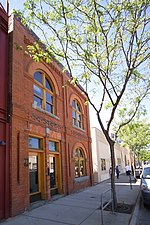
Loyola Sacred Heart High School

1873 establishments in Montana TerritoryCatholic secondary schools in MontanaEducational institutions established in 1873High schools in Missoula, MontanaJesuit high schools in the United States
Roman Catholic Diocese of HelenaSchools accredited by the Northwest Accreditation Commission
Loyola Sacred Heart High School Missoula

Loyola Sacred Heart High School is a private, Roman Catholic high school in Missoula, Montana. It is one of two high schools in the Roman Catholic Diocese of Helena, the other being Butte Central Catholic in Butte. It is affiliated with St. Joseph Elementary School, and both institutions are supported by the Loyola Sacred Heart Foundation. The Boys and Girls sports teams go by different names, being the Rams and the Breakers, respectively.

Excerpt from the Wikipedia article Loyola Sacred Heart High School (License: CC BY-SA 3.0, Authors, Images).

Loyola Sacred Heart High School
Tremont Street, Missoula

Geographical coordinates (GPS) Address Nearby Places
placeShow on map

Wikipedia: Loyola Sacred Heart High SchoolContinue reading on Wikipedia

Geographical coordinates (GPS)

Latitude Longitude
N 46.862222222222 ° E -114.00222222222 °
placeShow on map

Address

Loyola Sacred Heart High School

Tremont Street
59801 Missoula
Montana, United States
mapOpen on Google Maps

Loyola Sacred Heart High School Missoula
Share experience

Nearby Places

Missoula, Montana
Missoula, Montana

Missoula ( mih-ZOO-lə; Séliš: Nłʔay, lit. 'Place of the Small Bull Trout'; Kutenai: Tuhuⱡnana) is a city in and the county seat of Missoula County, Montana, United States. It is located along the Clark Fork River near its confluence with the Bitterroot and Blackfoot Rivers in western Montana and at the convergence of five mountain ranges, thus it is often described as the "hub of five valleys". The 2020 United States Census shows the city's population at 73,489 and the population of the Missoula Metropolitan Area at 117,922. After Billings, Missoula is the second-largest city and metropolitan area in Montana. Missoula is home to the University of Montana, a public research university. The Missoula area began seeing settlement by people of European descent in 1858 including William T. Hamilton, who set up a trading post along the Rattlesnake Creek, Captain Richard Grant, who settled near Grant Creek, and David Pattee, who settled near Pattee Canyon. Missoula was founded in 1860 as Hellgate Trading Post while still part of Washington Territory. By 1866, the settlement had moved east, 5 miles (8 km) upstream, and had been renamed Missoula Mills, later shortened to Missoula. The mills provided supplies to western settlers traveling along the Mullan Road. The establishment of Fort Missoula in 1877 to protect settlers further stabilized the economy. The arrival of the Northern Pacific Railway in 1883 brought rapid growth and the maturation of the local lumber industry. In 1893, the Montana Legislature chose Missoula as the site for the state's first university. Along with the U.S. Forest Service headquarters founded in 1908, lumber and the university remained the basis of the local economy for the next 100 years.By the 1990s, Missoula's lumber industry had gradually disappeared, and as of 2009, the city's largest employers were the University of Montana, Missoula County Public Schools, and Missoula's two hospitals. The city is governed by a mayor–council government with 12 city council members, two from each of the six wards. In and around Missoula are 400 acres (160 ha) of parkland, 22 miles (35 km) of trails, and nearly 5,000 acres (2,000 ha) of open-space conservation land, with adjacent Mount Jumbo being home to grazing elk and mule deer during the winter. The city is also home to both of Montana's largest and its oldest active breweries, as well as the Montana Grizzlies. Notable residents include the first woman to serve in the U.S. Congress, Jeannette Rankin.

Wilma Theatre (Missoula, Montana)

The Wilma Theatre is a cinema and events venue in Missoula, Montana, United States. It was built in 1921 by William "Billy" Simons and dedicated to his wife, light opera artist Edna Wilma. Designed by Norwegian architect Ole Bakke and his assistant H. E. Kirkemo, the steel-framed highrise features hallmarks of Sullivanesque architecture. The theatre is part of an eight-story complex that was the first steel-framed high-rise building in Missoula, and includes the main 1400-seat hall, a lounge, three banquet rooms, a restaurant, apartments and offices. The theatre interior is decorated with Louis XIV Style gilt trim.The original theatre organ was replaced in the 1950s with a Robert Morton organ from the Orpheum Theater in Spokane, Washington, which had been torn down in 1958.As originally built, the basement housed a swimming pool, the "Crystal Plunge". Condensation proved incompatible with the structure, and the pool closed within ten years. It now serves as additional storage space.In 1982 the Cinema of the Dove opened in the basement of the building. It was also known as the Chapel of the Dove. It was operated by Edward Sharp. The Chapel of the Dove was described as a "dazzlingly eclectic space." The Chapel of the Dove was turned into a more conventional theater after Edward Sharp died in 1993.The theatre shows a diverse range of entertainment, including independent movies, spoken word events, stand-up comedy, live and local music, plays, and other events. The venue is equipped with a full PA system and stage monitors with Yamaha M7 consoles at the core, as well as a secondary PA for use with the main movie screen. The theatre also employs a full theater lighting system with PAR and Leko fixtures, and six Martin Mac 500 automated moving head fixtures. The lighting is controlled by a Pearl 2000 console.