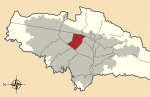
place

Estadio Compensar

Colombian building and structure stubsColombian sport stubsFootball venues in BogotáSouth American sports venue stubsSports venues in Bogotá
Partido de Atletico Bucaramanga Vs Academia

Estadio Compensar is a multi-use stadium in Bogotá, Colombia. It is currently used mostly for football matches and was the home stadium of Academia FC. The stadium holds 4,500 people and opened in 1998.

Excerpt from the Wikipedia article Estadio Compensar (License: CC BY-SA 3.0, Authors, Images).

Estadio Compensar
Calle 49A, Bogota Localidad Engativá

Geographical coordinates (GPS) Address External links Nearby Places
placeShow on map

Wikipedia: Estadio CompensarContinue reading on Wikipedia

Geographical coordinates (GPS)

Latitude Longitude
N 4.6611444444444 ° E -74.101094444444 °
placeShow on map

Address

Estadio Compensar

Calle 49A
111071 Bogota, Localidad Engativá
Colombia
mapOpen on Google Maps

linkWikiData (Q5400148)
linkOpenStreetMap (1008418546)

Partido de Atletico Bucaramanga Vs Academia
Share experience

Nearby Places

Children's Museum of Bogotá

The Children's Museum of Bogotá (Fundación Museo de los Niños) was a privately managed museum foundation in Bogotá, Colombia's capital city, established in 1986 and aimed at teaching children about science, technology, culture and arts. The foundation operated the Children's Museum in an 8,000 m2 (86,000 ft.²) building in the geographical centre of Bogotá, in which over 23 different modules and hundreds of individual exhibits were housed. The museum served approximately 150,000 visitors per year — 69% of them children under 11 years of age that come to "learn by playing" in the exhibits. In 2018, it became a park for children. Its main attractions are bouncing houses, bicycle rides, and races for kids. In addition to guided tours, the Children's Museum conducted workshops, special vacation programs for children and highly structured events for schools. To celebrate their 15th anniversary, the museum invited the most important young Colombian artists to each paint a mural on the museum walls. This resulted in a collection of 42 murals which have become a landmark for art students in Bogotá. Another highly important program of the Museum is the Computer Clubhouse – an international program promoted by the Intel Corporation and the Museum of Science, Boston. Computer Clubhouse teaches children of low income families computer skills for computer animation, graphic design, composing and editing, as a means to close the digital divide in the society. An introduction to robotics is also included in this program. In the outer gardens of the museum, a real Boeing 720 aircraft (without actual function, fuel, electricity or engines) was present to teach children the basics of aeronautics. The airliner was donated by Avianca (the biggest airline in Colombia) in the mid-1980s. The museum also featured a room with a small representation of a city's roads to teach children traffic signs and behaviour while driving or walking on the streets

TransMilenio
TransMilenio

TransMilenio is a bus rapid transit (BRT) system that serves Bogotá, the capital of Colombia, and Soacha. The system opened to the public in December 2000, covering Caracas Avenue and 80 street. Other lines were added gradually over the next several years, and as of 2022, 12 lines totalling 114.4 km (71 mi) run throughout the city. It is part of the city's Integrated Public Transport System (Sistema Integrado de Transporte Público [SITP] in Spanish), along with the urban, complementary and special bus services operating on neighbourhoods and main streets. It was inspired by Curitiba's Rede Integrada de Transporte (Integrated Transportation Network). TransMilenio consists of several interconnected BRT lines, with raised floor stations in the center of a main avenue, or "troncal". Passengers typically reach the stations via a bridge over the street. Usually four lanes down the center of the street are dedicated to bus traffic. The outer lanes allow express buses to bypass buses stopped at a station. Users pay at the station entrance using a smart card, pass through a turnstile, and wait for buses inside the station, which is typically 5 m wide. The bus and station doors open simultaneously, and passengers board by simply walking across the threshold. The elevated station platform and the bus floor are at the same height. In the beginning most buses were diesel-powered, purchased from such manufacturers as the Colombian-Brazilian company Marcopolo-Superior, German conglomerate Mercedes-Benz, and Swedish companies such as Volvo and Scania. The buses were articulated and had a capacity of 160 passengers each. In May 2007, a new, larger bi-articulated bus, with capacity for 270 passengers, was presented to the public. TransMilenio buses are not equipped with transponders to give them priority at traffic signals; regret over this fact was voiced by former general manager of the system, Angelica Castro.As of the 4th quarter of 2021, 1,759 buses on average were circulating on the trunk line system. An additional set of 800 regular buses, known as "feeders" (alimentadores in Spanish), carry passengers from certain important stations to many different locations that the main route does not reach. Unlike the main TransMilenio buses, feeders operate without dedicated lanes, are not articulated and are either green or blue (regular TransMilenio buses are red). There is no additional fare to use the feeder buses. There are 22 bicycle parking facilities in main TransMilenio stations with 6,059 parking spaces to facilitate cyclists using the system.8 BRT corridors were certified in 2013 to meet the BRT STANDARD with excellence: Autonorte and Caracas silver, Americas, Calle 80, Eldorado, NQS and Suba gold.