place

Tbilisi State Institute of Economic Relations

1992 establishments in Georgia (country)AC with 0 elementsBusiness schools in Georgia (country)Education in TbilisiEducational institutions established in 1992
Universities in Georgia (country)

Tbilisi State Institute Of Economic Relations (TSIER, Georgian: თბილისის სახელმწიფო უნივერსიტეტი ეკონომიკური ურთიერთობები ) is a state educational institution in Georgia.It is a business college. It is based in the capital city of Tbilisi. It has three campuses throughout the country: two in Tbilisi and one in Rustavi and serves more than 3,000 students. It is considered to be the top business school in Georgia. TSIER is fully accredited by the Ministry Of Education of Georgia. The school's success is popularly attributed to Dr. Guram Tavartkiladze, who has been its President and Rector since the founding day of March 19, 1992.

Excerpt from the Wikipedia article Tbilisi State Institute of Economic Relations (License: CC BY-SA 3.0, Authors).

Tbilisi State Institute of Economic Relations
Samghereti Street, Tbilisi Lotkini

Geographical coordinates (GPS) Address Nearby Places
placeShow on map

Wikipedia: Tbilisi State Institute of Economic RelationsContinue reading on Wikipedia

Geographical coordinates (GPS)

Latitude Longitude
N 41.7325 ° E 44.821666666667 °
placeShow on map

Address

სამღერეთის ქუჩა

Samghereti Street
0101 Tbilisi, Lotkini
Georgia
mapOpen on Google Maps

Share experience

Nearby Places

Georgian Soviet Socialist Republic

The Georgian Soviet Socialist Republic (Georgian SSR; Georgian: საქართველოს საბჭოთა სოციალისტური რესპუბლიკა, romanized: sakartvelos sabch'ota sotsialist'uri resp'ublik'a; Russian: Грузинская Советская Социалистическая Республика, romanized: Gruzinskaya Sovetskaya Sotsialisticheskaya Respublika) was one of the republics of the Soviet Union from its second occupation (by Russia) in 1921 to its independence in 1991. Coterminous with the present-day republic of Georgia, it was based on the traditional territory of Georgia, which had existed as a series of independent states in the Caucasus prior to the first occupation of annexation in the course of the 19th century. The Georgian SSR was formed in 1921 and subsequently incorporated in the Soviet Union in 1922. Until 1936 it was a part of the Transcaucasian Socialist Federative Soviet Republic, which existed as a union republic within the USSR. From November 18, 1989, the Georgian SSR declared its sovereignty over Soviet laws. The republic was renamed the Republic of Georgia on November 14, 1990, and subsequently became independent before the dissolution of the Soviet Union on April 9, 1991, whereupon each former SSR became a sovereign state. Geographically, the Georgian SSR was bordered by Turkey to the south-west and the Black Sea to the west. Within the Soviet Union it bordered the Russian SFSR to the north, the Armenian SSR to the south and the Azerbaijan SSR to the south-east.

Tbilisi
Tbilisi

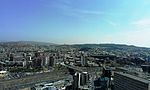
Tbilisi (English: tə-bil-EE-see, tə-BIL-iss-ee; Georgian: თბილისი [tʰbi'lisi] (listen)), in some languages still known by its pre-1936 name Tiflis ( TIF-liss), is the capital and the largest city of Georgia, lying on the banks of the Kura River with a population of approximately 1.5 million people. Tbilisi was founded in the 5th century AD by Vakhtang I of Iberia, and since then has served as the capital of various Georgian kingdoms and republics. Between 1801 and 1917, then part of the Russian Empire, Tiflis was the seat of the Caucasus Viceroyalty, governing both the northern and the southern parts of the Caucasus. Because of its location on the crossroads between Europe and Asia, and its proximity to the lucrative Silk Road, throughout history Tbilisi was a point of contention among various global powers. The city's location to this day ensures its position as an important transit route for energy and trade projects. Tbilisi's history is reflected in its architecture, which is a mix of medieval, neoclassical, Beaux Arts, Art Nouveau, Stalinist and the Modern structures. Historically, Tbilisi has been home to people of multiple cultural, ethnic, and religious backgrounds, though it is overwhelmingly Eastern Orthodox Christian. Its notable tourist destinations include cathedrals Sameba and Sioni, Freedom Square, Rustaveli Avenue and Agmashenebeli Avenue, medieval Narikala Fortress, the pseudo-Moorish Opera Theater, and the Georgian National Museum. The climate in Tbilisi mostly ranges from 20 to 32 °C (68 to 90 °F) in the summer and −1 to 7 °C (30 to 45 °F) in the winter.