place

Tbilisi railway station

Buildings and structures in TbilisiRailway stations in Georgia (country)Railway stations opened in 1872Transport in Tbilisi
Tbilisi railway station june 2010

Tbilisi Railway station (Georgian: თბილისის ცენტრალური სადგური, tbilisis tsent'raluri sadguri) is a railway station located in Tbilisi, Georgia. Originally built in 1872, Tbilisi Railway station has undergone various architectural transformations, and currently serves as a combined railway station and shopping mall.

Excerpt from the Wikipedia article Tbilisi railway station (License: CC BY-SA 3.0, Authors, Images).

Tbilisi railway station
Station Square, Tbilisi Didube-Chugureti Raion

Geographical coordinates (GPS) Address External links Nearby Places
placeShow on map

Wikipedia: Tbilisi railway stationContinue reading on Wikipedia

Geographical coordinates (GPS)

Latitude Longitude
N 41.720953 ° E 44.799339 °
placeShow on map

Address

თბილისი ცენტრალი

Station Square
0164 Tbilisi, Didube-Chugureti Raion
Georgia
mapOpen on Google Maps

linkWikiData (Q1341835)
linkOpenStreetMap (38424053)

Tbilisi railway station june 2010
Share experience

Nearby Places

Georgian Soviet Socialist Republic

The Georgian Soviet Socialist Republic (Georgian SSR; Georgian: საქართველოს საბჭოთა სოციალისტური რესპუბლიკა, romanized: sakartvelos sabch'ota sotsialist'uri resp'ublik'a; Russian: Грузинская Советская Социалистическая Республика, romanized: Gruzinskaya Sovetskaya Sotsialisticheskaya Respublika) was one of the republics of the Soviet Union from its second occupation (by Russia) in 1921 to its independence in 1991. Coterminous with the present-day republic of Georgia, it was based on the traditional territory of Georgia, which had existed as a series of independent states in the Caucasus prior to the first occupation of annexation in the course of the 19th century. The Georgian SSR was formed in 1921 and subsequently incorporated in the Soviet Union in 1922. Until 1936 it was a part of the Transcaucasian Socialist Federative Soviet Republic, which existed as a union republic within the USSR. From November 18, 1989, the Georgian SSR declared its sovereignty over Soviet laws. The republic was renamed the Republic of Georgia on November 14, 1990, and subsequently became independent before the dissolution of the Soviet Union on April 9, 1991, whereupon each former SSR became a sovereign state. Geographically, the Georgian SSR was bordered by Turkey to the south-west and the Black Sea to the west. Within the Soviet Union it bordered the Russian SFSR to the north, the Armenian SSR to the south and the Azerbaijan SSR to the south-east.

Tbilisi
Tbilisi

Tbilisi (English: tə-bil-EE-see, tə-BIL-iss-ee; Georgian: თბილისი [tʰbi'lisi] (listen)), in some languages still known by its pre-1936 name Tiflis ( TIF-liss), is the capital and the largest city of Georgia, lying on the banks of the Kura River with a population of approximately 1.5 million people. Tbilisi was founded in the 5th century AD by Vakhtang I of Iberia, and since then has served as the capital of various Georgian kingdoms and republics. Between 1801 and 1917, then part of the Russian Empire, Tiflis was the seat of the Caucasus Viceroyalty, governing both the northern and the southern parts of the Caucasus. Because of its location on the crossroads between Europe and Asia, and its proximity to the lucrative Silk Road, throughout history Tbilisi was a point of contention among various global powers. The city's location to this day ensures its position as an important transit route for energy and trade projects. Tbilisi's history is reflected in its architecture, which is a mix of medieval, neoclassical, Beaux Arts, Art Nouveau, Stalinist and the Modern structures. Historically, Tbilisi has been home to people of multiple cultural, ethnic, and religious backgrounds, though it is overwhelmingly Eastern Orthodox Christian. Its notable tourist destinations include cathedrals Sameba and Sioni, Freedom Square, Rustaveli Avenue and Agmashenebeli Avenue, medieval Narikala Fortress, the pseudo-Moorish Opera Theater, and the Georgian National Museum. The climate in Tbilisi mostly ranges from 20 to 32 °C (68 to 90 °F) in the summer and −1 to 7 °C (30 to 45 °F) in the winter.

Kingdom of Kartli-Kakheti

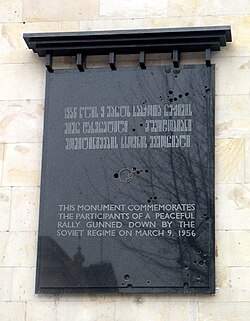
1956 Georgian demonstrations

The March 1956 demonstrations (also known as the 1956 Tbilisi riots or 9 March massacre) in the Georgian SSR were a series of protests against Nikita Khrushchev's de-Stalinization policy, which shocked Georgian supporters of Stalinist ideology. The center of the protests was the republic's capital, Tbilisi, where spontaneous rallies to mark the third anniversary of Stalin's death and to protest Khrushchev's denunciation of Stalin commencing on 4 March quickly evolved into an uncontrollable mass demonstration and rioting which paralyzed the city. Soon, political demands such as the change of the central government in Moscow and calls for the independence of Georgia from the Soviet Union appeared. The local Georgian authorities, confused and demoralized, passed on the responsibility to the Soviet military. Later on 9 March, the troops deployed in the city opened fire upon the students picketing the government buildings in what the official Soviet version held was "an act of self-defense". The agitated crowds continued resistance on 10 March but were eventually dispersed by tanks. Estimates of the number of casualties range from several dozens to several hundred. In spite of prompt pacification, the 1956 events marked a turning point after which Georgian loyalty to the Soviet Union was gravely compromised and the nation's consolidation intensified. In the view of the historian Ronald Grigor Suny, "the swift and brutal response from the Soviet government illustrated starkly its inability to resolve the dilemma of how much of the Soviet system to change and how much of Stalin's authoritarianism to preserve. The government's confusion in Tbilisi was a bloody sign that reform was to be limited by the party's determination to preserve its essential monopoly of power."