place

Tsar Bell

1735 worksAC with 0 elementsBroken bellsMoscow Kremlin
Tsar Bell in Kremlin

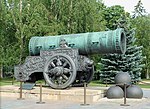
The Tsar Bell (Russian: Царь–колокол; Tsar'-kolokol), also known as the Tsarsky Kolokol, Tsar Kolokol III, or Royal Bell, is a 6.14-metre-tall (20.1 ft), 6.6-metre-diameter (22 ft) bell on display on the grounds of the Moscow Kremlin. The bell was commissioned by Empress Anna Ivanovna, niece of Peter the Great. It has never been in working order, suspended, or rung. The present bell is sometimes referred to as Kolokol III (Bell III), because it is the third generation.

Excerpt from the Wikipedia article Tsar Bell (License: CC BY-SA 3.0, Authors, Images).

Tsar Bell
площадь Васильевский Спуск, Moscow Tverskoy District

Geographical coordinates (GPS) Address Nearby Places
placeShow on map

Wikipedia: Tsar BellContinue reading on Wikipedia

Geographical coordinates (GPS)

Latitude Longitude
N 55.750833333333 ° E 37.618333333333 °
placeShow on map

Address

Московский Кремль

площадь Васильевский Спуск
109012 Moscow, Tverskoy District
Moscow, Russia
mapOpen on Google Maps

Tsar Bell in Kremlin
Share experience

Nearby Places

Moscow International Film Festival

The Moscow International Film Festival (Russian: Моско́вский междунаро́дный кинофестива́ль, translit. Moskóvskiy myezhdunaródniy kinofyestivál; abbreviated as MIFF) is a film festival first held in Moscow in 1935 and became regular since 1959. From its inception to 1959, it was held every second year in July, alternating with the Karlovy Vary festival. The festival has been held annually since 1999. In reaction to the 2022 Russian invasion of Ukraine, the FIAPF (Fédération Internationale des Associations de Producteurs de Films, translated as the International Federation of Film Producers Associations) paused the accreditation of the festival until further notice. The festival's top prize is the statue of Saint George slaying the dragon, as represented on the Coat of Arms of Moscow. Nikita Mikhalkov has been the festival's president since 2000. Over the years, the Stanislavsky Award—"I Believe. Konstantin Stanislavsky" for acting achievements was awarded to Jack Nicholson, Jeanne Moreau, Meryl Streep, Harvey Keitel, Fanny Ardant, Daniel Olbrychski, Gérard Depardieu, Oleg Yankovsky, Isabelle Huppert, Emmanuelle Beart, and Helen Mirren. In 2012, this prize was awarded to French actress Catherine Deneuve. In 2012 the jury was headed by the Brazilian director Hector Babenco. Among the members of the Jury were prominent filmmakers from different countries: the famous French director and actor Jean-Marc Barr; the Bulgarian director Javor Gardev; Adriana Chiesa di Palma, a producer from Italy; Sergei Loban from Russia. The "Perspectives" Jury was chaired by the filmmaker Marina Razbezhkina (Russia). The program director of the Festival is Kirill Razlogov.

Chudov Monastery
Chudov Monastery

The Chudov Monastery (Russian: Чу́дов монасты́рь; more formally known as Alexius’ Archangel Michael Monastery) was founded in the Moscow Kremlin in 1358 by Metropolitan Alexius of Moscow. The monastery was dedicated to the miracle (chudo in Russian) of the Archangel Michael at Chonae (feast day: September 19 [O.S. September 6]). The Monastery was closed in 1918, and dismantled in 1929. The construction of the monastery together with its katholikon (cathedral) was finished in 1365. The katholikon was replaced with a new one in 1431 and then once again in 1501–1503. It was traditionally used for baptising the royal children, including future Tsars Feodor I, Aleksey I and Peter the Great. The monastery’s hegumen (abbot) was considered the first among the hegumens of all the Russian monasteries until 1561. Alongside Simonov Monastery and Trinity-St. Sergius Lavra, the Chudov Monastery was the biggest center of the Muscovite book culture and learning. Prominent monks of the monastery, who dedicated their lives to translating and correcting ecclesiastic books, include Maximus the Greek, Yepifany Slavinetsky and Karion Istomin. Gennady, who as Archbishop of Novgorod, patronized the first complete codex of the Bible in Slavic in 1499, was hegumen of the monastery prior to his archiepiscopate. Patriarch Hermogenes was starved to death by the Poles in the monastery vaults in 1612. The Time of Troubles over, they opened the Greek-Latin School with support from Patriarch Filaret. In 1744–1833, the cloister accommodated the Moscow Ecclesiastic Consistory. As time went by, new churches were added to the monastery complex. These included the Church of St Alexius the Metropolitan and the Church of the Annunciation (both built in 1680) and the Church of Saint Andrew (1887). During the French invasion of Russia (1812), the French Marshal Louis Nicolas Davout commandeered the monastery for his own use. A painting by Vasili Vereshchagin shows Davout desecrating the cathedral, using the sanctuary itself as his office. Following the Bolshevik Revolution, the Chudov Monastery was closed down in 1918. All of its structures were dismantled in 1929, as part of the Soviet Union's ongoing policy of state atheism. On the spot of the Chudov Monastery and the nearby Ascension Convent the Soviets built the Red Commanders School. All of the monastery’s manuscripts of the 11th-18th centuries were transferred to the State Historical Museum. The relics of Metropolitan Alexius were first moved from the Church of St. Alexius (which he had built) to the Cathedral of the Dormition and then to another church in Moscow. Of the hundred or so other interments in the monastery (including Archbishop Gennady), their remains were lost and their whereabouts are still unknown.A scene in Mussorgsky's opera Boris Godunov is set at the monastery.