place

Dormition Cathedral, Moscow

15th-century Russian Orthodox church buildingsCathedrals in MoscowChurch buildings with domesChurches completed in 1479Coronation church buildings
Cultural heritage monuments of federal significance in MoscowMoscow KremlinRussian Orthodox cathedrals in RussiaRussian Orthodox churches in Moscow
Dormition Cathedral, Moscow

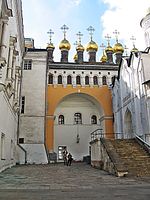
The Cathedral of the Dormition (Russian: Успенский собор, romanized: Uspensky sobor), also known as the Assumption Cathedral or Cathedral of the Assumption, is a Russian Orthodox church dedicated to the Dormition of the Theotokos. It is located on the north side of Cathedral Square of the Moscow Kremlin in Russia, where a narrow alley separates the north from the Patriarch's Palace with the Twelve Apostles Church. Separately in the southwest, also separated by a narrow passage from the church, stands the Palace of Facets. The cathedral is regarded as the mother church of Muscovite Russia. In its present form it was constructed between 1475 and 1479 at the behest of the Moscow Grand Duke Ivan III to a design by the Italian architect Aristotele Fioravanti. From 1547 to 1896 the coronation of Russian monarchs took place here. In addition, the cathedral is the burial place for most of the Moscow Metropolitans and Patriarchs of the Russian Orthodox Church; it also serves as a part of Moscow Kremlin Museums.

Excerpt from the Wikipedia article Dormition Cathedral, Moscow (License: CC BY-SA 3.0, Authors, Images).

Dormition Cathedral, Moscow
площадь Васильевский Спуск, Moscow Tverskoy District

Geographical coordinates (GPS) Address Nearby Places
placeShow on map

Wikipedia: Dormition Cathedral, MoscowContinue reading on Wikipedia

Geographical coordinates (GPS)

Latitude Longitude
N 55.751111111111 ° E 37.616944444444 °
placeShow on map

Address

Московский Кремль

площадь Васильевский Спуск
109012 Moscow, Tverskoy District
Moscow, Russia
mapOpen on Google Maps

Dormition Cathedral, Moscow
Share experience

Nearby Places

Moscow International Film Festival

The Moscow International Film Festival (Russian: Моско́вский междунаро́дный кинофестива́ль, translit. Moskóvskiy myezhdunaródniy kinofyestivál; abbreviated as MIFF) is a film festival first held in Moscow in 1935 and became regular since 1959. From its inception to 1959, it was held every second year in July, alternating with the Karlovy Vary festival. The festival has been held annually since 1999. In reaction to the 2022 Russian invasion of Ukraine, the FIAPF (Fédération Internationale des Associations de Producteurs de Films, translated as the International Federation of Film Producers Associations) paused the accreditation of the festival until further notice. The festival's top prize is the statue of Saint George slaying the dragon, as represented on the Coat of Arms of Moscow. Nikita Mikhalkov has been the festival's president since 2000. Over the years, the Stanislavsky Award—"I Believe. Konstantin Stanislavsky" for acting achievements was awarded to Jack Nicholson, Jeanne Moreau, Meryl Streep, Harvey Keitel, Fanny Ardant, Daniel Olbrychski, Gérard Depardieu, Oleg Yankovsky, Isabelle Huppert, Emmanuelle Beart, and Helen Mirren. In 2012, this prize was awarded to French actress Catherine Deneuve. In 2012 the jury was headed by the Brazilian director Hector Babenco. Among the members of the Jury were prominent filmmakers from different countries: the famous French director and actor Jean-Marc Barr; the Bulgarian director Javor Gardev; Adriana Chiesa di Palma, a producer from Italy; Sergei Loban from Russia. The "Perspectives" Jury was chaired by the filmmaker Marina Razbezhkina (Russia). The program director of the Festival is Kirill Razlogov.

Church of the Deposition of the Robe

The Church of the Deposition of the Robe (Russian: Церковь Ризоположения) is a church which stands on Cathedral Square in the Moscow Kremlin. It was begun in 1484 by masters from Pskov, most likely by the same group of architects who built the adjacent Cathedral of the Annunciation. It serves as a part of Moscow Kremlin Museums. The church was built on the site of a previous church, built by Jonah Metropolitan of Moscow in 1451. The name of the church, variously translated as the Church of the Virgin's Robe, The Church of Laying Our Lady’s Holy Robe, The Church of the Veil or simply Church of the Deposition, is said to refer to a festival dating from the 5th century AD, celebrating when the robe of the Virgin Mary was taken from Palestine to Constantinople, where it protected the city from being conquered. For example, tradition says that during the Rus'-Byzantine War of 860 the patriarch placed the Virgin's Robe into the sea, causing a storm that destroyed the invading Rus' ships. A four-level iconostasis, created by Nazary Istomin Savin in 1627, has been preserved in the church, and has frescoes painted by Ivan Borisov, Sidor Pospeev and Semyon Abramov in 1644. The church itself was built in the traditional Early Russian style, characterized by "a noticeable tendency towards more elevated proportions, the overall structure being extended by being placed on raised foundations, and the drum supporting the single dome also being raised." As with the Cathedral of the Annunciation, the intricate interior detail and ornamentation were characteristic of the Russian architecture of this period.Originally, the church served as the private chapel of the Patriarch of Moscow, but during the mid-17th century it was taken over by the Russian royal family. The church was badly damaged in a fire in 1737 (the same fire that cracked the Tsar Bell). Today, the church also houses a display of wood sculpture from the 14th to 19th century.