place

WSM (AM)

1925 establishments in TennesseeAmericana radio stationsClear-channel radio stationsCountry radio stations in the United StatesGrand Ole Opry
Radio stations established in 1925Radio stations in Nashville, TennesseeRyman Hospitality PropertiesUse American English from February 2025Use mdy dates from January 2025

WSM (650 kHz) is a commercial AM radio station, located in Nashville, Tennessee. It broadcasts a country music format (with classic country and Americana leanings, the latter of which is branded as "Route 650") and is known as the home of the Grand Ole Opry, the world's longest running radio program. The station is owned by Ryman Hospitality Properties, Inc. After nearly 40 years broadcasting from a studio within the Gaylord Opryland Resort & Convention Center, WSM moved to a showcase studio inside the former home of Roy Acuff, just outside the Grand Ole Opry House, in July 2024. Nicknamed "The Air Castle of the South", the station broadcasts with 50,000 watts around the clock from a facility in Brentwood, Tennessee. It has one of the largest daytime coverage areas in the country, providing at least grade B coverage as far southeast as Chattanooga, as far northwest as Evansville, Indiana, as far west as Jackson, Tennessee and as far south as Huntsville, Alabama. At night, WSM's clear channel signal reaches much of North America and nearby countries. WSM reaches a worldwide audience via its Internet simulcast. It is the National Primary Entry Point (PEP) for the Emergency Alert System (EAS) in Middle Tennessee and the southwestern portion of Indiana.

Excerpt from the Wikipedia article WSM (AM) (License: CC BY-SA 3.0, Authors).

WSM (AM)
Concord Road,

Geographical coordinates (GPS) Address Nearby Places
placeShow on map

Wikipedia: WSM (AM)Continue reading on Wikipedia

Geographical coordinates (GPS)

Latitude Longitude
N 35.997277777778 ° E -86.792222222222 °
placeShow on map

Address

Concord Road 8088
37027
Tennessee, United States
mapOpen on Google Maps

Share experience

Nearby Places

Nashville Basin

The Nashville Basin, also known as the Central Basin, is a term often used to describe the area surrounding Murfreesboro, Tennessee, in which Nashville is located. The Central Basin was caused by an uplifting which produced a dome known as the Nashville Dome. The Nashville Dome is evidenced by the underlying rock strata that all dip downward away from Nashville. The uplifting of the Nashville Dome fractured overlying strata, making it more easily eroded, and thus the "dome" resulted in a "basin". Uplifted strata in the center of a geological dome have higher potential erosive energy than the surrounding strata, because they are physically higher. Erosion thus acts on the uplifted area at a greater rate than on the surrounding flat-lying area, creating a low area, i.e., a basin. This area is more correctly referred to as the "Central Dome" of Tennessee. Nashville is located in the northwestern portion of the Central Basin. The basin extends for approximately forty-five to sixty miles to the east of Nashville and about eighty miles to the south, near the Tennessee–Alabama state line. Travelers leaving Nashville in a northerly or easterly direction will soon begin the climb up the escarpment that marks the bordering geographic/geologic province, the Highland Rim and further eastwards, the Cumberland Plateau. The southern edge of the Highland Rim is more distant and somewhat less pronounced. The only downhill routes leaving the area follow the course of the Cumberland River as it flows northwest toward Ashland City and Clarksville, Tennessee. The Central Basin is underlain primarily by limestone from the Ordovician Period. The Nashville Basin and a similar but smaller area surrounding Lexington, Kentucky referred to as the "Kentucky Bluegrass" area, are the two primary areas of this sort in the world.The Inner Basin of the flattest terrain and most limestone-derived soil chemistry is located to the south and east of Nashville, primarily in the counties of Marshall, Rutherford, Wilson, and Bedford. Here also are seen the horse farms somewhat reminiscent of the Kentucky Bluegrass region. Supposedly the underlying rock weathers to a soil particularly suited to the growing of the sorts of grasses most favored by horses. Limestone glades (or cedar glades), located to the east of Nashville, primarily in Wilson and Rutherford Counties, are open areas where the flat limestone rock is denuded of overlying soil or nearly so, provide an environment for flora unlike any other in the world.

Samuel Crockett House

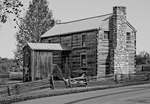
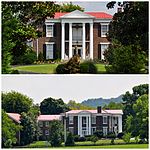
The Samuel Crockett House, also known as Forge Seat, is a property in Brentwood, Tennessee, United States, that was listed on the National Register of Historic Places in 1988. It was home of Samuel Crockett, son of Andrew Crockett, whose home is also NRHP-listed as Andrew Crockett House. When listed the property included five contributing buildings, one non-contributing building, and one non-contributing structure, on an area of 18.5 acres (7.5 ha). Andrew Crocket, Samuel's father, received a 640-acre (260 ha) grant for Revolutionary War services. He built his first log home on the southeast side of what is now Brentwood in 1799. His son, Samuel Crockett built a two-story brick home nearby, which was completed ca. 1808. The home became known as "Forge Seat" because of the iron forge located on the property. Samuel Crockett and his son, Andrew, made iron implements here and specialized in rifle making. Crockett's rifles "were identified by their fine craftsmanship and the initials 'S. & A. C.' engraved on the barrels." On his way to New Orleans and the War of 1812, Andrew Jackson stopped here and purchased rifles to arm his soldiers. It is also said that Davy Crockett stopped on his way to Texas as well.Samuel and Andrew Crockett and other family members are buried in the cemetery nearby.The log building containing the forge and the seat of the stone forge itself still remain. There has been no other early blacksmith or forge site found in the county.