place

Strand Theatre (Shreveport, Louisiana)

Buildings and structures in Shreveport, LouisianaCulture of Shreveport, LouisianaEmile Weil buildingsIndividually listed contributing properties to historic districts on the National RegisterIndividually listed contributing properties to historic districts on the National Register in Louisiana
Louisiana Registered Historic Place stubsNational Register of Historic Places in Caddo Parish, LouisianaTheatres on the National Register of Historic Places in LouisianaUnited States theater (structure) stubsUse mdy dates from August 2023Wikipedia page with obscure subdivision
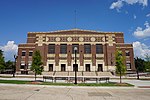
Strand Theater Louisiana Street side IMG 1587

The Strand Theatre in Shreveport, Louisiana, United States, opened in 1925 as a Vaudeville venue and was nicknamed "The greatest theatre of the South" and the "Million Dollar Theatre" by its builders, Julian and Abraham Saenger of Shreveport, owners of the Saenger Amusements Company, which operated theaters throughout the American South and in Central America. By the 1940s it had evolved into a movie cinema, which it remained until its closure in 1977. Threatened with demolition, it was saved by a coalition of concerned citizens who restored it to its original grandeur over a nearly seven-year period. It is the "Official State Theatre of Louisiana". Since its re-opening in 1984 following restoration it has served as a performing arts venue, featuring the Shreveport Broadway Series and other traveling Off-Broadway shows. In 1977, the theatre was placed on the National Register of Historic Places. It also became a contributing property of Shreveport Commercial Historic District when its boundaries were increased on May 16, 1997.

Excerpt from the Wikipedia article Strand Theatre (Shreveport, Louisiana) (License: CC BY-SA 3.0, Authors, Images).

Strand Theatre (Shreveport, Louisiana)
Crockett Street, Shreveport

Geographical coordinates (GPS) Address Nearby Places
placeShow on map

Wikipedia: Strand Theatre (Shreveport, Louisiana)Continue reading on Wikipedia

Geographical coordinates (GPS)

Latitude Longitude
N 32.51022 ° E -93.74992 °
placeShow on map

Address

Crockett Street 602
71101 Shreveport
Louisiana, United States
mapOpen on Google Maps

Strand Theater Louisiana Street side IMG 1587
Share experience

Nearby Places

Scottish Rite Cathedral (Shreveport, Louisiana)

The Scottish Rite Cathedral is a historic building located at 725 Cotton Street in Shreveport, Louisiana. It was designed in 1915 by architect Edward F. Neild in Beaux Arts style. The building was listed on the National Register of Historic Places in 1986. It also became a contributing property of Shreveport Commercial Historic District when its boundaries were increased on May 16, 1997.The Cathedral was completed on July 1, 1917. The grand opening ceremony was held on Monday, November 12, 1917, amid great fanfare and local interest. As part of the dedication ceremonies, the masons and their wives were treated to two organ recitals, one at 3:30 PM and the other at 8:00 PM. The guest organist was John Allen Richardson, organist and choirmaster of the St. Paul's Episcopal Church of Chicago, Illinois. Following the second recital, a dance was held with music provided by the Shriner's El Karubah Band and Orchestra. Edward F. Neild, a member of the Shreveport Scottish Rite, was the architect of the Scottish Rite Cathedral. Among Mr. Neild's many other notable achievements were his architectural contributions to the renovation of our nation's capital in Washington D.C, the White House, and the Truman Memorial Library and Museum in Independence, Missouri. In addition, he is credited with the design of the Shriner's Hospital for Crippled Children, also in Shreveport and the first of its kind in North America. The building measures 133'1" by 110'5" and the final cost to construct the building in 1917 was $186,477.28. The Shreveport Scottish Rite Cathedral is one of the most historic and beautiful buildings in the Shreveport area. It includes a three level auditorium with a seating capacity of five hundred, a wardrobe room, a marble lobby, a pair of matching marble staircases, a kitchen, a banquet hall, a masonic library, numerous offices, a DeMolay room, a basement, and a section where children receive help through a Speech and Language Clinic Charity.

St. Mark's Episcopal Church (Shreveport, Louisiana)

The Church of the Holy Cross (Episcopal), which housed St. Mark's until 1954, is a historic church at 875 Cotton Street in Shreveport, Louisiana, United States. The first services of the Episcopal church in Shreveport were celebrated by the Rt. Rev. Leonidas Polk, the Bishop of Louisiana in March 1839. That liturgy is considered the founding day of St. Mark's Church. Prior to this church building, the church was located on Fannin Street. St. Mark's moved into a new church building at Fairfield Avenue and Rutherford Street in 1954. That church became the cathedral of the Diocese of Western Louisiana on July 7, 1990.Holy Cross was formed because a group of Episcopalians from St. Mark's felt that the Church should maintain a presence in the inner city. It owns and operates a number of ministries around Shreveport, but most notably it runs Holy Cross Hope House. Hope House is a day shelter down the street for homeless people.Holy Cross is also known for its progressive attitude toward social issues. It is one of the few churches in North Louisiana that will marry gay couples. It is also known for its traditional worship style. It had an E.M. Skinner organ built in 1920, another large Aeolian-Skinner organ was ordered in 1956.The current rector is the Reverend Garrett Boyte, M.Div. Holy Cross has been served by the Reverend Mary Richard (2008-2019), and the Reverend Kenneth W. Paul (1968-2008). The church was added to the National Register of Historic Places in 1991. It also became a contributing property of Shreveport Commercial Historic District when its boundaries were increased on May 16, 1997.