place

Omar Ali Saifuddien Mosque

1958 establishments in BruneiBuildings and structures in Bandar Seri BegawanEngvarB from October 2021Mosques completed in 1958Mosques in Brunei
Omar Ali Saifuddien Mosque

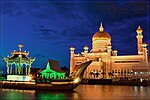
Omar Ali Saifuddien Mosque (Malay: Masjid Omar Ali Saifuddien, Jawi: مسجد عمر علي سيف الدين) is a mosque in Bandar Seri Begawan, the capital of Brunei. It is one of the country's two masjid negara or national mosques (the other Jame' Asr Hassanil Bolkiah Mosque), as well as a national landmark. It is one of the largest and oldest mosques in the country and is named after Omar Ali Saifuddien III (1914–1986), the 28th Sultan of Brunei and the father of the current monarch Sultan Hassanal Bolkiah. The mosque serves as a symbol of the Islamic faith in Brunei.

Excerpt from the Wikipedia article Omar Ali Saifuddien Mosque (License: CC BY-SA 3.0, Authors, Images).

Omar Ali Saifuddien Mosque
Jalan Masjid Omar Ali Saifuddien, Bandar Seri Begawan City Centre

Geographical coordinates (GPS) Address External links Nearby Places
placeShow on map

Wikipedia: Omar Ali Saifuddien MosqueContinue reading on Wikipedia

Geographical coordinates (GPS)

Latitude Longitude
N 4.8894 ° E 114.9392 °
placeShow on map

Address

Masjid Omar 'Ali Saifuddien

Jalan Masjid Omar Ali Saifuddien
BS8711 Bandar Seri Begawan, City Centre
Brunei
mapOpen on Google Maps

linkWikiData (Q842921)
linkOpenStreetMap (45840473)

Omar Ali Saifuddien Mosque
Share experience

Nearby Places

Bandar Seri Begawan
Bandar Seri Begawan

Bandar Seri Begawan (BSB; Jawi: بندر سري بڬاوان; Malay: [ˌbandar səˌri bəˈɡawan] ) is the capital and largest city of Brunei. It is officially a municipal area (kawasan bandaran) with an area of 100.36 square kilometres (38.75 sq mi) and an estimated population of 100,700 as of 2007. It is part of Brunei-Muara District, the smallest yet most populous district which is home to over 70 per cent of the country's population. It is the country's largest urban centre and nominally the country's only city. The capital is home to Brunei's seat of government, as well as a commercial and cultural centre. It was formerly known as Brunei Town until it was renamed in 1970 in honour of Sultan Omar Ali Saifuddien III, the 28th Sultan of Brunei and the father of the current Sultan Hassanal Bolkiah. The history of Bandar Seri Begawan can be traced back to the establishment of a Malay stilt settlement on the waters of the Brunei River which became the predecessor of Kampong Ayer today. It became the capital of the Bruneian Sultanate from the 16th century onwards, as well as in the 19th century when it became a British protectorate. The establishment of a British Residency in the 20th century saw the establishment of modern-day administration on land, as well as the gradual resettlement of the riverine dwellers to the land. During World War II, the capital was occupied by the Japanese forces from 1941 and bombed in 1945 upon liberation by Allied forces. Brunei's independence from the British was declared on 1 January 1984 on a square in the city centre. Bandar Seri Begawan is home to Istana Nurul Iman, the largest residential palace in the world by the Guinness World Records, and Omar Ali Saifuddien Mosque, Brunei's iconic landmark. It is also home to Kampong Ayer, the largest 'water village' in the world and nicknamed Venice of the East. It was once the host city of the 20th Southeast Asian Games in 1999 and 8th APEC Summit in 2000.