place

Eternal Flame (Bangladesh)

Architecture in BangladeshMartyrs' monuments and memorialsMemorials to Bangladesh Liberation WarModernist architectureMonuments and memorials in Dhaka
National symbols of Bangladesh
The Universal Flame
The Universal Flame

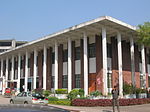
The Eternal Flame also known as Shikha Chironton (Bengali: শিখা চিরন্তন) is a historical landmarks of Bangladesh. The flame was created to keep alive the memory of the martyrs who lost their lives in the Liberation War of Bangladesh and the defeat of the Pakistani Forces. It was jointly opened on March 26, 1997, on the occasion of Bangladesh independence day by then Prime minister of Bangladesh Sheikh Hasina, the President of South Africa Nelson Mandela, the President of Palestine Yasir Arafat and the President of Turkiye Süleyman Demirel.

Excerpt from the Wikipedia article Eternal Flame (Bangladesh) (License: CC BY-SA 3.0, Authors, Images).

Eternal Flame (Bangladesh)
Kazi Nazrul Islam Avenue, Dhaka Shahbag

Geographical coordinates (GPS) Address Nearby Places
placeShow on map

Wikipedia: Eternal Flame (Bangladesh)Continue reading on Wikipedia

Geographical coordinates (GPS)

Latitude Longitude
N 23.7349 ° E 90.3961 °
placeShow on map

Address

সোহরাওয়ার্দী উদ্যান

Kazi Nazrul Islam Avenue
1000 Dhaka, Shahbag
Dhaka Division, Bangladesh
mapOpen on Google Maps

The Universal Flame
The Universal Flame
Share experience

Nearby Places

Kazi Nazrul Islam
Kazi Nazrul Islam

Kazi Nazrul Islam (Bengali: কাজী নজরুল ইসলাম, pronounced [kad͡ʒi ˈnod͡ʒɾul islam] ; 24 May 1899 – 29 August 1976) was a Bengali poet, writer, journalist, and musician. He is the national poet of Bangladesh. Nazrul produced a large body of poetry, music, messages, novels, and stories with themes that included equality, justice, anti-imperialism, humanity, rebellion against oppression and religious devotion. Nazrul Islam's activism for political and social justice as well as writing a poem titled as "Bidrohī", meaning "the rebel" in Bengali, earned him the title of "Bidrohī Kôbi" (Rebel Poet). His compositions form the avant-garde music genre of Nazrul Gīti (Music of Nazrul). Born into a Bengali Muslim Kazi family hailing from Burdwan district in Bengal Presidency (now in West Bengal, India), Nazrul Islam received religious education and as a young man worked as a muezzin at a local mosque. He learned about poetry, drama, and literature while working with the rural theatrical group Leṭor Dôl, Leṭo being a folk song genre of West Bengal usually performed by the people from Muslim community of the region. He joined the British Indian Army in 1917 and was posted in Karachi. Nazrul Islam established himself as a journalist in Calcutta after the war ended. He criticised the British Raj and called for revolution through his famous poetic works, such as "Bidrohī" ('The Rebel') and "Bhangar Gan" ('The Song of Destruction'), as well as in his publication Dhūmketu ('The Comet'). His nationalist activism in Indian independence movement led to his frequent imprisonment by the colonial British authorities. While in prison, Nazrul Islam wrote the "Rajbôndīr Jôbanbôndī" ('Deposition of a Political Prisoner'). His writings greatly inspired Bengalis of East Pakistan during the Bangladesh Liberation War. Nazrul Islam's writings explored themes such as freedom, humanity, love, and revolution. He opposed all forms of bigotry and fundamentalism, including religious, caste-based and gender-based. Nazrul wrote short stories, novels, and essays but is best known for his songs and poems. He introduced the ghazal songs in the Bengali language and is also known for his extensive use of Arabic and Persian influenced Bengali words in his works. Nazrul Islam wrote and composed music for nearly 4,000 songs (many recorded on HMV gramophone records), collectively known as Nazrul Gīti. In 1942 at the age of 43, he began to be affected by an unknown disease, losing his voice and memory. A medical team in Vienna diagnosed the disease as Pick's disease, a rare incurable neurodegenerative disease. It caused Nazrul Islam's health to decline steadily and forced him to live in isolation. He was also admitted in Ranchi (Jharkhand) psychiatric hospital for many years. At the invitation of the Government of Bangladesh, Nazrul Islam's family took him to Bangladesh and moved to Dhaka in 1972. He died on 29 August 1976.

Israt Manzil Palace
Israt Manzil Palace

Israt Manzil was one of the royal residences of the Nawabs of Dhaka. The mansion served as a retreat for members of the Dhaka Nawab Family.Israt Manzil is best known for hosting the opening session of the All India Muhammadan Educational Conference in 1906. The conference, sponsored by Nawab Sir Khwaja Salimullah, the Nawab of Dhaka, established the All India Muslim League, the first Muslim political party of the Indian Subcontinent. The party, which became the prime platform for Indian Muslims and led to the creation of Pakistan, was formed against the backdrop of political agitation by the Indian National Congress against the 1905 Partition of Bengal. During the durbar at Israt Manzil palace, delegates debated the new name to be given to the political party. A party styled as All India Muslim Confederacy was discussed. But, in the process the name All India Muslim League, proposed by Nawab Sir Khwaja Salimullah Bahadur and seconded by Hakim Ajmal Khan, was resolved in the meeting. In 1912, a delegation led by Baron Hardinge of Penshurst, the Viceroy of India, met with Nawab Sir Khwaja Salimullah. During the meeting, Sir Salimullah demanded the establishment of a university for the mainly Muslim people of eastern Bengal. The demands would be realised with the establishment of the University of Dhaka in 1921. The present day Madhur Canteen, situated in the northeastern part of the Arts Faculty compound of Dhaka University was the Jalsaghar of this garden-house. The floor and the spacious surrounding area of the building were covered with marbles. The building was also called 'Skating Pavilion' since members of the Nawab family used to skate there.