place

Lady Knox Geyser

Geysers of New ZealandLandforms of WaikatoOkataina Volcanic CentreTourist attractions in WaikatoUse New Zealand English from July 2024
Waikato geography stubs
Lady Knox Geyser
Lady Knox Geyser

The Lady Knox Geyser is a geyser in the Waiotapu area of the Taupō Volcanic Zone in New Zealand. It is named after Lady Constance Knox, the second daughter of Uchter Knox, 15th Governor of New Zealand. The geyser is induced to erupt daily at 10:15 am by dropping a surfactant into the opening of the vent. Eruptions produce a jet of water reaching up to 20m and can last for over an hour, depending on the weather. The visible spout is made of rocks placed around the base of the spring to enhance the eruption; over the years silica from the eruptions has built up to give a white cone-shaped appearance. Because the geyser was discovered early in the 20th century, it has no Māori name, unlike almost every other thermal feature in New Zealand.

Excerpt from the Wikipedia article Lady Knox Geyser (License: CC BY-SA 3.0, Authors, Images).

Lady Knox Geyser
Waiotapu Loop Road,

Geographical coordinates (GPS) Address External links Nearby Places
placeShow on map

Wikipedia: Lady Knox GeyserContinue reading on Wikipedia

Geographical coordinates (GPS)

Latitude Longitude
N -38.350833333333 ° E 176.37694444444 °
placeShow on map

Address

Lady Knox Geyser

Waiotapu Loop Road

Waikato, New Zealand
mapOpen on Google Maps

linkWikiData (Q6470306)
linkOpenStreetMap (1563538653)

Lady Knox Geyser
Lady Knox Geyser
Share experience

Nearby Places

Frying Pan Lake
Frying Pan Lake

Frying Pan Lake (renamed Waimangu Cauldron in 1963 though not widely used) is the world's largest hot spring. It is located in the Echo Crater of the Waimangu Volcanic Rift Valley, New Zealand and its acidic water maintains a temperature of about 50 to 60 °C (122–140 °F). The Lake covers 38,000 square metres (9.4 acres) in part of the volcanic crater and the shallow lake is only 5.5 metres (18 ft) deep, but at vents, it can go down to 18.3 metres (60 ft). Echo Crater was formed as part of the 1886 Mount Tarawera eruption, which opened several craters along a 17-kilometre (11 mi) rift stretching southwest from Mount Tarawera to the nearby Southern Crater. After this event, the crater's floor partly filled with rainwater and heated groundwater, but it was not until after a large eruption in Echo Crater on 1 April 1917 that the resulting larger crater filled up from hot springs to reach its current size by mid 1918. The most recent eruption in Echo Crater occurred on 22 February 1973, destroying the Trinity Terrace area on the south-eastern shore of Frying Pan Lake. An area of colourful sinter terraces is still visible on the western shore of the lake. To the north, the lake is bounded by the steaming Cathedral Rocks. This monolithic rock structure is composed of rhyolitic lava at least 60,000 years old and was named Gibraltar Rock until the 1917 Echo Crater eruption completely changed its shape. A fumarole known as the Devil's Blowhole in the northern wall of Echo Crater also disappeared in that event. The water of Frying Pan Lake is typically steaming and can appear to be boiling, due to carbon dioxide and hydrogen sulphide gas bubbling to the surface, but the lake's average temperature is 55 °C (131 °F). The lake and its outflow, Waimangu Stream (referred to as Hot Water Creek in the Waimangu Wanderer Guide), have an average pH level of 3.8, even though some of the boiling hot springs and vents on the lake's bed feed it with alkaline water of pH 8.2 to 8.7. This leads to various gradients of pH levels, which govern which types of algae are present, the blue-green algae Mastigocladus laminosus, or the eukaryotic algae Cyanidium caldarium. The unique cyclic nature of the hydrothermal system interconnecting Frying Pan Lake and the nearby Inferno Crater Lake has been the subject of studies since monitoring equipment was installed in 1970 at the outflow stream from Frying Pan Lake and at Inferno Crater Lake. Both lakes' water levels and overflow volumes follow a complicated rhythm that repeats itself roughly every 38 days. When the water level and temperature of Inferno Crater Lake increase, the water level and outflow of Frying Pan Lake decrease. The outflow volume of Frying Pan Lake has decreased from over 122 litres per second (4.3 cubic feet per second) in 1970 to around 100 L/s (3.5 cu ft/s) in 2014, but varies by up to 20 L/s (0.7 cu ft/s) as part of the 38-day cycle. Frying Pan Lake is one of the first major attractions encountered along the main Waimangu walking track. The site of the extinct Waimangu Geyser is located not far from its north-eastern shore.

Waimangu Geyser
Waimangu Geyser

The Waimangu Geyser, located near Rotorua in New Zealand, was for a time the most powerful geyser in the world. The geyser was seen erupting in late 1900. Its eruptions were observed reaching up to 1,500 feet (460 m) in height, and it excited worldwide interest. Day trip visitors from Rotorua were keen to see the geyser erupting regularly for 5–6 hours out of a cycle of about 36 hours, and a tourist trip called the "Round Trip" ran from the summer of 1902/1903. The geyser was the catalyst for tourism to the Waimangu Valley. Its workings were apparently created by the great 1886 Mount Tarawera eruption. The water expelled by the geyser was black with rocks and mud from the surrounding terrain, so the indigenous Māori people named the geyser Waimangu, meaning 'Black Waters'. The geyser gave its name to the surrounding geothermal region, the Waimangu Volcanic Rift Valley. Joseph Perry of the Limelight Department of the Salvation Army filmed the Waimangu Geyser in action. In August 1903, tourist guide Alfred Warbrick measured the depth of the 260-by-430-foot (80 m × 130 m) geyser lake at only 48 feet (15 m) when he launched a rowboat on the lake as a result of a dare. The lake's shallow depth was attributed to much of the ejected solid material falling back into the vent each time. On 30 August 1903, New Zealand rugby international Joe Warbrick, David McNaughton, and sisters Ruby and Catherine Nicholls were killed after venturing close to the edge of the geyser, having ignored requests from Warbrick's brother Alfred to return to a safe distance. The four were scalded and then swept away in a sudden violent eruption. In mid-1904, the geyser became dormant for several weeks and subsequent eruptions were shorter and weaker until they stopped on 1 November 1904. This coincided with a landslide that changed the water table of Lake Tarawera by several metres. While it was hypothesized that this was the cause for the extinction of the geyser, later studies found no apparent physical connection between these two events. The geyser became extinct in 1908. Afterwards, hydrothermal activity in the nearby Echo Crater increased, leading to eruptions in the crater in 1915, 1917, and 1924.

Waimangu Volcanic Rift Valley

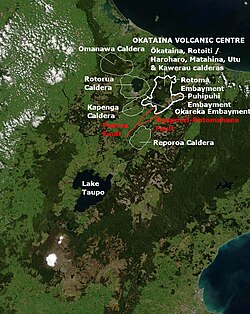
The Waimangu Volcanic Rift Valley is the hydrothermal system created on 10 June 1886 by the volcanic eruption of Mount Tarawera, on the North Island of New Zealand. It encompasses Lake Rotomahana, the site of the Pink and White Terraces, as well as the location of the Waimangu Geyser, which was active from 1900 to 1904. The area has been increasingly accessible as a tourist attraction and contains Frying Pan Lake, which is the largest hot spring in the world, and the steaming and usually pale blue Inferno Crater Lake, the largest geyser-like feature in the world although the geyser itself cannot be seen since it plays at the bottom of the lake. Waimangu is a Māori-language word meaning "black water". This name comes from the water that was thrown up by the Waimangu Geyser, which was black with mud and rocks. From the 1890s onwards, the valley has gradually been re-populated naturally by plants ranging from hot water-loving algae and bacteria to mosses and many species of native ferns, shrubs and trees. These in turn support native birdlife including kererū, tūī, shining cuckoo, fantail, bellbird, and pūkeko, as well as introduced bird species such as mynah, magpie, finch and sparrow. A population of black swan thrives in the lower parts of the valley and on Lake Rotomahana. According to local guides, these have been introduced to the region from Western Australia by George Edward Grey in the 19th century along with wallaby. As a rare eco-system completely naturally re-established following a volcanic eruption, Waimangu is protected as a Scenic Reserve, administered by the Department of Conservation NZ. The developing local native forest is the only current New Zealand instance of vegetation re-establishing from complete devastation without any human influence such as planting. Many of Waimangu's geothermal features are ranked as Category A – extremely important, of international significance.

Inferno Crater Lake
Inferno Crater Lake

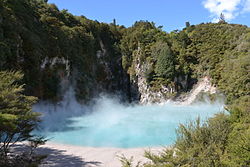
Inferno Crater Lake is a large hot spring located in the Waimangu Volcanic Rift Valley on the North Island of New Zealand, and the largest geyser-like feature in the world. The actual geyser is not visible, as it plays underwater at the bottom of the lake. However, fumaroles are visible on the lake's shore and the rock wall behind it. The water temperature in the lake shifts from 35 to 80 °C (95 to 176 °F) every six weeks, with acidity up to pH 2.2, and lake levels that vary up to 12 metres (39 ft), following a complicated 38-day cycle that includes an overflow stage. White silica deposits grow up to the overflow level, and the lake's colour is a result of finely divided silica suspended in the water. At low water levels the lake can be a dull grey colour, changing to an intensely sky blue colour at higher lake levels, in particular after the overflow stage. Inferno Crater was blasted out of the side of the locally prominent Mt Haszard as part of the 1886 Mount Tarawera eruption, which opened several craters along a 17-kilometre (11 mi) rift stretching southwest from Mount Tarawera to the nearby Southern Crater. Inferno Crater's trumpet-shaped lake bed is up to 30 metres (98 ft) deep when the lake is full, which is also when it reaches its highest temperature. Since 1901 the lake occupying Inferno Crater has exhibited water-level variations closely associated with the Waimangu Geyser cycle. Inferno Crater Lake and its neighbouring Frying Pan Lake form a unique relationship and follow an interconnected rhythmic cycle of hydrology variations repeating itself over the course of roughly 38 days. When the water level and temperature of Inferno Crater Lake increase, the water level and outflow of Frying Pan Lake decrease. Comparable cyclic activity is unknown in other hydrothermal systems in the world. The system has been the subject of studies since monitoring equipment was installed in the area in 1970. Four distinct phases can be recognised in its cycle: First, the lake level rises steadily from its lowest level by a total of almost five metres (16 ft) over the course of eight days, and then it commences oscillating. The average lake level keeps rising over the course of the oscillations of the second phase until it reaches overflow level. At that point, the lake's volume has increased by 45,800 cubic metres (45.8 million litres; 12.1 million US gallons). Next, the lake overflows for about 51 hours at a rate of almost 80 litres per second (0.080 m3/s; 21 US gal/s), discharging on average 140,000 cubic metres (140 million litres; 37 million US gallons) of over 70 °C (158 °F) hot water down a temporary overflow stream into Waimangu Stream in the valley below. The last stage sees the lake recede to its low level over the last 13 days of the cycle, its water temperature also falling to the low point. During that stage, around 30 million litres (30 thousand cubic metres; 7.9 million US gallons) of water drain back under Mt Haszard. Inferno Crater Lake is accessible via a side track with 50 steps off the main Waimangu walking track. It is one of three lakes filling craters created in the vicinity during the 1886 event.