place

Royal Theatre (Thessaloniki)

1940 establishments in GreeceBuildings and structures in ThessalonikiTheatres completed in 1940Theatres in Thessaloniki
20160516 404 thessaloniki

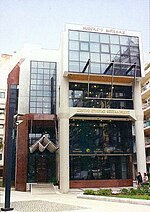
The Royal Theatre of Thessaloniki (Greek:Βασιλικό Θέατρο Θεσσαλονίκης) is the seat of the National Theatre of Northern Greece and one of the institution’s winter stages. It is located at 2, 30 October Avenue in White Tower Square in Thessaloniki and has a capacity of 683 seats.

Excerpt from the Wikipedia article Royal Theatre (Thessaloniki) (License: CC BY-SA 3.0, Authors, Images).

Royal Theatre (Thessaloniki)
30ής Οκτωβρίου, Thessaloniki Μητροπολιτική Περιοχή Θεσσαλονίκης

Geographical coordinates (GPS) Address Phone number Website External links Nearby Places
placeShow on map

Wikipedia: Royal Theatre (Thessaloniki)Continue reading on Wikipedia

Geographical coordinates (GPS)

Latitude Longitude
N 40.6251 ° E 22.9494 °
placeShow on map

Address

Βασιλικό Θέατρο

30ής Οκτωβρίου 2
540 13 Thessaloniki, Μητροπολιτική Περιοχή Θεσσαλονίκης
Macedonia and Thrace, Greece
mapOpen on Google Maps

Phone number
Κρατικό Θέατρο Βορείου Ελλάδος

call+302315200200

Website
ntng.gr

linkVisit website

linkWikiData (Q20970646)
linkOpenStreetMap (19855083)

20160516 404 thessaloniki
Share experience

Nearby Places

National Theatre of Northern Greece

The National (or State) Theatre of Northern Greece (Κρατικό Θέατρο Βορείου Ελλάδος), an institution promoting theatrical plays in Thessaloniki and northern Greece, was founded in 1961 by Sokratis Karantinos, its first director. The Drama School and the Dance Theatre are integral parts of the National Theatre.The first base of the institution was the building of the Royal Theatre (Thessaloniki) but in 1962 was transferred to the current building. The complex of the Society of Macedonian Studies consists of three buildings. Megaron B', which hosts the theatre, was designed in early 1950s by Vasilis Kassandras, influenced by the Théâtre des Champs-Élysées. NTNG’s present institutional framework was established in 1994, with an Artistic Director and a seven-member Board of Directors who run the Theatre, which is subsidized by the Ministry of Culture and Tourism (Greece). With four indoor theatres and two open-air theatres, NTNG is one of the biggest theatre organizations in Greece and Europe. Since May 1996, NTNG has been a member of the Union of the Theatres of Europe (https://www.union-theatres-europe.eu). In October 1997, the 6th Festival of the Union of the Theatres of Europe took place in Thessaloniki, and was a great cultural event for Thessaloniki as well as for Greece. NTNG is also a member of the International Theatre Institute and the Greek Theatre Centre for children and young people.

Thessaloniki History Centre

The Thessaloniki History Centre was established by the Municipal Council of Thessaloniki, the largest city in northern Greece, in 1983, and has occupied its present premises (the gift of Anastasios and Ioulia Billis) in Ippodromiou Square since 1995. The purpose of the centre is to collect, rescue, record, and preserve printed, written, and audio-visual material relating to the history of the city and wider area of Thessaloniki. It also promotes and facilitates historical research relating to Thessaloniki and seeks to rouse the interest of foreigners in the modern city and its historical past. It is governed by an Advisory Committee made up of distinguished scholars. The centre has preserved the Municipal Archive and is classifying it, and has also acquired a number of private archives by gift or purchase. It has built up a history library, comprising 4,000 books, 3,000 photographs, 5,000 postcards, posters, videocassettes, and historical maps. It publishes its research work with periodic exhibitions illustrating the historical continuity of Thessaloniki and the wider area of Macedonia, organizes conferences and lecture series, and hosts events organized by other institutions with related interests. The History Centre also produces a scholarly journal titled Thessaloniki, containing original scholarly articles, and books on Thessaloniki and its history. The Centre intends to convert the city’s archives into electronic form to make them more accessible to researchers, and to link up to the Internet so that information and knowledge about the history of Thessaloniki will be accessible to a wider public.