place

Rodriguez Key

Hills of FloridaIslands of FloridaIslands of Monroe County, FloridaIslands of the Florida KeysMonroe County, Florida geography stubs
Rodriguez Key 20230713

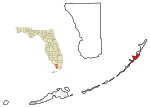
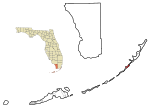
Rodriguez Key is an uninhabited island in the upper Florida Keys. It is located east of Key Largo. The island is covered by mangrove forests, including the species Rhizophora mangle, Avicennia nitida, and Laguncularia racemosa.

Excerpt from the Wikipedia article Rodriguez Key (License: CC BY-SA 3.0, Authors, Images).

Geographical coordinates (GPS)

Latitude Longitude
N 25.051111111111 ° E -80.453888888889 °
placeShow on map

Address

Monroe County (Monroe)


Florida, United States
mapOpen on Google Maps

Rodriguez Key 20230713
Share experience

Nearby Places

Key Largo
Key Largo

Key Largo (Spanish: Cayo Largo) is an island in the upper Florida Keys archipelago and is the largest section of the keys, at 33 miles (53 km) long. It is one of the northernmost of the Florida Keys in Monroe County, and the northernmost of the keys connected by U.S. Highway 1 (the Overseas Highway). Three census-designated places are on the island of Key Largo: North Key Largo, near the Card Sound Bridge, Key Largo, eight to nine miles from the southern end of the island, and Tavernier, at the southern end of the island. As of 2010, the three places have a combined population of 13,850. None of Key Largo is an incorporated municipality, so it is governed at the local level by Monroe County. Key Largo is connected to the mainland in Miami-Dade County by two routes. The first route is the Overseas Highway, the southernmost portion of U.S. Highway 1, which enters Key Largo at Jewfish Creek near the middle of the island and turns southwest. The second route is Card Sound Road, which connects to the northern part of Key Largo at Card Sound Bridge and runs southeastward to connect with County Road 905, which runs southwest and joins U.S. 1 at about mile marker 106. These routes originate at Florida City on the mainland. Key Largo is a popular tourist destination and calls itself the "Diving Capital of the World" because the living coral reef a few miles offshore attracts thousands of scuba divers and sport-fishing enthusiasts.Key Largo's proximity to the Everglades also makes it a premier destination for kayakers and ecotourists. Automotive and highway pioneer and Miami Beach developer Carl G. Fisher built the Caribbean Club in 1938 as his last project. Key Largo is situated between Everglades National Park to the northwest and John Pennekamp Coral Reef State Park to the east, the first underwater park in the United States, which protects part of the Florida Reef, the only living coral barrier reef in the continental United States.

Florida Reef
Florida Reef

The Florida Reef (also known as the Great Florida Reef, Florida reefs, Florida Reef Tract and Florida Keys Reef Tract) is the only living coral barrier reef in the continental United States. It lies a few miles seaward of the Florida Keys, is about 4 miles (6 to 7 km) wide and extends (along the 20 meter depth contour) 270 km (170 mi) from Fowey Rocks just east of Soldier Key to just south of the Marquesas Keys. The barrier reef tract forms a great arc, concentric with the Florida Keys, with the northern end, in Biscayne National Park, oriented north-south and the western end, south of the Marquesas Keys, oriented east-west. The rest of the reef outside Biscayne National Park lies within John Pennekamp Coral Reef State Park and the Florida Keys National Marine Sanctuary. Isolated coral patch reefs occur northward from Biscayne National Park as far north as Stuart, in Martin County. Coral reefs are also found in Dry Tortugas National Park west of the Marquesas Keys. There are more than 6,000 individual reefs in the system. The reefs are 5,000 to 7,000 years old, having developed since sea levels rose following the Wisconsinan glaciation.The densest and most spectacular reefs, along with the highest water clarity, are found to the seaward of Key Largo (in and beyond John Pennekamp Coral Reef State Park) and Elliott Key (the northernmost 'true' Florida Key) where the two long keys help protect the reefs from the effects of water exchange with Florida Bay, Biscayne Bay, Card Sound and Barnes Sound. The bays and sounds (all between the Florida Keys and the mainland) tend to have lower salinity, higher turbidity and wider temperature variations than the water in the open ocean. Channels between the Keys allow brackish water from the bays to flow onto the reefs (especially in the middle Keys), limiting their growth.