place

Old University of Alabama Observatory

Astronomical observatories in AlabamaGreek Revival architecture in AlabamaHistoric American Buildings Survey in AlabamaInfrastructure completed in 1844National Register of Historic Places in Tuscaloosa County, Alabama
University of Alabama buildings
Old University of Alabama Observatory 02

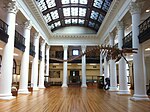
The Old University of Alabama Observatory, now known as Frederick R. Maxwell Hall, was an astronomical observatory owned and operated by the University of Alabama in Tuscaloosa, Alabama. Although no longer used as an observatory, the building has been restored and preserved. It currently houses the university's Collaborative Arts Research Initiative (CARI), an interdisciplinary, arts-focused research engine driven by the interests of faculty from across the university. By facilitating collaborations across disciplines, CARI maximizes the impact of faculty arts research, while enriching the university, local, and regional communities. Significant for its architectural and historical importance, it was added to the National Register of Historic Places on January 14, 1972.

Excerpt from the Wikipedia article Old University of Alabama Observatory (License: CC BY-SA 3.0, Authors, Images).

Old University of Alabama Observatory
4th Street, Tuscaloosa

Geographical coordinates (GPS) Address Nearby Places
placeShow on map

Wikipedia: Old University of Alabama ObservatoryContinue reading on Wikipedia

Geographical coordinates (GPS)

Latitude Longitude
N 33.21104 ° E -87.55014 °
placeShow on map

Address

4th Street
35487 Tuscaloosa
Alabama, United States
mapOpen on Google Maps

Old University of Alabama Observatory 02
Share experience

Nearby Places

University of Alabama Quad

The Quad is an approximately 22-acre (8.9 ha) quadrangle on the campus of the University of Alabama located in Tuscaloosa, Alabama. Home to most of the university's original buildings, this portion of the campus remains the geographic and historic center of the modern campus. Originally designed by noted English-born architect William Nichols, construction of the university campus began in 1828, following the move of the Alabama state capital from Cahaba to Tuscaloosa in 1826. The overall design for this early version of the campus was patterned after Thomas Jefferson's plan for the University of Virginia, with its Lawn and Rotunda. Following the destruction of the campus during the American Civil War, a new Quad emerged in the late 19th and early 20th centuries. Different in form and function from the original design of the early 19th century, the modern Quad continues to fill its role as the heart of the campus. Although surrounded by academic and administrative buildings, only five structures are built directly on the Quad: the Little Round House, Tuomey Hall, Oliver-Barnard Hall, Amelia Gayle Gorgas Library, and Denny Chimes. The remainder of the space is occupied by a grove of trees on the west side and a great lawn on the east. A feature on the northwestern side, known as The Mound, is the site of the old Franklin Hall. A popular gathering place, the Quad is home to pep rallies, a bonfire during homecoming, and numerous day-to-day student activities.

Caplewood Drive Historic District

Caplewood Drive Historic District, in Tuscaloosa, Alabama, is a residential historic district which was listed on the National Register of Historic Places in 1985. It included 37 contributing buildings out of a total of about 45 buildings, on 11 acres (4.5 ha).The district runs along the long narrow lane of Caplewood Drive, originally known as Caplewood Terrace, south to its intersection with University Boulevard in Tuscaloosa. It is between downtown Tuscaloosa and the University of Alabama campus. Specifically it includes 1418 University Blvd. and 21–27; 301–329; 400–430; 1309, 1315, 1409, 1411, 1415, 1416 Caplewood Drive.It is a set of modest bungalows and cottages built primarily during the 1920s and 1930s by local builders, using common building materials and designs which happen to achieve a kind of unity.The street was developed by J. D. Caples, Sr. (1860-1934) in 1922 along a creek and a natural ravine. Low areas were filled by dirt excavated in the construction of the NRHP-listed City National Bank, and sewers and water pipes were installed by manual labor. Caples paved the street and planted trees. Caples himself built five or six of the homes; his son-in-law B.D. Sumner built three; only one is known to be designed by an architect, being the one at #33 designed by Birmingham architect George P. Turner. It includes one or more Craftsman bungalows, as well as mission/Spanish revival and English Cottage styles.