place

Little Hall (University of Alabama)

Alabama Crimson Tide basketball venuesAlabama stubsBasketball stubsUnited States sports venue stubsUniversity of Alabama buildings

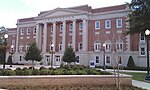
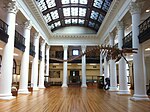
Little Hall is a historic building on the campus of the University of Alabama at Tuscaloosa, Alabama. It was built in 1915 and designed by Frank Lockwood of Montgomery as the university's first stand-alone gymnasium. The gymnasium was named for William Gray "Bill" Little (1873–1938), the student credited with introducing football to the university. It was in use by the Alabama Crimson Tide men's basketball from 1915 to 1939, when Foster Auditorium opened nearby. The gym received an expansion in 1935 (now known as Archie Wade Hall), and has been converted twice; once in the 1950s for the School of Nursing, and again in 1967 to host the School of Social Work, its current tenant.

Excerpt from the Wikipedia article Little Hall (University of Alabama) (License: CC BY-SA 3.0, Authors).

Little Hall (University of Alabama)
Judy Bonner Drive, Tuscaloosa

Geographical coordinates (GPS) Address Nearby Places
placeShow on map

Wikipedia: Little Hall (University of Alabama)Continue reading on Wikipedia

Geographical coordinates (GPS)

Latitude Longitude
N 33.208611111111 ° E -87.545555555556 °
placeShow on map

Address

Little Hall

Judy Bonner Drive 670
35487 Tuscaloosa
Alabama, United States
mapOpen on Google Maps

Share experience

Nearby Places

University of Alabama Quad

The Quad is an approximately 22-acre (8.9 ha) quadrangle on the campus of the University of Alabama located in Tuscaloosa, Alabama. Home to most of the university's original buildings, this portion of the campus remains the geographic and historic center of the modern campus. Originally designed by noted English-born architect William Nichols, construction of the university campus began in 1828, following the move of the Alabama state capital from Cahaba to Tuscaloosa in 1826. The overall design for this early version of the campus was patterned after Thomas Jefferson's plan for the University of Virginia, with its Lawn and Rotunda. Following the destruction of the campus during the American Civil War, a new Quad emerged in the late 19th and early 20th centuries. Different in form and function from the original design of the early 19th century, the modern Quad continues to fill its role as the heart of the campus. Although surrounded by academic and administrative buildings, only five structures are built directly on the Quad: the Little Round House, Tuomey Hall, Oliver-Barnard Hall, Amelia Gayle Gorgas Library, and Denny Chimes. The remainder of the space is occupied by a grove of trees on the west side and a great lawn on the east. A feature on the northwestern side, known as The Mound, is the site of the old Franklin Hall. A popular gathering place, the Quad is home to pep rallies, a bonfire during homecoming, and numerous day-to-day student activities.