place

Edwards Heights Historic District

1936 establishments in OklahomaAfrican-American segregation in the United StatesCommons link is the pagenameEthnic enclaves in the United StatesHistoric districts on the National Register of Historic Places in Oklahoma
NRHP infobox with nocatNational Register of Historic Places in Oklahoma CityNeighborhoods in Oklahoma CityRedliningUse mdy dates from January 2023

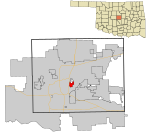
Edwards Heights Historic District is a U.S. historic district and residential neighborhood in Oklahoma City, Oklahoma. It is approximately 4 miles east of downtown Oklahoma City and is roughly bounded by NE. 16th Street, N. Page Avenue, NE. Success Street and N. Bryant Avenue, extension on NE. Grand Boulevard. The Edward Heights Historic District was developed and subdivided specifically for African-Americans; and was founded in the 1930s and 1940s, at a time of racist residential deed restrictions in Oklahoma City.It has been listed as one of the National Register of Historic Places (NRHP) since September 7, 2005.

Excerpt from the Wikipedia article Edwards Heights Historic District (License: CC BY-SA 3.0, Authors).

Edwards Heights Historic District
Northeast 19th Street, Oklahoma City

Geographical coordinates (GPS) Address Nearby Places
placeShow on map

Wikipedia: Edwards Heights Historic DistrictContinue reading on Wikipedia

Geographical coordinates (GPS)

Latitude Longitude
N 35.488333 ° E -97.464444 °
placeShow on map

Address

Northeast 19th Street 2630
73111 Oklahoma City
Oklahoma, United States
mapOpen on Google Maps

Share experience

Nearby Places

Douglass High School (Oklahoma City)

Frederick A. Douglass High School is a public high school in the city of Oklahoma City, Oklahoma. The school is known for its role in serving African-American students in the state of Oklahoma and has produced a variety of academic researchers and civic leaders as well as military figures. Frederick Douglass Moon, the longest-serving principal at the school, went on to play a major role in the desegregation movement in the middle of the 20th century. Working from 1940 to 1961 at the High School, he went on to be elected to the Oklahoma City Board of Education in 1972 and served as its first African-American president in 1974. It is also known for its music program and the teacher, Zelia Breaux, who created the program that helped produce several notable musicians. The school began as a segregated school. It is named for Frederick Douglass. The school is located at 900 North Martin Luther King Avenue. The Trojans are the school's mascot. The new school building was built in 2006. The school song is "Rise up O Douglassites!". It serves 9th to 12th grades. The school colors are black and orange.According in US News in 2018, the school has about 405 students, 97 percent are minority, college readiness is about 7 percent, and slightly less than half of students are proficient in reading and math. About a quarter take Advanced Placement (AP) exams.Students from the school protested segregation and conducted sit-ins at segregated Oklahoma City businesses.

Springlake Amusement Park

Springlake Amusement Park was an amusement park in Oklahoma City, Oklahoma. It was originally established in 1922 (some sources say 1924) by Roy Staton about six years after his spring-fed pond at NE 40th and Eastern (now Martin Luther King Blvd) had been open to swimmers and picnickers. Staton expanded the park with the addition of many rides acquired from the defunct Belle Isle Park and construction of a ballroom. In 1929 he added the Big Dipper roller coaster, which would be a fixture in the park for the next 50 years. Admission was free and the rides and pool were pay-as-you-go, so visitors could picnic by the lake at no cost until the 1960s when pay one price came into being. The park was popular throughout the 1950s and 1960s and it attracted many of the top entertainers of the era, including Johnny Cash, Jerry Lee Lewis, The Righteous Brothers, Roy Acuff, Conway Twitty and The Beach Boys. A race riot in 1971, a change in ownership to Thomas Traveling Shows, poor maintenance, a devastating fire in the arcade and in the owner's nearby home led to the park's demise. A large scale unadvertised garage sale in the spring of 1981 began the end of this popular city attraction. All of the rides, buildings, and memorabilia were offered for sale, some going as far away as Lima, Peru. What remained, huge electric motors from the merry go round and other rides, boxes of paper cups and rolls of tickets, advertising, and an assortment of old bumper cars and coaster cars were buried on site. The property was purchased in mid 1981 by the Oklahoma City Vo-Tech Board and the Metro Technology Center was constructed on the site. Of the original park structures, only the amphitheater remains; a car from the Big Dipper and many photos of the park are on display at Metro Tech.