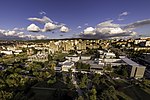
Pristina or Prishtina (UK: PREE-shtin-ə, prish-TEE-nə, US: PRISHT-in-ə) is the capital and largest city of Kosovo. It is the administrative center of the eponymous municipality and district.
In antiquity, the area of Pristina was part of the Dardanian Kingdom. The heritage of the classical era is represented by the settlement of Ulpiana. After the Roman Empire was divided into a western and an eastern half, the area remained within the Byzantine Empire between the 5th and 9th centuries. In the middle of the 9th century, it was ceded to the First Bulgarian Empire, before falling again under Byzantine occupation in the early 11th century and then in the late 11th century to the Second Bulgarian Empire. The growing Kingdom of Serbia annexed the area in the 13th century and it remained under the Serbian Empire in the 14th century up to the start of the Ottoman era (1389–1455). The next centuries would be characterized by Ottoman rule. During this period, Pristina developed from a village to a major urban center of the region. Following the end of the First Balkan War in 1914, it became a part of the newly formed Kingdom of Serbia. In 1948, it was chosen as the capital of the province SAP Kosovo under the statehood of Yugoslavia. Furthermore, Pristina would continue to serve as the capital of Kosovo after its 2008 independence from Serbia.
Pristina seems to have been a small village before the late 15th century. It is first recorded in 1342 as a village during the reign of Stefan Dušan, and about a century later in 1455 at the beginning of the Ottoman era it had a small population of 300 households. In the following century, Pristina became an important mining and trading center due to its strategic position near the rich mining town of Novo Brdo. The city was known for its trade fairs and items, such as goatskin and goat hair as well as gunpowder.
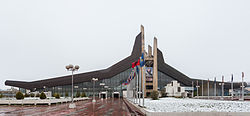
Pristina is the capital and the economic, financial, political and trade center of Kosovo, due to its location in the center of the country. It is the seat of power of the Government of Kosovo, the residences for work of the President and Prime Minister of Kosovo, and the Parliament of Kosovo. Pristina is also the most important transportation junction of Kosovo for air, rail, and roads. Pristina International Airport is the largest airport of the country and among the largest in the region. A range of expressways and motorways, such as the R 6 and R 7, radiate out the city and connect it to Albania and North Macedonia. Pristina will host the 2030 Mediterranean Games.

 Continue reading on Wikipedia