place

Sia Boey Urban Archaeological Park

Geography of PenangTourist attractions in George Town, Penang
Sia Boey, George Town, Penang

The Sia Boey Urban Archaeological Park, also colloquially known as the Sia Boey Park, is an urban archaeology park in the city of George Town in Penang, Malaysia. Located beside the Prangin Road, the Sia Boey Urban Archaeological Park was opened in 2019 as the first Urban Archaeological Park in Malaysia.The Sia Boey Urban Archaeological Park contains various recreational amenities, such as a koi fish-filled revitalised Prangin Canal, aged-old trees and a playground for the kids, all of which are open to the public. The park is maintained by the Penang Development Corporation. The cost of diverting and restoring the old canal, as well as the construction of the new canal and "archaeological" works, was RM9.1 million ringgit, while the Old Prangin Market was being restored at a cost of RM5.1 million.

Excerpt from the Wikipedia article Sia Boey Urban Archaeological Park (License: CC BY-SA 3.0, Authors, Images).

Sia Boey Urban Archaeological Park
Magazine Road, George Town

Geographical coordinates (GPS) Address Nearby Places
placeShow on map

Wikipedia: Sia Boey Urban Archaeological ParkContinue reading on Wikipedia

Geographical coordinates (GPS)

Latitude Longitude
N 5.4124 ° E 100.33352 °
placeShow on map

Address

Magazine Road
10100 George Town
Penang, Malaysia
mapOpen on Google Maps

Sia Boey, George Town, Penang
Share experience

Nearby Places

Eng Chuan Tong Tan Kongsi

Eng Chuan Tong Tan Kongsi (Chinese: 穎川堂陳公司; Pe̍h-ōe-jī: Éng-chhoan-tông Tân-kong-si) is a Hokkien clan house at Beach Street in George Town, Penang, Malaysia. It was founded in the early 19th century by a Tan family from the Fujian province of Zhangzhou in China. The building is a place of worship devoted to Kai Zhang Sheng Wang (開漳聖王; Pe̍h-ōe-jī: Khai-chiang Sèng-ông) or Tan Goan-kong (陳元光), the founder of Zhangzhou, and his two deputies, Generals Fushun and Fusheng. It was also the ancestral temple of Tan clansmen for the purposes of cultural integration. Members of the Tan family worship their ancestor, Tan Guan Kong.This Kongsi represents what locals consider to be one of the ‘Big Five' clan surnames in Penang. Founded under the name Tan Seng Ong Kongsi, it is claimed by its owners to be the oldest clan house in Penang. The clan house and its associated residences form a culturally embedded Seh Tan Court. In 1941, from the start of the Japanese Occupation, many historic relics vanished, and activities were suspended except for Chinese New Year and the Mid-Autumn Festival. In recent years, clan members have attended two annual ceremonies of ancestral worship.In the early 1900s, a Tan Si School was established, which was later renamed Eng Chuan School. It was one of several schools in Penang which taught Confucian classics as a main part of the curriculum.The main structure was erected in 1878, then renovated in the late 1940s, and again in the 1990s. The building is located at number 28 Seh Tan Court, George Town (off Beach Street).

Lebuh Aceh Mosque
Lebuh Aceh Mosque

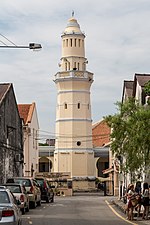
Lebuh Aceh Mosque (Acheen St Mosque) is a 19th-century mosque built by the Acehnese situated on Acheen Street, George Town, Penang, Malaysia. Next to the mosque lay the cemetery of the mosque's original benefactor, Tengku Syed Hussain Al-Aidid and members of his family. The houses surrounding the mosque today is part of the original Muslim settlement of the mid 19th century. Another interesting mosque in Georgetown area that are open to visitors is the Kapitan Keling Mosque. The Acheen Street Mosque was built in 1808 on land donated by an Achenese aristocrat, Tengku Syed Hussain Al-Aidid. It all began in 1792 when Tengku Syed Hussain opened a Muslim settlement in the area near Lebuh Acheh. Over the following years, this settlement became the centre of Islamic studies in Pulau Pinang, frequented by traders from the surrounding Malay archipelago, Arab and India. The mosque was built alongside houses, shops and a Madrasah for Quranic Studies. One of the religious figures of the time was Sheikh Omar Basheer Al-Khalilee, who was succeeded by his son Sheikh Zakaria who later was appointed as the first Mufti of Pulau Pinang and in 1888, Sheikh Yahya, his older brother, was appointed as the first Kadi of Pulau Pinang. Following the demise of Tengku Hussain in mid 19th century, the Lebuh Acheh Muslim settlement continued to thrive and was at one time referred to as the Second Jeddah, as pilgrims from nearby congregate here before departing to Mecca by sea. Each year when the Haj season began, the Lebuh Acheh area was thronged by pilgrims and their families. However, all this ended with the establishment of the Lembaga Tabung Haji in the 1970s.