place

Penang Islamic Museum

Buildings and structures in George Town, PenangIslam stubsIslamic museums in MalaysiaMalaysian museum stubsMuseums in Penang
Tourist attractions in George Town, Penang
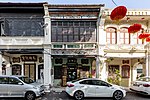
Islamic Museum Penang Dec 2006 001

The Penang Islamic Museum (Malay: Muzium Islam Pulau Pinang) is a museum about Islam in George Town, Penang, Malaysia.

Excerpt from the Wikipedia article Penang Islamic Museum (License: CC BY-SA 3.0, Authors, Images).

Penang Islamic Museum
Armenian Street, George Town

Geographical coordinates (GPS) Address Nearby Places
placeShow on map

Wikipedia: Penang Islamic MuseumContinue reading on Wikipedia

Geographical coordinates (GPS)

Latitude Longitude
N 5.4156666666667 ° E 100.33594444444 °
placeShow on map

Address

Syed Al-Attas Mansion

Armenian Street 128
10300 George Town
Penang, Malaysia
mapOpen on Google Maps

Islamic Museum Penang Dec 2006 001
Share experience

Nearby Places

Lebuh Aceh Mosque
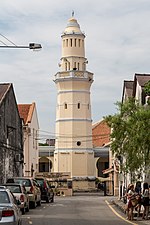
Lebuh Aceh Mosque

Lebuh Aceh Mosque (Acheen St Mosque) is a 19th-century mosque built by the Acehnese situated on Acheen Street, George Town, Penang, Malaysia. Next to the mosque lay the cemetery of the mosque's original benefactor, Tengku Syed Hussain Al-Aidid and members of his family. The houses surrounding the mosque today is part of the original Muslim settlement of the mid 19th century. Another interesting mosque in Georgetown area that are open to visitors is the Kapitan Keling Mosque. The Acheen Street Mosque was built in 1808 on land donated by an Achenese aristocrat, Tengku Syed Hussain Al-Aidid. It all began in 1792 when Tengku Syed Hussain opened a Muslim settlement in the area near Lebuh Acheh. Over the following years, this settlement became the centre of Islamic studies in Pulau Pinang, frequented by traders from the surrounding Malay archipelago, Arab and India. The mosque was built alongside houses, shops and a Madrasah for Quranic Studies. One of the religious figures of the time was Sheikh Omar Basheer Al-Khalilee, who was succeeded by his son Sheikh Zakaria who later was appointed as the first Mufti of Pulau Pinang and in 1888, Sheikh Yahya, his older brother, was appointed as the first Kadi of Pulau Pinang. Following the demise of Tengku Hussain in mid 19th century, the Lebuh Acheh Muslim settlement continued to thrive and was at one time referred to as the Second Jeddah, as pilgrims from nearby congregate here before departing to Mecca by sea. Each year when the Haj season began, the Lebuh Acheh area was thronged by pilgrims and their families. However, all this ended with the establishment of the Lembaga Tabung Haji in the 1970s.

Kapitan Keling Mosque

The Kapitan Keling Mosque (Malay: Masjid Kapitan Keling, Tamil: காப்பித்தான் கெலிங மசூதி, romanized: Kāppittāṉ Keliṅa Macūti) is a mosque built in the 19th century by Indian Muslim traders in George Town, Penang, Malaysia. It is situated on the corner of Buckingham Street (Lebuh Buckingham) and Pitt Street (Jalan Masjid Kapitan Keling). Being a prominent Islamic historic centre, it is part of the World Heritage Site of George Town and lies at the centre of the city's Tamil Muslim neighbourhood, the chulias. It is the first permanent Muslim institution to have been established in the area, dating from the early 1800s. Cauder Mohuddeen Merican is known as the founder of the mosque and leader of the Chulias. In 1801 Sir George Leith, who was then Lieutenant Governor of Penang, appointed a prominent Indian Muslim leader, Cauder Mohudeen, as Captain of the South Indian “Keling” community. He granted a piece of land to build a mosque on the south side of Malabar Street (Chulia Street). Cauder Mohudeen (born c. 1759) was a ship mandoor or foreman from Porto Novo, which the Tamils called Paringgipettai and the Muslims Mahmudbandar, about 50 kilometres south of Pondicherry in India. He was referred to as 'Kapitan Kling'."Keling" is a Malay term for people of Indian origin, nowadays considered offensive but not so considered at the time when the mosque was built. The "Kapitan " was a representative of the Indian community, like the "Kapitan Cina" for the Chinese community. Another renovation in 1930 gave the Kapitan Keling Mosque its present appearance after the previous design was deemed impractical. In keeping with tradition, the mosque was not rebuilt, but only enlarged. Among the major work during this period included doubling the height of the central prayer hall, improvement to the ventilation system, and allowing more natural light to enter. The exterior is ochre yellowed while the interior had white marble floors and a high ceiling. The interior aisles are formed by a series of horseshoe arches, crowned with King Edward's plaques. The façade of the building and its interior were decorated with geometric designs, as human and animal forms are forbidden in Islam.

Eng Chuan Tong Tan Kongsi

Eng Chuan Tong Tan Kongsi (Chinese: 穎川堂陳公司; Pe̍h-ōe-jī: Éng-chhoan-tông Tân-kong-si) is a Hokkien clan house at Beach Street in George Town, Penang, Malaysia. It was founded in the early 19th century by a Tan family from the Fujian province of Zhangzhou in China. The building is a place of worship devoted to Kai Zhang Sheng Wang (開漳聖王; Pe̍h-ōe-jī: Khai-chiang Sèng-ông) or Tan Goan-kong (陳元光), the founder of Zhangzhou, and his two deputies, Generals Fushun and Fusheng. It was also the ancestral temple of Tan clansmen for the purposes of cultural integration. Members of the Tan family worship their ancestor, Tan Guan Kong.This Kongsi represents what locals consider to be one of the ‘Big Five' clan surnames in Penang. Founded under the name Tan Seng Ong Kongsi, it is claimed by its owners to be the oldest clan house in Penang. The clan house and its associated residences form a culturally embedded Seh Tan Court. In 1941, from the start of the Japanese Occupation, many historic relics vanished, and activities were suspended except for Chinese New Year and the Mid-Autumn Festival. In recent years, clan members have attended two annual ceremonies of ancestral worship.In the early 1900s, a Tan Si School was established, which was later renamed Eng Chuan School. It was one of several schools in Penang which taught Confucian classics as a main part of the curriculum.The main structure was erected in 1878, then renovated in the late 1940s, and again in the 1990s. The building is located at number 28 Seh Tan Court, George Town (off Beach Street).