place

Vince Genna Stadium

1964 establishments in OregonBaseball venues in OregonBuildings and structures in Bend, OregonMinor league baseball venuesSports in Bend, Oregon
Sports venues completed in 1964
Vgs2011
Vgs2011

Vince Genna Stadium is a baseball park in the northwest United States, located in Bend, Oregon. Opened 60 years ago in 1964, it currently hosts college summer baseball league and area American Legion games. Originally known as "Municipal Ball Park", it was renamed 52 years ago in June 1972 for Vince Genna (1921–2007), the director of the city's parks & recreation department and former American Legion coach. When minor league baseball returned in 1978 with the Timber Hawks, Genna was an honorary first base coach in their debut game.The stadium was the longtime home of Bend's minor league teams in the Class A-Short Season Northwest League, and later the Bend Bandits of the Western Baseball League. It is currently the home of the Bend Elks in the collegiate summer West Coast League and has a seating capacity of approximately 3,500. In the south end of the city, the elevation of the natural grass playing field is approximately 3,700 feet (1,130 m) above sea level and is unconventionally oriented northwest; the recommended alignment of a baseball diamond (home plate to center field) is east-northeast. In 1978, the Timber Hawks had intermissions called "sun breaks" near sundown when the glare was excessive. The Angels cited the need for adequate sun screens in left field (west) as one of the reasons for breaking their affiliation with the Bend Bucks after the 1989 season.The stadium has hosted affiliates of four major-league teams (Angels, A's, Phillies, and Rockies), four players who made the majors (Brian Barden, Julio Franco, Jacoby Ellsbury, and Eric Sogard), and one future movie star (Kurt Russell played for the Bend Rainbows in 1971).In 1979, the Central Oregon Phillies paid the Bend Metro Park and Recreation District $9,500 for use of the ballpark for the season. In 1980, the team paid $9,700. In 2008, the Bend Elks led the WCL in league and overall attendance, averaging 1,430 fans at Genna Stadium over 21 league home games. In 2010 Genna Stadium continued to lead the WCL in total and league attendance, along with average game attendance; its record-setting season attendance exceeded 50,000.

Excerpt from the Wikipedia article Vince Genna Stadium (License: CC BY-SA 3.0, Authors, Images).

Vince Genna Stadium
Southeast 5th Street, Bend

Geographical coordinates (GPS) Address Nearby Places
placeShow on map

Wikipedia: Vince Genna StadiumContinue reading on Wikipedia

Geographical coordinates (GPS)

Latitude Longitude
N 44.043 ° E -121.299 °
placeShow on map

Address

Southeast 5th Street
97702 Bend
Oregon, United States
mapOpen on Google Maps

Vgs2011
Vgs2011
Share experience

Nearby Places

Old Mill District
Old Mill District

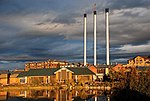
The Old Mill District is a historic area formerly occupied by two lumber mills in Bend, Oregon. Encompassing approximately 270 acres (110 ha) along the Deschutes River, the Old Mill District is now a mixed-use area known for its shops, galleries and restaurants. It draws thousands of visitors and employs more than 2,500 people. The area underwent significant development since the mid-1990s, when the land was purchased by developer Bill Smith, president of William Smith Properties. He maintained elements of the original buildings, including the area's three signature smokestacks. There are nine historically renovated buildings on property. The oldest is the Little Red Shed used to store fire equipment and is now the home to the art studio and gallery of Anna Amejko. Notable additions include the Hayden Homes Amphitheater and the nation's first 12-station Fly Casting Course.William Smith Properties and its partners also restored 14,000 lineal feet of the river area, which had been off limits to the public for close to 80 years. The banks were blown out to accommodate the floating logs and the river itself was mired with debris. The restored area is now a habitat for native species, such as fish, mink, otters and birds.It was work like this that led the Old Mill District to become the only project in the Western half of the United States to receive a national 2017 Excellence on the Waterfront Award from the Waterfront Center, become a finalist for the 2016 Urban Land Institute's Global Awards for Excellence and garnered Bill Smith, and William Smith Properties, a Lifetime Achievement Award in the 2014 Building a Better Central Oregon Awards.The Old Mill District is located southwest of downtown, roughly between Colorado Avenue on the west, Bond Street on the east and north and Reed Market to the south.

Old St. Francis School

St. Francis School in Bend, Oregon, was designed by Hugh Thompson and planned for the site of the Catholic parish house, adjoining St. Francis Catholic Church. It was budgeted at $45,000 ($35,000 for the building and $10,000 for equipment). The two-story structure was planned to face Lava Road and was to include four classrooms, an assembly hall, and a principal's room on the first floor with two more classrooms and a "large parish hall" on the second floor "to be used by altar societies, the Knights of Columbus and by children's organizations of the parish." The parish house was to be moved to the rear of the house and construction to begin at once in May 1925 for opening during the next school year. A playground was also planned and four "teaching sisters" of the order of St. Joseph expected to come and teach students up to eighth grade. The school was said to be the only one of its kind in Central Oregon, while there was a "parochial academy at Klamath Falls." The new school had been discussed "for a number of years, even before the new Catholic church replaced the old structure." Meanwhile, in 1925, "Bend School" graduated the largest class in its history, 58 students, with an invocation from St. Francis church's Father Luke Sheehan. According to the website of the building's current owners, an addition of two classrooms was made in 1953. An expansion to the school was planned in 1959. The current owner's website also reports on a major parish center expansion in 1968 with gym, stage, meeting rooms, and cafeteria.