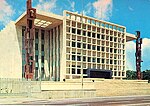
place

National Organization for Civil Registration of Iran

Civil registriesGovernment agencies of Iran
National Organization for Civil Registration of Iran

National Organization for Civil Registration of Iran is one of the governmental organizations in Iran that is responsible for collecting information and population statistics of Iran. This organization with independent duties and functions is one of the subordinate institutions of the Ministry of Interior of Iran. The organization is responsible for providing basic registration information such as births, deaths and marriages, as well as issuing identity documents such as birth certificates and Identity certificate. The current head of the organization is Hashem Kargar. In Iran, the third day of Dey (month) (23 or 24 December) has been named as National Organization for Civil Registration Day.It was successfully hacked September 2023 vital records of l entire population stolen.

Excerpt from the Wikipedia article National Organization for Civil Registration of Iran (License: CC BY-SA 3.0, Authors, Images).

National Organization for Civil Registration of Iran
افشین, Tehran District 11

Geographical coordinates (GPS) Address Nearby Places
placeShow on map

Wikipedia: National Organization for Civil Registration of IranContinue reading on Wikipedia

Geographical coordinates (GPS)

Latitude Longitude
N 35.6888224 ° E 51.4074849 °
placeShow on map

Address

افشین

افشین
11366-43915 Tehran, District 11
Iran
mapOpen on Google Maps

National Organization for Civil Registration of Iran
Share experience

Nearby Places

Guardian Council
Guardian Council

The Guardian Council (also called Council of Guardians or Constitutional Council, Persian: شورای نگهبان, romanized: Shourā-ye Negahbān) is an appointed and constitutionally mandated 12-member council that wields considerable power and influence in the Islamic Republic of Iran. The constitution of the Islamic Republic gives the council three mandates: a) veto power over legislation passed by the parliament (Majlis); b) supervision of elections; and c) approving or disqualifying candidates seeking to run in local, parliamentary, presidential, or Assembly of Experts elections.The Iranian constitution calls for the council to be composed of six Islamic faqihs (experts in Islamic Law), "conscious of the present needs and the issues of the day" to be selected by the Supreme Leader of Iran, and six jurists, "specializing in different areas of law, to be elected by the Majlis (the Iranian Parliament) from among the Muslim jurists nominated by the Chief Justice" (who, in turn, is also appointed by the Supreme Leader).The Council has played a central role in controlling the interpretation of Islamic values in Iranian law in the following ways: As part of its vetting of potential candidates to determine who can and cannot run for national office, it has disqualified reform-minded candidates—including the most well-known candidates—from running for office; Vetoes laws passed by the popularly elected Majlis. Has increased the influence that the Islamic Revolutionary Guard Corps (an ideological fighting force separate from the Iranian army) has on the economic and cultural life of the country.When the 2009 presidential election was announced, popular former president Mohammad Khatami would not discuss his plans to run against Mahmoud Ahmadinejad, for the Council might have disqualified Khatami as it had other reformists' candidatures, on the grounds that they were not dedicated enough to Islamic values.There have also been instances where the Constitutional Council reversed its ban on particular people after being ordered to do so by Khamenei.