place

Castle of Amer

17th-century establishments in SpainBalearic Islands stubsBien de Interés Cultural landmarks in the Balearic IslandsBuildings and structures in MallorcaCastles in the Balearic Islands
Spanish history stubs
Castell de n'Amer 09

The Castle of la Punta de Amer (Spanish: Castillo de la Punta de Amer) is a 17th century fortification located in Sant Lorenzo des Cardessar on the island of Mallorca. The sandstone structure was built in the late 17th century, and is now a protected site.

Excerpt from the Wikipedia article Castle of Amer (License: CC BY-SA 3.0, Authors, Images).

Castle of Amer
Carrer de les Liles,

Geographical coordinates (GPS) Address Nearby Places
placeShow on map

Wikipedia: Castle of AmerContinue reading on Wikipedia

Geographical coordinates (GPS)

Latitude Longitude
N 39.58 ° E 3.3961111111111 °
placeShow on map

Address

punta de n’Amer

Carrer de les Liles
07560 , sa Coma
Balearic Islands, Spain
mapOpen on Google Maps

Castell de n'Amer 09
Share experience

Nearby Places

Cuevas del Drach
Cuevas del Drach

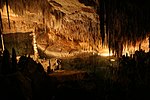
The Caves of Drach (modern Catalan spelling: Coves del Drac [ˈkɔβəz ðəl ˈdɾak]; Spanish: Cuevas del Drach; lit. 'Dragon caves') are four great caves that are located in the island of Majorca, Balearic Islands, Spain, extending to a depth of 25 m and reaching approximately 4 km in length. They are in the municipality of Manacor, near the locality of Porto Cristo. They were first mentioned in a letter dated 1338. The four caves, called Black Cave, White Cave, Cave of Luis Salvador, and Cave of the French, are connected to each other. The caves have formed by water being forced through the entrance from the Mediterranean Sea, and some researchers think the formation may date back to the Miocene Epoch. There is an underground lake situated in the caves called Martel Lake, which is about 115 m in length and 30 m in width, and its depth varies between four and twelve meters. It is named after the French explorer and scientist Édouard-Alfred Martel, considered the founding father of speleology, who was invited to explore the cave 1896. While German cave explorer, M.F. Will, had mapped the White and Black cave in 1880, Martel found two more caves, as well as the underground lake.The caves are open to the public for a fee, and are one of the main tourist attractions on Mallorca. The visit typically ends with a classical music concert, performed by a small orchestra of musicians on a fleet of small row boats.The caves are such an integral part of the tourism industry, that its closure, even if temporary, is seen by the locals as a bad sign for the economy.