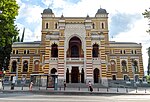
National Youth and Children's Palace (Georgian: მოსწავლე ახალგაზრდობის ეროვნული სასახლე), sometimes referred as Pioneer Palace, National Palace or by its original name – Viceroy's Palace, is a historical building located on Rustaveli Avenue in Tbilisi, Georgia.
The history of the building dates back to 1802, when the establishment of the Russian government in Georgia was followed by the appointment of a Commander-in-Chief of the Caucasus in Tiflis. A small building was built for him in 1802. However, in 1807 the building was demolished and replaced with a new one. It was an example of Russian classicism, the most grandiose building in Tbilisi at the time, which was also considered a kind of symbol of the government at the time.
After that the palace was rebuilt several times. In 1818 it was demolished and a new building was designed by architect Brownmiller. With this change, the original administration house became the real palace-residence of the Commander-in-Chief.
In 1845-47, the architect Semyonov, invited from Russia, thoroughly changed the look of this whole palace and, in fact, built an interesting and unique building in the style of Classicism. At the same time, the palace garden and a fountain was built.
In 1865, Otto Jakob Simonson, a Swedish architect working in Tbilisi, began a thorough reconstruction of the building and completed it in 4 years. In 1869, the Viceroy's palace took its final form - as it is today. Simonson significantly increased the palace built by Semyonov and gave it a new look.
During the various periods of Russian Imperial rule in Georgia, the palace was sometimes the residence and palace of the Commander-in-Chief of the Caucasus, and sometimes of the Viceroy
In 1917 the palace housed the government of the Transcaucasian Democratic Federative Republic. On May 26, 1918, the dissolution of the federation was announced in this palace. The National Council of Georgia, convened at the palace on the same day, declared Georgia's independence at 5:10 p.m. Two days later, the independence of the Democratic Republic of Azerbaijan was declared in the same palace. After that, the Government of the Democratic Republic of Georgia housed in the palace. At the same time, the palace was first the seat of the National Council and then of the Constituent Assembly of Georgia. On February 21, 1921, the Constituent Assembly of Georgia adopted the Constitution of the Democratic Republic in this very palace.
After the sovietization of Georgia, the palace first housed the Georgian Revolutionary Committee, then the governments of the Transcaucasian Socialist Federative Soviet Republic and Soviet Georgia. In 1937 the palace was handed over to children. On April 2, 1941, the palace was opened for children.
 Continue reading on Wikipedia