place

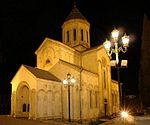
Alexander Nevsky Cathedral, Tiflis

1870s establishments in Georgia (country)1872 establishments in the Russian Empire1930 disestablishments in Russia1930s disestablishments in Georgia (country)19th-century Russian Orthodox church buildings
20th century in TbilisiAlexander Nevsky cathedralsBuildings and structures demolished in 1930Byzantine Revival architecture in Georgia (country)Cathedrals in Georgia (country)Churches completed in 1872Churches in TbilisiDemolished churches in the Soviet UnionDestroyed churchesFormer buildings and structures in Georgia (country)
Alexander Nevsky Cathedral, Tbilisi (ტფილისის სამხედრო ტაძარი)

The St. Alexander Nevsky Military Cathedral of Tiflis (Georgian: ტფილისის სამხედრო ტაძარი, tp'ilisis samkhedro tadzari; Russian: Тифлисский Александро-Невский военный собор, Tiflisskiy Aleksandro-Nevskiy voyenny sobor) was an Orthodox Christian cathedral in downtown Tiflis (now Tbilisi), Georgia, constructed during the Imperial Russian rule in the 1871-1872 and 1889–1897 and demolished by the Soviet authorities in 1930. The novel design of the cathedral became a standard for the emerging Neo-Byzantine style well before the cathedral was completed.

Excerpt from the Wikipedia article Alexander Nevsky Cathedral, Tiflis (License: CC BY-SA 3.0, Authors, Images).

Alexander Nevsky Cathedral, Tiflis
Rustaveli Avenue, Tbilisi Mtatsminda

Geographical coordinates (GPS) Address Website Nearby Places
placeShow on map

Wikipedia: Alexander Nevsky Cathedral, TiflisContinue reading on Wikipedia

Geographical coordinates (GPS)

Latitude Longitude
N 41.696666666667 ° E 44.798055555556 °
placeShow on map

Address

საქართველოს პარლამენტი

Rustaveli Avenue 8
0136 Tbilisi, Mtatsminda
Georgia
mapOpen on Google Maps

Website
parliament.ge

linkVisit website

Alexander Nevsky Cathedral, Tbilisi (ტფილისის სამხედრო ტაძარი)
Share experience

Nearby Places

National Youth and Children's Palace

National Youth and Children's Palace (Georgian: მოსწავლე ახალგაზრდობის ეროვნული სასახლე), sometimes referred as Pioneer Palace, National Palace or by its original name – Viceroy's Palace, is a historical building located on Rustaveli Avenue in Tbilisi, Georgia. The history of the building dates back to 1802, when the establishment of the Russian government in Georgia was followed by the appointment of a Commander-in-Chief of the Caucasus in Tiflis. A small building was built for him in 1802. However, in 1807 the building was demolished and replaced with a new one. It was an example of Russian classicism, the most grandiose building in Tbilisi at the time, which was also considered a kind of symbol of the government at the time. After that the palace was rebuilt several times. In 1818 it was demolished and a new building was designed by architect Brownmiller. With this change, the original administration house became the real palace-residence of the Commander-in-Chief. In 1845-47, the architect Semyonov, invited from Russia, thoroughly changed the look of this whole palace and, in fact, built an interesting and unique building in the style of Classicism. At the same time, the palace garden and a fountain was built. In 1865, Otto Jakob Simonson, a Swedish architect working in Tbilisi, began a thorough reconstruction of the building and completed it in 4 years. In 1869, the Viceroy's palace took its final form - as it is today. Simonson significantly increased the palace built by Semyonov and gave it a new look. During the various periods of Russian Imperial rule in Georgia, the palace was sometimes the residence and palace of the Commander-in-Chief of the Caucasus, and sometimes of the Viceroy In 1917 the palace housed the government of the Transcaucasian Democratic Federative Republic. On May 26, 1918, the dissolution of the federation was announced in this palace. The National Council of Georgia, convened at the palace on the same day, declared Georgia's independence at 5:10 p.m. Two days later, the independence of the Democratic Republic of Azerbaijan was declared in the same palace. After that, the Government of the Democratic Republic of Georgia housed in the palace. At the same time, the palace was first the seat of the National Council and then of the Constituent Assembly of Georgia. On February 21, 1921, the Constituent Assembly of Georgia adopted the Constitution of the Democratic Republic in this very palace. After the sovietization of Georgia, the palace first housed the Georgian Revolutionary Committee, then the governments of the Transcaucasian Socialist Federative Soviet Republic and Soviet Georgia. In 1937 the palace was handed over to children. On April 2, 1941, the palace was opened for children.

Simon Janashia Museum of Georgia

The Simon Janashia Museum of Georgia (Georgian: სიმონ ჯანაშიას სახელობის საქართველოს მუზეუმი), formerly known as the State Museum of History of Georgia, is one of the main history museums in Tbilisi, Georgia, which displays the country’s principal archaeological findings. The Museum evolved from the Museum of the Caucasian Department of the Russian Imperial Geographic Society, founded on May 10, 1852 and converted into the Caucasian Museum on the initiative of the German explorer Gustav Radde in 1865. After Georgia regained independence from Russia (1918), the museum was renamed into the Museum of Georgia in 1919. Noe Kipiani was the first director of the museum. A bulk of its collection was evacuated by the Government of Georgia to Europe following the Bolshevik takeover of the country in 1921, and was returned to Soviet Georgia through the efforts of the Georgian émigré scholar Ekvtime Takaishvili in 1945. In 1947, the Museum was named after the late Georgian historian Simon Janashia. The Museum suffered significantly during the years of post-Soviet turmoil in Georgia early in the 1990s: It was first damaged in fighting during the military coup in 1991-2, followed by the destruction of part of its collection by fire. In 2004, the Janashia Museum was integrated with other leading Georgian museums under a joint management system of the Georgian National Museum. The Museum occupies chronologically and stylistically diverse buildings in downtown Tbilisi, with the main exhibition located in Rustaveli Avenue. This latter edifice was designed utilizing elements of medieval Georgian décor by the architect Nikolay Severov in 1910 in the place of an older building authored by A. Zaltsman. The Museum houses hundreds of thousands of Georgian and Caucasian archaeological and ethnographical artifacts. A permanent exhibition chronologically follows the development of Georgia’s material culture from the Bronze Age to the early 20th century. Some of the Museum’s most valuable exhibits include the Homo Ergaster fossils discovered at Dmanisi; the Akhalgori hoard of the 5th century BC which contains unique examples of jewelry, blending Achaemenid and local inspirations; a collection of approximately 80,000 coins, chiefly of Georgian minting; medieval icons and goldsmith pieces brought here from various archeological sites in Georgia; Shukhuti's mosaic, a bath mosaic from the village of Shukhuti that dates from the 4th-5th century; and a lapidary which includes one of the world’s richest collection of Urartian inscriptions.