place

Thạnh Mỹ massacre

Collective punishmentConflicts in 1970History of Quảng Nam provinceJune 1970 in AsiaMass murder in 1970
Massacres in 1970Massacres in the Vietnam WarSource attributionTerrorism in VietnamUnited States Marine Corps in the Vietnam WarVietnam War crimes by the Viet Cong
Thanh My 11 June 1970 (cropped)

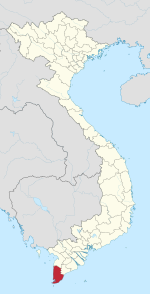
The Thạnh Mỹ Massacre was a massacre of South Vietnamese civilians committed by the Viet Cong (VC) during the Vietnam War, in Thạnh Mỹ hamlet, Phú Thạnh commune, (now Bà Rén village, Quế Xuân 1 commune) Quế Sơn District, Quảng Nam Province, South Vietnam on 11 June 1970. The hamlet, which was pro-government and defended by US Marines and South Vietnamese militia, was attacked by the VC in the early morning of 11 June. Under cover of a mortar barrage VC sappers set fire to houses and killed civilians either by shooting or throwing explosives into their shelters. The Marines and South Vietnamese forces engaged with the VC and called in artillery support. By 03:15 the VC began to withdraw and the Marines reoccupied the village and began evacuating the wounded. In all 156 houses were destroyed and 35 damaged during the attack. Four militiamen were killed and two wounded, ten U.S. Marines were wounded. Civilian casualties were 74 dead, many of them women and children; 60 severely injured; and over 100 lightly wounded. Four VC dead were found, one prisoner was taken and one of the VC defected. The VC later claimed that they had been attempting to capture the bridge in the village and that the civilians had merely been caught in the crossfire.

Excerpt from the Wikipedia article Thạnh Mỹ massacre (License: CC BY-SA 3.0, Authors, Images).

Thạnh Mỹ massacre
Quốc lộ 1,

Geographical coordinates (GPS) Address Nearby Places
placeShow on map

Wikipedia: Thạnh Mỹ massacreContinue reading on Wikipedia

Geographical coordinates (GPS)

Latitude Longitude
N 15.818 ° E 108.296 °
placeShow on map

Address

Quốc lộ 1

Quốc lộ 1
51506
Quảng Nam Province, Vietnam
mapOpen on Google Maps

Thanh My 11 June 1970 (cropped)
Share experience

Nearby Places

Mỹ Sơn
Mỹ Sơn

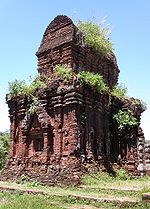
Mỹ Sơn (Vietnamese pronunciation: [mǐˀ səːn]) is a cluster of abandoned and partially ruined Shaiva Hindu temples in central Vietnam, constructed between the 4th and the 14th century by the Kings of Champa, an Indianized kingdom of the Cham people. The temples are dedicated to the veneration of God in accordance with Shaivism, wherein God is named Shiva, or The Auspicious One. In this particular complex, he is venerated under various local names, the most important of which is Bhadreshvara. Mỹ Sơn is located near the village of Duy Phú, in the administrative district of Duy Xuyên in Quảng Nam Province in Central Vietnam, 69 km southwest of Da Nang, and approximately 10 km from the historic Champa capital of Trà Kiệu. The temples are in a valley roughly two kilometres wide that is surrounded by two mountain ranges. From the 4th to the 14th century AD, the valley at Mỹ Sơn was a site of religious ceremony for kings of the ruling dynasties of Champa, as well as a burial place for Cham royalty and national heroes. It was closely associated with the nearby Cham cities of Indrapura (Đồng Dương) and Simhapura (Trà Kiệu). At one time, the site encompassed over 70 temples as well as numerous stele bearing historically important inscriptions in Sanskrit and Cham.Mỹ Sơn is perhaps the longest inhabited archaeological site in Mainland Southeast Asia, but a large majority of its architecture was destroyed by US bombing during a single week of the Vietnam War.The Mỹ Sơn temple complex is regarded one of the foremost Shaiva Hindu temple complexes in Southeast Asia and is the foremost heritage site of this nature in Vietnam. It is often compared with other historical temple complexes in Southeast Asia, such as Borobudur of Java in Indonesia, Angkor Wat of Cambodia, Wat Phou of Laos, Bagan of Myanmar and Prasat Hin Phimai of Thailand. As of 1999, Mỹ Sơn has been recognized by UNESCO as a World Heritage Site. At its 23rd meeting, UNESCO accorded Mỹ Sơn this recognition pursuant to its criterion C (II), as an example of evolution and change in culture, and pursuant to its criterion C (III), as evidence of an Asian civilization which is now extinct.