place

The DeSoto

Historic Hotels of AmericaHotel buildings completed in 1968Hotels established in 1890Hotels established in 1968Hotels in Savannah, Georgia
Madison Square (Savannah) buildingsSavannah Historic District
DeSoto Hotel, Savannah, GA, US

The DeSoto is a historic hotel at 15 East Liberty Street on Madison Square in Savannah, Georgia, constructed in 1968. It is within the area of the Savannah Historic District, which was listed on the National Register of Historic Places in November 1966, although it is not specifically mentioned in the nomination form, because the current structure had not been built yet.

Excerpt from the Wikipedia article The DeSoto (License: CC BY-SA 3.0, Authors, Images).

The DeSoto
East Liberty Street, Savannah Savannah Historic District

Geographical coordinates (GPS) Address Nearby Places
placeShow on map

Wikipedia: The DeSotoContinue reading on Wikipedia

Geographical coordinates (GPS)

Latitude Longitude
N 32.0742 ° E -81.0931 °
placeShow on map

Address

Desoto Savannah

East Liberty Street 15
31401 Savannah, Savannah Historic District
Georgia, United States
mapOpen on Google Maps

DeSoto Hotel, Savannah, GA, US
Share experience

Nearby Places

Sorrel–Weed House
Sorrel–Weed House

The Sorrel–Weed House, or the Francis Sorrel House, is a historic landmark and Savannah Museum located at 6 West Harris Street in Savannah, Georgia. It represents one of the finest examples of Greek Revival and Regency architecture in Savannah and was one of the first two homes in the State of Georgia to be made a State Landmark in 1954. At 16,000 square feet, it is also one of the largest houses in the city. The Sorrel–Weed House was first opened to the public in January 1940 by the Society for the Preservation of Savannah Landmarks. It was the society's first exhibit and was called "The Society for the Preservation of Savannah Landmarks Presents a loan Exhibit of Furniture and Fine Arts 18th and 19th Centuries at the Sorrel-Weed House on Madison Square: Jan-April 1940." This society later became the Historic Savannah Foundation. The Sorrel–Weed House was opened again to the public in 2005 and conducts Historic Savannah Tours during the day and Savannah Ghost Tours inside the house every evening. These tours are conducted by the Sorrel-Weed House Museum. It is located at the corner of Bull Street and Harris Street. The Sorrel–Weed House was the boyhood home of Brigadier General Moxley Sorrel, who fought for the Confederate States of America during the Civil War. He served under General James Longstreet, and after the War wrote "Recollections of a Confederate Staff Officer", considered to be one of the top postwar accounts written. General Robert E. Lee visited the home in late 1861 and early 1862. He and Francis Sorrel had been friends since the early 1830s. Lee also visited the Sorrel family in April 1870, shortly before his death. A.J. Cohen, Sr., a prominent Savannah businessman bought the Sorrel-Weed house in 1941. The Cohen family lived in the home for more than fifty years. A.J. Cohen, Jr., built a brick addition to the house and opened Lady Jane, an upscale women's clothing store which thrived in Savannah for decades. The store closed in 1991, and the home was bought by Stephen Bader in 1996. Bader removed the brick addition soon after his purchase.The opening scene of the 1994 film Forrest Gump was filmed from the rooftop of the Sorrel–Weed House and is a popular tourist stop. The scene, which begins with a floating feather through the Savannah sky, pans the rooftops of other buildings occupying Madison Square as seen from the very top of the Sorrel–Weed home. The scene is then spliced to a scene of another church located on Chippewa square, where ultimately, Forrest is seen sitting on a bench. The house was investigated by TAPS during a special 2005 Halloween Special episode of Ghost Hunters. The house was also featured on HGTV's "If Walls Could Talk" in March 2006. It was also investigated by the Ghost Adventures crew in 2014. The house was featured on the Travel Channel's "The Most Terrifying Places in America" in 2010, and on the Paula Deen Network in 2015.The house is a contributing property to the Savannah Historic District.

Madison Square (Savannah, Georgia)

Madison Square is one of the 22 squares of Savannah, Georgia, United States. It is located in the fourth row of the city's five rows of squares, on Bull Street and Macon Street, and was laid out in 1837. It is south of Chippewa Square, west of Lafayette Square, north of Monterey Square and east of Pulaski Square. The square is named for James Madison, fourth president of the United States. The oldest building on the square is the Sorrel–Weed House, at 6 West Harris Street, which dates to 1840.In the center of the square is the William Jasper Monument, an 1888 work by Alexander Doyle memorializing Sergeant William Jasper, a soldier in the siege of Savannah who, though mortally wounded, heroically recovered his company's banner. Savannahians sometimes refer to this as Jasper Square, in honor of Jasper's statue.Madison Square features a vintage cannon from the Savannah Armory. These now mark the starting points of the first highways in Georgia, the Ogeechee Road, leading to Darien, and the Augusta Road.The square also includes a monument marking the center of the British resistance during the siege.The Masonic Hall, at 341 Bull Street, was designed by Hyman Witcover, also the architect of Savannah City Hall.In 1971 Savannah landscape architect Clermont Huger Lee and Mills B. Lane planned and initiated a project to install new walk patterns with offset sitting areas and connecting walks at curbs, add new benches, lighting and planting.

Savannah Historic District (Savannah, Georgia)

The Savannah Historic District is a large urban U.S. historic district that roughly corresponds to the pre-civil war city limits of Savannah, Georgia. The area was declared a National Historic Landmark District in 1966, and is one of the largest urban, community-wide historic preservation districts in the United States. The district was made in recognition of the Oglethorpe Plan, a unique sort of urban planning begun by James Oglethorpe at the city's founding and propagated for the first century of its growth.The plan of the historic portions of Savannah is based on the concept of a ward, as defined by James Oglethorpe. Each ward had a central square, around which were arrayed four trust lots and four tythings. Each trust lot was to be used for a civic purpose, such as a school, government building, church, museum, or other public venue, while the tythings were each subdivided into ten lots for residential use. The wards were oriented in a rectilinear grid with north–south and east–west alignment. In a typical ward, the trust lots were set east and west of the square, and the residential lots of the tythings were extended north and south of the trust lots and the square, each tything divided into two rows of five lots, separated by alleys. In the early years of the Province of Georgia, the ward organization was in part military, with each ward's inhabitants organized into militia units, and the central squares acting as a gathering point for refugees from outside the city walls.Each year, the Savannah Historic District attracts millions of visitors, who enjoy its eighteenth- and nineteenth-century architecture and green spaces. The district includes the birthplace of Juliette Gordon Low (founder of the Girl Scouts of the United States of America, see Juliette Gordon Low Historic District), the Telfair Academy of Arts and Sciences (one of the South's first public museums), the First African Baptist Church (the oldest African American Baptist congregation in the United States), Temple Mickve Israel (the third-oldest synagogue in America), the Central of Georgia Railway roundhouse complex (the oldest standing antebellum rail facility in America), Christ Church (the Mother Church of Georgia), the old Colonial Cemetery, Cathedral of St. John the Baptist, Old Harbor Light, and Factors Row, a line of former cotton warehouses, along its waterfront, some built from ships' ballast stones.Other buildings in the district include the Isaiah Davenport House, the Green-Meldrim House, the Owens–Thomas House, the William Scarbrough House, the Sorrel–Weed House, and the United States Customhouse. Notable green spaces in the district include Savannah's 22 squares, the 30-acre Forsyth Park (at the southern limit of the district), and Emmet Park, part of The Strand, near the city's riverfront, in what was known as the Old Fort neighborhood.

Chippewa Square (Savannah, Georgia)

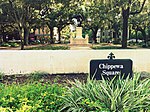
Chippewa Square is one of the 22 squares of Savannah, Georgia, United States. It is located in the middle row of the city's five rows of squares, on Bull Street and McDonough Street, and was laid out in 1815. It is south of Wright Square, west of Colonial Park Cemetery, north of Madison Square and east of Orleans Square. The oldest building on the square is The Savannah Theatre, at 222 Bull Street, which dates to 1818. The square named in honor of American soldiers killed in the Battle of Chippawa during the War of 1812. (The spelling "Chippewa" is correct in reference to this square.) In the center of the square is the James Oglethorpe Monument, created by sculptor Daniel Chester French and architect Henry Bacon and unveiled in 1910. Oglethorpe faces south, toward Georgia's one-time enemy in Spanish Florida, and his sword is drawn. Busts of Confederate figures Francis Stebbins Bartow and Lafayette McLaws were moved from Chippewa Square to Forsyth Park to make room for the Oglethorpe monument. Due to the location of the monument, Savannahians sometimes refer to this as Oglethorpe Square, but that is located just to the northeast.The "park bench" scene which opens the 1994 film Forrest Gump was filmed on the north side of Chippewa Square. The bench was a fiberglass prop, rather than one of the park's actual benches. A replica of the prop bench used in the film is on display at the Savannah Visitors Center. The original prop is now kept in Paramount Studios, Los Angeles.Chippewa Square is also home to the First Baptist Church (1833), the Independent Presbyterian Church and the Philbrick–Eastman House (1847).