place

Savannah Historic District (Savannah, Georgia)

Geography of Savannah, GeorgiaHistoric districts on the National Register of Historic Places in Georgia (U.S. state)NRHP infobox with nocatNational Historic Landmarks in Savannah, GeorgiaNational Register of Historic Places in Savannah, Georgia
Savannah Historic District
200 Savannah river front

The Savannah Historic District is a large urban U.S. historic district that roughly corresponds to the pre-civil war city limits of Savannah, Georgia. The area was declared a National Historic Landmark District in 1966, and is one of the largest urban, community-wide historic preservation districts in the United States. The district was made in recognition of the Oglethorpe Plan, a unique sort of urban planning begun by James Oglethorpe at the city's founding and propagated for the first century of its growth.The plan of the historic portions of Savannah is based on the concept of a ward, as defined by James Oglethorpe. Each ward had a central square, around which were arrayed four trust lots and four tythings. Each trust lot was to be used for a civic purpose, such as a school, government building, church, museum, or other public venue, while the tythings were each subdivided into ten lots for residential use. The wards were oriented in a rectilinear grid with north–south and east–west alignment. In a typical ward, the trust lots were set east and west of the square, and the residential lots of the tythings were extended north and south of the trust lots and the square, each tything divided into two rows of five lots, separated by alleys. In the early years of the Province of Georgia, the ward organization was in part military, with each ward's inhabitants organized into militia units, and the central squares acting as a gathering point for refugees from outside the city walls.Each year, the Savannah Historic District attracts millions of visitors, who enjoy its eighteenth- and nineteenth-century architecture and green spaces. The district includes the birthplace of Juliette Gordon Low (founder of the Girl Scouts of the United States of America, see Juliette Gordon Low Historic District), the Telfair Academy of Arts and Sciences (one of the South's first public museums), the First African Baptist Church (the oldest African American Baptist congregation in the United States), Temple Mickve Israel (the third-oldest synagogue in America), the Central of Georgia Railway roundhouse complex (the oldest standing antebellum rail facility in America), Christ Church (the Mother Church of Georgia), the old Colonial Cemetery, Cathedral of St. John the Baptist, Old Harbor Light, and Factors Row, a line of former cotton warehouses, along its waterfront, some built from ships' ballast stones.Other buildings in the district include the Isaiah Davenport House, the Green-Meldrim House, the Owens–Thomas House, the William Scarbrough House, the Sorrel–Weed House, and the United States Customhouse. Notable green spaces in the district include Savannah's 22 squares, the 30-acre Forsyth Park (at the southern limit of the district), and Emmet Park, part of The Strand, near the city's riverfront, in what was known as the Old Fort neighborhood.

Excerpt from the Wikipedia article Savannah Historic District (Savannah, Georgia) (License: CC BY-SA 3.0, Authors, Images).

Savannah Historic District (Savannah, Georgia)
Floyd Street, Savannah Savannah Historic District

Geographical coordinates (GPS) Address Nearby Places
placeShow on map

Wikipedia: Savannah Historic District (Savannah, Georgia)Continue reading on Wikipedia

Geographical coordinates (GPS)

Latitude Longitude
N 32.074444444444 ° E -81.091666666667 °
placeShow on map

Address

Floyd Street

Floyd Street
31401 Savannah, Savannah Historic District
Georgia, United States
mapOpen on Google Maps

200 Savannah river front
Share experience

Nearby Places

Hamilton–Turner Inn
Hamilton–Turner Inn

The Hamilton–Turner Inn (also known as the Hamilton–Turner House and the Samuel P. Hamilton House) is a historic mansion in Savannah, Georgia, United States. Built in 1873, it is located at 330 Abercorn Street in the southeastern trust/civic lot of Lafayette Square. It is now a luxury inn. Virginia native Samuel Pugh Hamilton (1837–1899), colloquially known as the Lord of Lafayette Square, had the mansion built for his family. He and his wife, Sarah Virginia (née Stillings) (1836–1920), "created a social center for the city's elite" with their home.Sarah, his deceased brother's widow, was Hamilton's second wife, whom he married on June 10 1866; his first, Emma Sprigg, died around 1862, after having two children with Hamilton.Due to Hamilton's work with the Brush Electric Light & Power Company, the Hamilton's mansion was the first home in Savannah with electricity, for in 1883, lights were installed in its salon. The rest of the house was fitted with lights by 1886.The mansion survived Savannah's fire of 1898 that nearly destroyed the nearby Cathedral of St. John the Baptist. This was, in part, due to the Connecticut limestone roof, which prevented it from being engulfed by the flames.Hamilton died in 1899, in his early sixties. He and his wife, who survived him by 21 years, are buried in Savannah's Bonaventure Cemetery. In 1915, Dr. Francis Turner (1884–1961) purchased the mansion from the Hamiltons, and lived there with his family until 1926.The home was then opened for boarding and became a home for the nurses of the Marine Hospital in 1928, before the Turner family moved back in during the 1940s.The Turners sold the property to the Cathedral of St. John the Baptist in 1965. The latter wanted to demolish the structure to make a playground for their nearby school, but the Historic Savannah Foundation stepped in, and the mansion was saved.The home is featured in John Berendt's 1994 book Midnight in the Garden of Good and Evil as the scene of raucous parties held by its resident Joe Odom. Nancy Hillis, on whom the book's character Mandy Nichols was based, later owned the property.Three years after the book's release, around the time of the film adaptation, Charles and Sue Strickland converted the mansion into luxury suites.

Chippewa Square (Savannah, Georgia)

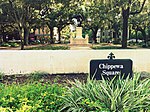
Chippewa Square is one of the 22 squares of Savannah, Georgia, United States. It is located in the middle row of the city's five rows of squares, on Bull Street and McDonough Street, and was laid out in 1815. It is south of Wright Square, west of Colonial Park Cemetery, north of Madison Square and east of Orleans Square. The oldest building on the square is The Savannah Theatre, at 222 Bull Street, which dates to 1818. The square named in honor of American soldiers killed in the Battle of Chippawa during the War of 1812. (The spelling "Chippewa" is correct in reference to this square.) In the center of the square is the James Oglethorpe Monument, created by sculptor Daniel Chester French and architect Henry Bacon and unveiled in 1910. Oglethorpe faces south, toward Georgia's one-time enemy in Spanish Florida, and his sword is drawn. Busts of Confederate figures Francis Stebbins Bartow and Lafayette McLaws were moved from Chippewa Square to Forsyth Park to make room for the Oglethorpe monument. Due to the location of the monument, Savannahians sometimes refer to this as Oglethorpe Square, but that is located just to the northeast.The "park bench" scene which opens the 1994 film Forrest Gump was filmed on the north side of Chippewa Square. The bench was a fiberglass prop, rather than one of the park's actual benches. A replica of the prop bench used in the film is on display at the Savannah Visitors Center. The original prop is now kept in Paramount Studios, Los Angeles.Chippewa Square is also home to the First Baptist Church (1833), the Independent Presbyterian Church and the Philbrick–Eastman House (1847).