place

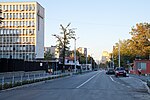
Bulgaria Boulevard, Sofia

Bulgaria geography stubsEurope road stubsStreets in Sofia
Bulevard Bulgaria v Sofia

Bulgaria Boulevard (Bulgarian: Булевард „България“) is a boulevard and key thoroughfare connecting the centre of Sofia, the capital of Bulgaria, with the southern neighbourhoods of the city and Boyana. The National Palace of Culture is located close to the northern end of the boulevard, as after the intersection with Cherni Vrah Boulevard it continues as Evlogi Georgiev Boulevard towards Orlov most. The southern end of Bulgaria Boulevard is the intersection with the Sofia ring road towards Boyana, after which it is called Daskal St. Popandreev. Neighbourhoods located along or near Bulgaria Boulevard, listed in a north to south order, include Ivan Vazov, Hipodruma, Belite brezi, Strelbishte, Krasno selo, Motopista, Borovo, Buxton, Gotse Delchev, Bokar, Manastirski Livadi and Boyana.

Excerpt from the Wikipedia article Bulgaria Boulevard, Sofia (License: CC BY-SA 3.0, Authors, Images).

Bulgaria Boulevard, Sofia
Bulgaria Blvd., Sofia ж.к. Гоце Делчев (Triadica)

Geographical coordinates (GPS) Address Nearby Places
placeShow on map

Wikipedia: Bulgaria Boulevard, SofiaContinue reading on Wikipedia

Geographical coordinates (GPS)

Latitude Longitude
N 42.671111111111 ° E 23.293611111111 °
placeShow on map

Address

Bulgaria Blvd. бл.5А
1680 Sofia, ж.к. Гоце Делчев (Triadica)
Bulgaria
mapOpen on Google Maps

Bulevard Bulgaria v Sofia
Share experience

Nearby Places

Krasno selo
Krasno selo

Krasno selo (Bulgarian: Красно село [ˈkrasno ˈsɛɫo]) is a district and neighbourhood of Sofia, the capital of Bulgaria, located in the western part of the city. The main thoroughfare in the neighbourhood is Tsar Boris III Boulevard. Until 1910, Krasno selo was a mahala (neighbourhood) of Boyana. In 1956, it became a district of Sofia, but it had been a suburb of the city since the early 20th century. The name stems from the common noun selo ("village") and the adjective krasno, meaning "beautiful".After the Second Balkan War and the First World War thousands of families of Bulgarian refugees (mainly from Western Thrace, Vardar Macedonia, Southern Dobruja and the Western Outlands) headed to the large Bulgarian cities in search of a better life. During that period prior to the Second World War Krasno selo, once a satellite neighbourhood, urbanized quickly and accommodated many refugee families, with various parts of Krasno selo today known as the Dobrujan neighbourhood, the Tsaribrod neighbourhood, etc. Architectural elements in the houses of Bulgarian refugees show a nostalgia for their native regions, an example of which is the round tower of a 1929 house reminiscent of the White Tower in Thessaloniki. The growth of Krasno selo was aided by the geographical importance of the western transport corridor leading to Pernik. One of the first tramways of the Balkans, then known as Knyazhevska, was officially opened on 1 January 1901 along what is today Tsar Boris III Boulevard. There is a possibility that a subway route may pass through the neighbourhood in the future. The architecture of Krasno selo is made of mostly residential buildings. The largest portion of residential structures are of the type Soviet era panel buildings. Newer residential buildings date to the period after 1990. These structures are made of brick and are only several stories high. The panel buildings, on the other hand, vary in height from five to over twenty stories. Krasno Selo is home to the Krasno Selo market. The second largest market is in Borovo quarter. Borovo is located at the end stop of trolley #9. The 1–12 grade school within the limits of the Krasno selo neighborhood is 142 SOU. In 2020 Krasno selo metro station was opened as part of Sofia Metro Line 3.

Lozenetz Hospital
Lozenetz Hospital

The Lozenetz University Hospital, also known as "the former Governmental Hospital" is one of the biggest hospitals in Bulgaria.The hospital was founded in 1948 – similar to the practice in former socialist countries – as a governmental clinic with the purpose of providing health care to employees of high state and government institutions. In 1999 the hospital became a national multispecialty hospital under the management of Council of Ministers of Bulgaria.Today the Lozenetz Hospital is a multispecialty hospital, which budget is funded by the state. All clinics in the hospital have a third level of competence, with the exception of the emergency department (first level), virology and neonatology (2nd level). The Lozenets Hospital performs: Diagnosis, treatment and rehabilitation of patients, monitoring of pregnant women and maternity care, monitoring of chronic diseases and patients at risk of such disease, prevention and early detection of diseases and to healthcare measures, transplantation of organs, tissues and cells. As a multispecialty hospital, all pointed out prophylactic, diagnostic and treatment activities are being performed both as well to representatives of government and public institutions, members of the Diplomatic Corps in Bulgaria and the official foreign delegations, as to all Bulgarian and foreign citizens on the basis of contracts with the National Health Insurance Fund or private health insurance funds. University Hospital for Active Treatment "Lozenets" specializes in modern and leading diagnostic and therapeutic activities such as medical imaging, cardiac surgery, invasive cardiology, endoscopic surgery and more. The hospital is multifarious and has 32 clinics and departments, three operating units in 22 surgical rooms, cardiac surgery, Invasive cardiology, broad and modern diagnostic center, high-tech equipment, a center for preventive and occupational medicine. Director of the hospital is Lubomir Spasov cardiac surgeon and specialist in liver transplantation. Under his leadership and with direct participation in the University Hospital "Lozenets" for the first time in our country have done unique operations such as coronary artery bypass without ESC, etc. "Beating heart" (April 5, 2000), mitral-valve prosthesis via a unique endoscopic method (May 22, 2003), a liver transplantation from a living donor (November 26, 2004) and others. University Hospital "Lozenets" has a modern diagnostic equipment and laboratories of the last generation.