place

Francisco Alberto Caamaño metro station

2009 establishments in the Dominican RepublicRailway stations opened in 2009Santo Domingo Metro stations

Francisco Alberto Caamaño is a Santo Domingo Metro station on Line 1. It was open on 22 January 2009 as part of the inaugural section of Line 1 between Mamá Tingó and Centro de los Héroes. The station is between Amín Abel and Centro de los Héroes.This is an underground station, built below Avenida Dr. Bernardo Correa y Cidrón. It is named to honor Francisco Caamaño.

Excerpt from the Wikipedia article Francisco Alberto Caamaño metro station (License: CC BY-SA 3.0, Authors).

Francisco Alberto Caamaño metro station
Avenida Correa y Cidrón, Santo Domingo

Geographical coordinates (GPS) Address Nearby Places
placeShow on map

Wikipedia: Francisco Alberto Caamaño metro stationContinue reading on Wikipedia

Geographical coordinates (GPS)

Latitude Longitude
N 18.455611111111 ° E -69.923972222222 °
placeShow on map

Address

Universidad Dominico Americana

Avenida Correa y Cidrón
10105 Santo Domingo
Distrito Nacional, Dominican Republic
mapOpen on Google Maps

Share experience

Nearby Places

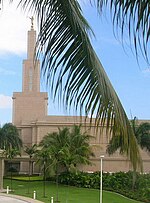
Santo Domingo Dominican Republic Temple

The Santo Domingo Dominican Republic Temple is the 99th operating temple of the Church of Jesus Christ of Latter-day Saints (LDS Church). It was the first temple to be built in the church's Caribbean area. Santo Domingo is the Dominican Republic's capital city. Founded in 1496, it is the oldest European settlement existing in the New World. In 1978 the Dominican Republic was opened to Mormon missionaries. By 1986, membership had grown to eleven thousand and in 1998, LDS Church membership reached sixty thousand. Before the temple was built in the Dominican Republic, members of the church traveled to Peru, Guatemala, or the U.S. state of Florida to attend a temple. The temple was announced on December 4, 1993. On August 18, 1996, Richard G. Scott of the Quorum of the Twelve presided over the groundbreaking, marking the beginning of construction. When construction was completed, a public open house was held from August 26 to September 9, 2000, attracting nearly forty thousand people. Over ten thousand church members from the Dominican Republic and their neighbors from Haiti, Puerto Rico, and other islands witnessed the dedication of the temple on September 17, 2000 by LDS Church president Gordon B. Hinckley. The Santo Domingo Dominican Republic Temple is located in the western part of the city. It is built on a rise that has kept it dry when other parts of the city were flooded. The site is adorned with trees and overlooks the Caribbean Sea. It has a total of 67,000 square feet (6,200 m2), four ordinance rooms, and four sealing rooms.

Santo Domingo
Santo Domingo

Santo Domingo, formerly known as Santo Domingo de Guzmán, is the capital and largest city of the Dominican Republic and the largest metropolitan area in the Caribbean by population. As of 2022, the city center had a population of 1,029,110 while its Metropolitan area, the Greater Santo Domingo, had a population of 4,274,651. The city is coterminous with the boundaries of the Distrito Nacional (D.N.), itself bordered on three sides by Santo Domingo Province. Santo Domingo was founded in 1496 by the Spanish Empire and is the oldest continuously inhabited European settlement in the Americas. It was the first seat of Spanish colonial rule in the New World, the Captaincy General of Santo Domingo. Santo Domingo is the site of the first university, cathedral, castle, monastery, and fortress in the New World. The city's Colonial Zone was declared as a World Heritage Site by UNESCO. Santo Domingo was called Ciudad Trujillo (Spanish pronunciation: [sjuˈðað tɾuˈxiʝo]), from 1936 to 1961, after the Dominican Republic's dictator, Rafael Trujillo, named the capital after himself. Following his assassination, the city resumed its original designation. Santo Domingo is the cultural, financial, political, commercial and industrial center of the Dominican Republic, with the vast majority of the country' industries being located within the city. Santo Domingo also serves as the chief seaport of the country. The city's harbor at the mouth of the Ozama River accommodates the largest vessels, and the port handles both heavy passenger- and freight traffic.