place

University of Missouri College of Human Environmental Sciences

1960 establishments in MissouriEducation in Columbia, MissouriEnvironmental studies institutions in the United StatesMidwestern United States university stubsMissouri school stubs
Universities and colleges established in 1960University of MissouriUniversity subdivisions in Missouri

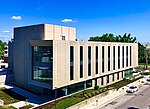
The College of Human Environmental Sciences was a school of environmental science, and one of the major academic divisions of the University of Missouri in Columbia, Missouri. It awarded undergraduate and graduate degrees and was the only human environmental science college in Missouri. On February 8, 2021, the University of Missouri announced the academic restructuring of the College of Human Environmental Sciences that, effective August 1, 2021, all departments from the college will merge with other schools and colleges across the campus.

Excerpt from the Wikipedia article University of Missouri College of Human Environmental Sciences (License: CC BY-SA 3.0, Authors).

University of Missouri College of Human Environmental Sciences
Hitt Street, Columbia

Geographical coordinates (GPS) Address Nearby Places
placeShow on map

Wikipedia: University of Missouri College of Human Environmental SciencesContinue reading on Wikipedia

Geographical coordinates (GPS)

Latitude Longitude
N 38.9447 ° E -92.3248 °
placeShow on map

Address

Gwynn

Hitt Street 520
65201 Columbia
Missouri, United States
mapOpen on Google Maps

Share experience

Nearby Places

University of Missouri College of Agriculture, Food and Natural Resources

The College of Agriculture, Food and Natural Resources (CAFNR) at the University of Missouri is a teaching and research institution that includes 15 degree programs and six academic/research divisions. Areas of study range from animal and plant sciences to biochemistry, agribusiness management, science and agricultural journalism, animal science, fisheries and wildlife, and atmospheric science. In 2018, there were more than 2,428 undergraduate and 384 graduate students studying in CAFNR. CAFNR has the highest sponsored research expenditures on the MU campus ($31,873,581 in 2010). The college is ranked among the Top 15 programs in the world for animal and plant science research (Thomson Reuters). Divisions in CAFNR are: • Animal Sciences • Biochemistry • Division of Applied Social Sciences (Agricultural and Applied Economics, Agricultural Education, Rural Sociology, Science and Agricultural Journalism) • Food Systems and Bioengineering (Agricultural Systems Management, Biological Engineering, Food Science, Hospitality Management, Continental Climate Viticulture and Enology) • Plant Sciences • School of Natural Resources (Fisheries and Wildlife; Forestry; Soil, Environmental and Atmospheric Sciences; Parks, Recreation and Tourism). CAFNR operates the Agricultural Experiment Station, a network of several research centers around Missouri designed to meet the regional research and demonstration needs of agricultural producers and natural resource managers. CAFNR's research efforts have regional and international economic impact. Projects include a drought simulator that allows scientists to develop drought tolerant crops, an inexpensive genetic tool to judge the economic value of cattle, and a study to determine the connection between eating breakfast and obesity. The Food and Agricultural Policy Research Institute (FAPRI), part of the Division of Applied Social Sciences, conducts research in national and global agricultural policy. Its researchers regularly testify before Congress. CAFNR's marketing tag line is Collaborating for the Greater Good, a recognition of its long culture of interdisciplinary partnerships that result in discoveries that could not be easily obtained by researchers in a single area.

Columbia, Missouri
Columbia, Missouri

Columbia is a city in the U.S. state of Missouri. It is the county seat of Boone County and home to the University of Missouri. Founded in 1821, it is the principal city of the five-county Columbia metropolitan area. It is Missouri's 4th most populous with an estimated 128,555 residents in 2022.As a Midwestern college town, Columbia maintains high-quality health care facilities, cultural opportunities, and a low cost of living. The tripartite establishment of Stephens College (1833), the University of Missouri (1839), and Columbia College (1851), which surround the city's Downtown to the east, south, and north, has made Columbia a center of learning. At its center is 8th Street (also known as the Avenue of the Columns), which connects Francis Quadrangle and Jesse Hall to the Boone County Courthouse and the City Hall. Originally an agricultural town, education is now Columbia's primary economic concern, with secondary interests in the healthcare, insurance, and technology sectors; it has never been a manufacturing center. Companies like Shelter Insurance, Carfax, Veterans United Home Loans, and Slackers CDs and Games, were founded in the city. Cultural institutions include the State Historical Society of Missouri, the Museum of Art and Archaeology, and the annual True/False Film Festival and the Roots N Blues Festival. The Missouri Tigers, the state's only major college athletic program, play football at Faurot Field and basketball at Mizzou Arena as members of the rigorous Southeastern Conference. The city rests upon the forested hills and rolling prairies of Mid-Missouri, near the Missouri River valley, where the Ozark Mountains begin to transform into plains and savanna. Limestone forms bluffs and glades while rain dissolves the bedrock, creating caves and springs which water the Hinkson, Roche Perche, and Bonne Femme creeks. Surrounding the city, Rock Bridge Memorial State Park, Mark Twain National Forest, and Big Muddy National Fish and Wildlife Refuge form a greenbelt preserving sensitive and rare environments. The Columbia Agriculture Park is home to the Columbia Farmers Market. The first humans who entered the area at least 12,000 years ago were nomadic hunters. Later, woodland tribes lived in villages along waterways and built mounds in high places. The Osage and Missouria nations were expelled by the exploration of French traders and the rapid settlement of American pioneers. The latter arrived by the Boone's Lick Road and hailed from the culture of the Upland South, especially Virginia, Kentucky, and Tennessee. From 1812, the Boonslick area played a pivotal role in Missouri's early history and the nation's westward expansion. German, Irish, and other European immigrants soon joined. The modern populace is unusually diverse, over 8% foreign-born. White and black people are the largest ethnicities, and people of Asian descent are the third-largest group. Columbia has been known as the "Athens of Missouri" for its classic beauty and educational emphasis, but is more commonly called "CoMo".