place

Truman School of Public Affairs

2001 establishments in MissouriEducation in Columbia, MissouriEducational institutions established in 2001Public administration schools in the United StatesUniversity of Missouri

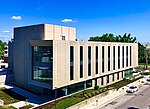
The Harry S Truman School of Public Affairs is one of twenty-one schools and colleges at the University of Missouri. Established in 2001, it was previously known as the Department of Public Administration. The school mission is to "advance the knowledge and practice of governance in Missouri, the nation, and beyond by informing public policy, educating for ethical leadership in public service, and fostering democratic discourse among citizens, policy makers, and scholars." As part of the College of Arts and Science, the school awards master's, and doctoral degrees. The school is named after Missourian and U.S. President, Harry S. Truman. It was ranked the 38th best public affairs program by U.S. News & World Report in 2020.

Excerpt from the Wikipedia article Truman School of Public Affairs (License: CC BY-SA 3.0, Authors).

Truman School of Public Affairs
University Avenue, Columbia

Geographical coordinates (GPS) Address Nearby Places
placeShow on map

Wikipedia: Truman School of Public AffairsContinue reading on Wikipedia

Geographical coordinates (GPS)

Latitude Longitude
N 38.94617 ° E -92.326934 °
placeShow on map

Address

Middlebush Hall

University Avenue 900
65201 Columbia
Missouri, United States
mapOpen on Google Maps

Share experience

Nearby Places

Columbia, Missouri
Columbia, Missouri

Columbia is a city in the U.S. state of Missouri. It is the county seat of Boone County and home to the University of Missouri. Founded in 1821, it is the principal city of the five-county Columbia metropolitan area. It is Missouri's 4th most populous with an estimated 128,555 residents in 2022.As a Midwestern college town, Columbia maintains high-quality health care facilities, cultural opportunities, and a low cost of living. The tripartite establishment of Stephens College (1833), the University of Missouri (1839), and Columbia College (1851), which surround the city's Downtown to the east, south, and north, has made Columbia a center of learning. At its center is 8th Street (also known as the Avenue of the Columns), which connects Francis Quadrangle and Jesse Hall to the Boone County Courthouse and the City Hall. Originally an agricultural town, education is now Columbia's primary economic concern, with secondary interests in the healthcare, insurance, and technology sectors; it has never been a manufacturing center. Companies like Shelter Insurance, Carfax, Veterans United Home Loans, and Slackers CDs and Games, were founded in the city. Cultural institutions include the State Historical Society of Missouri, the Museum of Art and Archaeology, and the annual True/False Film Festival and the Roots N Blues Festival. The Missouri Tigers, the state's only major college athletic program, play football at Faurot Field and basketball at Mizzou Arena as members of the rigorous Southeastern Conference. The city rests upon the forested hills and rolling prairies of Mid-Missouri, near the Missouri River valley, where the Ozark Mountains begin to transform into plains and savanna. Limestone forms bluffs and glades while rain dissolves the bedrock, creating caves and springs which water the Hinkson, Roche Perche, and Bonne Femme creeks. Surrounding the city, Rock Bridge Memorial State Park, Mark Twain National Forest, and Big Muddy National Fish and Wildlife Refuge form a greenbelt preserving sensitive and rare environments. The Columbia Agriculture Park is home to the Columbia Farmers Market. The first humans who entered the area at least 12,000 years ago were nomadic hunters. Later, woodland tribes lived in villages along waterways and built mounds in high places. The Osage and Missouria nations were expelled by the exploration of French traders and the rapid settlement of American pioneers. The latter arrived by the Boone's Lick Road and hailed from the culture of the Upland South, especially Virginia, Kentucky, and Tennessee. From 1812, the Boonslick area played a pivotal role in Missouri's early history and the nation's westward expansion. German, Irish, and other European immigrants soon joined. The modern populace is unusually diverse, over 8% foreign-born. White and black people are the largest ethnicities, and people of Asian descent are the third-largest group. Columbia has been known as the "Athens of Missouri" for its classic beauty and educational emphasis, but is more commonly called "CoMo".

Francis Quadrangle
Francis Quadrangle

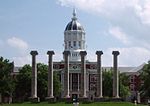
David R. Francis Quadrangle is the historical center of the University of Missouri in Columbia, Missouri. Known as The Quad, it is the oldest part of Red Campus and adjacent to Downtown Columbia at the south end of the Avenue of the Columns. At its center are six Ionic columns, all that remains of the original university building Academic Hall. Twelve buildings front the modern quadrangle including the domed main administration building Jesse Hall, the tallest building in Columbia. The Quad was designed and constructed by architect Morris Frederick Bell and his assistant William Lincoln Garver. It is named after Missouri governor David R. Francis. Eighteen structures, including the entire quad and most of Red Campus are listed as the Francis Quadrangle National Historic District. An obelisk, the original tombstone of Thomas Jefferson, stands in front of the Chancellor's Residence. It was gifted to the University by Jefferson's descendants in recognition of Missouri's ties to Virginia. In front of Jesse Hall stand markers honoring university president Richard Henry Jesse and Missouri governor David R. Francis. Nearby is another obelisk in memory of Missouri's first U.S. senator David Barton, The Missouri School of Journalism is located at the northeast corner of The Quad, comprising Walter Williams Hall, Neff Hall, Gannet Hall, along with the Reynolds Journalism Institute. To the west, Switzler Hall is the oldest academic building on campus, though the Residence on the Quad, home of the chancellor, is the oldest building overall. The University of Missouri College of Engineering completes the west side. Pickard Hall is currently closed due to radiation contamination from turn of the century experiments. Swallow Hall was recently renovated and houses the Departments of Anthropology, Visual Studies and Ancient Mediterranean Studies.

Mizzou Botanic Garden

The Mizzou Botanic Garden contains thousands of plants within the campus of the University of Missouri in Columbia, Missouri, United States. The Garden includes famous icons, such as Thomas Jefferson's original grave marker and the Columns of Academic Hall, and is open year-round, only asking for a small donation to visit. Notable collections within the Garden include: Arboretum in McAlester Park 4 acres (1.6 ha), with more than 100 trees of 43 species. Asiatic & Oriental Lily Garden. Beetle Bailey Statue and Garden: Cartoon character Beetle Bailey and the surrounding gardens pay tribute to Mort Walker, creator of Beetle Bailey and MU distinguished alum. Bulb Display Garden. Butterfly Garden. Daylily Garden: Features more than 50 cultivars of daylily hybrids donated by the Central Missouri Hemerocallis Society. Ellis Perennial Garden. Hydrangea: 10 varieties of the genus Hydrangea. Jefferson Garden: Includes cardinal flower, columbine, Virginia bluebells, sweetshrub, and Rose of Sharon. A bronze sculpture of Thomas Jefferson, as well as the original tombstone, a simple obelisk, which once sat next to Jefferson's grave, are also located in the garden. Life Sciences Discovery Garden. Mel Carnahan Quadrangle. Memorial Union Gardens. Native Missouri Tree Collection. Peony Garden: Features peonies, lilacs and other "old-fashioned" plants. Perennial Phlox Garden: Features 11 varieties of perennial phlox and English roses. Rothwell Family Garden. The Gardens on David R. Francis Quadrangle: More than 100 hardy, herbaceous perennials, with ornamental shrubs, trees and annual flowers woven throughout the garden. Tiger Plaza. Tree Trails: There are three self-guided walks designed to highlight the trees on campus. Wildlife Pond: In the 1920s, a spring north of Stephens Hall was transformed into a pond surrounded by a Japanese garden with an arched bridge and Pagoda gate. Recently several water plants native to Missouri, including Water Lilies, Pickerel Weed, Copper Iris and Thalia have been added.